


Director: Park Chan-wook
Starring: Lee Byung-hun, Son Ye-jin, Park Hee-soon, Lee Sung-min, Yeom Hye-ran, Cha Seung-won
Certificate: 15
Run Time: 139 mins
No Other Choice is the new film by South Korean auteur Park Chan-wook, of Oldboy and The Handmaiden fame. It’s the second adaptation of a 1997 novel ‘The Ax’ by Donald E. Westlake, the first being a 1997 French film called The Axe. Park Chan-wook is no stranger to adapting English-language novels and transplanting them into his native South Korea, with The Handmaiden, for example, an adaptation of Sarah Waters’s ‘Fingersmith’.
Man-su (Lee Byung-hun) is an award-winning employee of papermaking company Solar Paper. He’s got a decent salary, he has purchased his childhood home and lives a luxurious lifestyle with his wife, two children and dogs. When an American company buys Solar Paper and fires many employees, Man-su finds himself out of work after 25 years of service. After thirteen months, he struggles to find a new gig, and the family have minimised their spending and now struggling to pay the mortgage, Man-su decides to identify those whose credentials exceed his own by posting a fake job advert and then bump them off to improve his employment prospects.
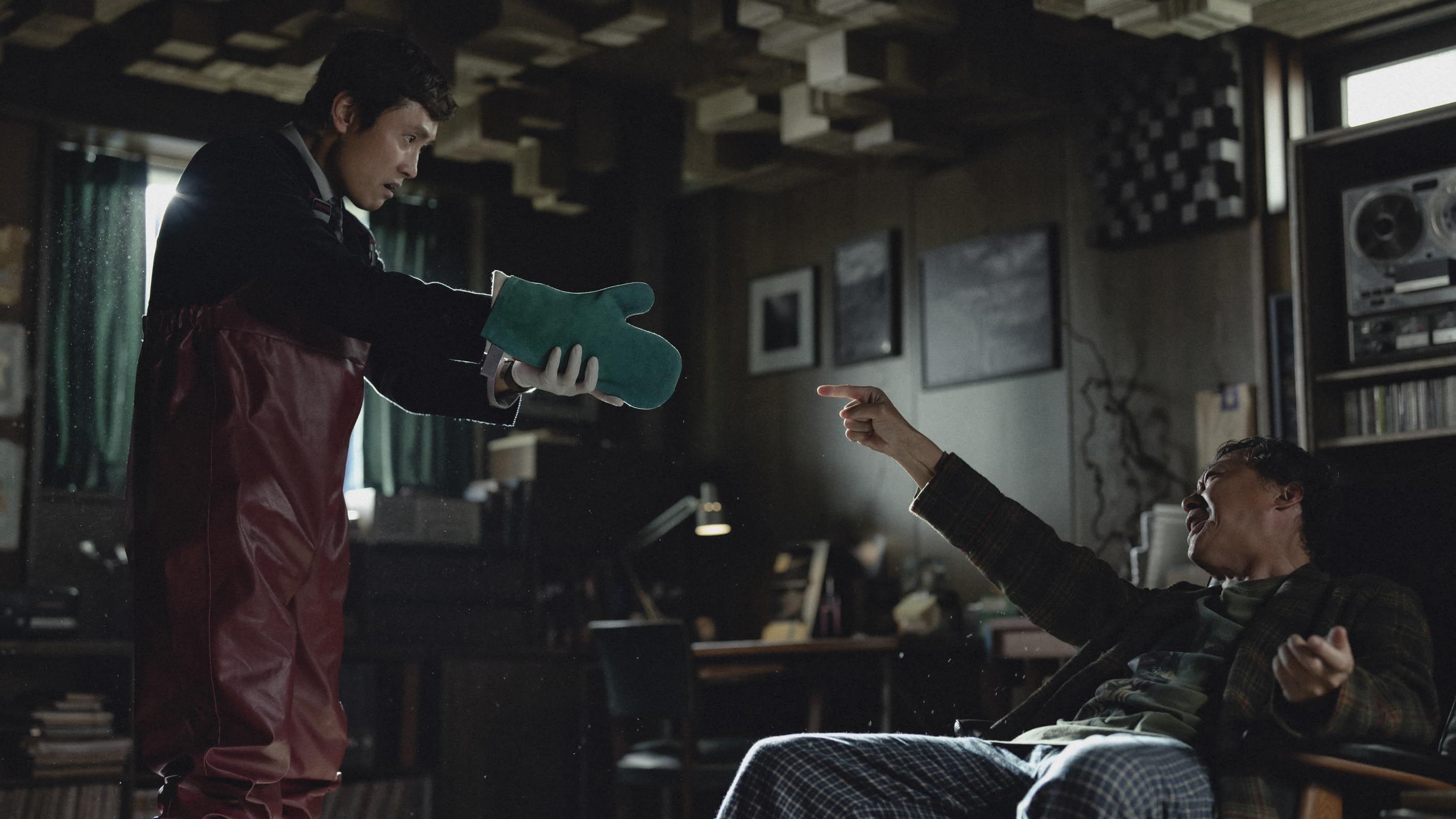
No Other Choice is yet another excellent film by the auteur filmmaker that’s directed with real confidence. Although its tone at first seems a little off for the usually serious director (it almost feels as if Park Chan-wook is trying to emulate Bong Joon Ho’s Parasite), the film quickly becomes darker with a scathing outlook on capitalism and Man-su’s murderous descent. There’s a sensational sequence with loud music and a three-way struggle involving oven gloves that goes straight up there with the director’s most memorable work.
The characters are uniformly well-developed, with the always-reliable Lee Byung-hun making for a compelling lead, a character who has to go through all the emotions that come with redundancy and finding one’s purpose again. It’s beautifully shot by Kim Woo-hyung with the director’s meticulous attention to detail and symmetry, and I found the film’s ending commentary on automation particularly grim and affecting. While No Other Choice isn’t quite up there with Park Chan Wook’s very best, it’s still a brilliant and ruthless critique on capitalism with excellent performances and memorable set pieces. I suspect it will be even better on future rewatches.
 The Film Meister
One thought on “No Other Choice (Review)”