Lady Bird (Review)

Uncategorized
ladybird2

⭐⭐⭐⭐ (Excellent)

Director: Greta Gerwig
Starring: Saoirse Ronan, Laurie Metcalf, Tracy Letts, Lucas Hedges, Timothée Chalamet, Beanie Feldstein, Stephen McKinley Henderson, Lois Smith 

Certificate: 15
Run Time: 94 mins

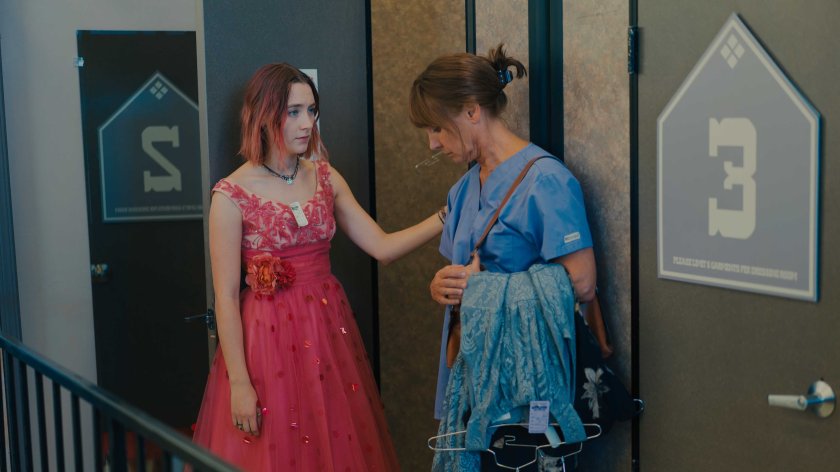
Lady Bird, the directorial debut of actress / writer Greta Gerwig, is a beautifully humane coming-of-age story of a teenager whose strong personality conflicts with her mothers equally volatile temper. It makes for a fascinating character study, containing plenty of scenarios and vignettes that run true to many home experiences of growing up. Gerwig’s script is particularly polished, mostly avoiding cliche, which keeps the story fresh and makes for a deeply personal insight into the film’s setting of Sacramento, where Gerwig herself grew up.

The performances in the film further bring to life the excellent characters that have been crafted on the page. Saorise Ronan gives a career-best performance as the titular character, Christine ‘Lady Bird’ MacPherson, a teenager who is in her final year of high school and is applying for colleges and universities next year. Laurie Metcalf, as her psychologist mother, Marion, makes for a challenging and often, fiery counterpart but ultimately a mother who deeply cares about her daughter and just wants the best for her. Both actresses are fully deserving of all the Awards attention they have recieved.

Perhaps rather underappreciated is Tracy Letts as Christine’s father, who is facing his own personal demons. Letts is wonderfully subdued as a man who is struggling as he grows older, but he is so convincingly warm and admiring of his daughter and acts as the bridge between Christine and her mother. formances brilliant.

The film is not without flaws though and there are a handful of decisions that Gerwig takes in her narrative that felt a little off, but otherwise the film is excellent. It’s hard to stand up against similar films that have released recently, the minor-key realism of Manchester By The Sea perhaps the best result, but Lady Bird is a film fully deserving of its praise and is definitely an experience that will harken back to one’s adolescent memories. I would have happily spent another hour and a half with these characters as I was so invested in them and the thought of Gerwig recently announcing she wanted to tell other stories based from her experiences in Sacramento can surely be the sign of great things to come.

⭐⭐⭐⭐ (Excellent)

The Shape of Water (Review)

Uncategorized
shapecover.0

⭐⭐⭐⭐ (Excellent)

Director: Guillermo Del Toro
Starring: Sally Hawkins, Michael Shannon, Richard Jenkins, Doug Jones, Michael Stuhlbarg, Octavia Spencer

Certificate: 15
Run Time: 123 mins

The Shape of Water is the latest film by director Guillermo Del Toro, whose films at worst, are ambitious and thoughtful and at best, masterpieces. Del Toro is one of the most visionary directors working today, who consistently explores the supernatural and his films are full of beautifully realised monsters. Pan’s Labyrinth is his magnum-opus, a Spanish adult fairy tale set to the backdrop of the Spanish civil war and The Devil’s Backbone is not too far behind. I really liked his work on both Hellboy films, particularly the second which is a brilliant alternative superhero film and I’ve got a soft spot for Crimson Peak, which recieved a very mixed reception on its release. Naturally, I was very excited for The Shape of Water, particularly considering the Awards attention that it has recieved for a filmmaker who is often, sadly underappreciated.

The Shape of Water tells the story of a mute cleaner, Elisa (Sally Hawkins) who works at a top security government facility who falls in love with a mysterious amphibian-like creature with human qualities. This is set to the backdrop of the Cold War which means there are uneasy relations within this facility between its staff and some are suspicious that there could be spies working there.

The Shape of Water is a beautiful triumph from Del Toro, who once again successfully interweaves and juxtaposes the supernatural to reality. Del Toro has clearly been inspired from The Creature from the Black Lagoon, a film that he wanted to remake from a female perspective but wasn’t allowed. As well as this inspiration, Del Toro’s film is a love letter to early cinema which it borrows in some of its tropes and plot points, infused with his darker work on Pan’s Labyrinth and The Devil’s Backbone. I was hooked by the film throughout and it has a lot hidden up its sleeve and like his other films, it earns its adult rating with its sex and grotesque violence.

The performances in the film are all top-notch. Sally Hawkins is wonderful as Elisa, who manages to convey all of her emotions through her physicality in the role and her relationship with the creature is very convincing. Richard Jenkins is great as her homosexual illustrator neighbour, an individual who shares a strong bond with Hawkins. There is a brilliant sequence mid-way through the film where Jenkins’ character tries to introduce himself to someone who he admires, which Del Toro cleverly interweaves the historical context of the time. Octavia Spencer is also ever-likeable as Hawkins’ work colleague, who effectively does the talking for the both of them.

All three of these actors have been nominated for their performances in this film but I think the standouts are actually Michael Shannon, Michael Stuhlbarg and Doug Jones. Michael Shannon is superb as the antagonistic Colonel, who will stop at nothing to get what he wants, a character who is icily cold and brutal. Stuhlbarg has a particularly meaty role as a Doctor, which he is very convincing as a scientist investigating the creature. Doug Jones as the creature is brilliant, again a character that relies on physicality with Jones having to spend long bouts in a full prosthetic body suit. In combination with Andy Serkis in his motion capture roles, it’s high time that roles and performances such as Jones’ recieve recognition.

Alexandre Desplat’s score is beautiful and hypnotic, really complimenting the film well. Desplat balances his score with endlessly memorable cues, as well as being a nostalgia trip into early cinema and music. Dan Laustsen’s cinematography is excellent too and the film is a visual treat to behold, Doug Jones’ creature in particular painstakingly wonderfully realised.

The film isn’t quite perfect though. The relationship between Elisa and the creature feels a little rushed and I think the film would have been slightly better if it had taken its time a little more in the beginning to fully set the scene. There is also a sex scene between two characters mid-way in the film that is a little silly and unbelievable, but is important to the film’s narrative. Finally, I don’t think Del Toro has quite managed to weave in the film’s Cold War backdrop as assuredly as he did with the Spanish Civil War in Pan’s Labyrinth. It wasn’t evident at the beginning of the film that this is what he was trying to do and I think a little more development there would have helped.

These are all minor points in what is otherwise a wonderful film and The Shape of Water is certainly Del Toro’s best English-language film, closely followed by Crimson Peak. The Shape of Water is an engrossing and enrapturing experience, that shouldn’t be missed on the big screen and fully deserves all the Awards praise it is getting.The only downside, not of the film but of this Awards attention, is that the other half of the cast should have been nominated for their performances, not Richard Jenkins. Despite this, The Shape of Water is a masterful exercise in visual and narrative storytelling and is a film that on further viewing, will reveal itself even more with regards to a couple of plot points.  I cannot wait to watch it again.

⭐⭐⭐⭐ (Excellent)

Last Flag Flying (Review)

Uncategorized
28-last-flag-flying.w710.h473

⭐⭐⭐⭐ (Excellent)

Director: Richard Linklater
Starring: Steve Carell, Bryan Cranston, Laurence Fishburne

Certificate: 15
Run Time: 124 mins

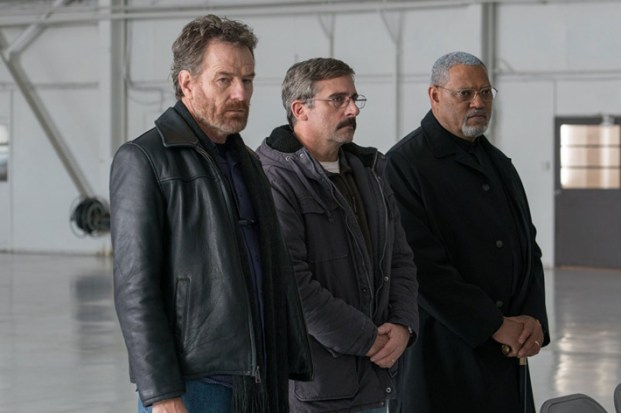
Director Richard Linklater never seems to make the same kind of film twice, always choosing very interesting projects on varying degrees of subject matter. He’s consistently proven himself as a director from films like School of Rock to the Before trilogy to his magnum opus, Boyhood. Last Flag Flying is an unofficial sequel to a 1973 film called The Last Detail, starring Jack Nicholson. Both are based on novels penned by Darryl Ponicsan, only Linklater has opted to change the names of some of the characters in this film.  The film follows three Vietnam war veterans who reunite after Larry ‘Doc’ Sheppard’s (Steve Carell) son is killed in action. Doc finds and reunites with Sal Nealon (Bryan Cranston) and Richard Mueller (Laurence Fishburne) and asks them to accompany him to retrieve his son’s body and bury him.

Last Flag Flying really knocked me back. Linklater has crafted a bittersweet and warm tale of friendship and coming to terms with loss that is very mature. Yet, the film also has bite in its conflicted commentary of military service and patriotism. The performances by the entirety of the cast are superb and of course, the trio of Carell, Cranston and Fishburne have such good chemistry together.

All of the characters are so well developed that when the film finished, I could have easily watched another two hours of these characters interacting with each other. They are all morally flawed individuals, who have all made mistakes in the past but they all have good intentions. Linklater documents their change from the past beautifully. Carell continues to prove that he is not a comedic actor and gives a very mournful performance as a broken man struggling to come to terms with the loss of his son and before, his wife. Doc only has himself and doesn’t know what to do with himself, but he appreciates the time he had with his family. Cranston’s performance as Sal, is also brilliant. Sal now runs a bar and is a no-nonsense figure who always wants the right thing for his friends. There’s an excellent sequence where he openly disagrees and challenges a Colonel, choosing to find the truth rather than respecting a higher rank military official. Fishburne might even give a career-best performance here as Richard Mueller. He is no longer the brutal, sweary Marine he was in the war and has now turned to the path of religion, becoming a pastor in his town.

Whilst this may sound like a depressing watch, and it can be quite heartbreaking at times, it also balances comedic moments very well. There’s a brilliant sequence in which the characters discover and buy mobile phones to keep in touch with each other and an equally funny recounting of experiences in the war. This film isn’t billed as a comedy, but I laughed far more in it than some recent comedy releases.

The film also looks and sounds beautiful. Shane F. Kelly’s cinematography chooses to focus on the urban areas, grey and gritty images interrogating the decay of America and the cold country that has failed these characters. Graham Reynold’s score proves a warm, yet non-obtrusive accompaniment that is used sparingly.

Last Flag Flying is ultimately a transformative and emotionally moving exercise in filmmaking. Linklater perfectly balances the tone, with just the right measure of sadness and warmth, peppered with humour. The characters are so brilliantly written and realised on the page and all of the actors are a perfect match for the material. I’d need to see it a few more times to see how it lives up to repeat viewing but it might even be one of Linklater’s best works. Last Flag Flying will be a tricky film to find in its very limited release but its simultaneous internet release means that is easily accessible at the click of a button. It’s a brilliant film and one that I highly recommend seeking.

⭐⭐⭐⭐ (Excellent)

The 15:17 To Paris (Review)

Uncategorized
0208_1517-paris01-1000x668

⭐⭐ (Poor)

Director: Clint Eastwood
Starring: Anthony Sadler, Alek Skarlatos, Spencer Stone, Judy Greer, Jenna Fischer, Ray Corasani 

Certificate: 15
Run Time: 94 mins

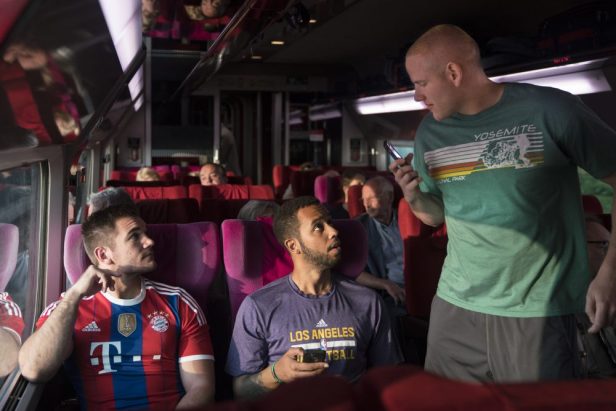
The 15:17 To Paris is the latest by Clint Eastwood, who continues to churn out film after film despite being almost ninety. Will Eastwood ever take a break? For the most part, Eastwood’s films have been great and he has proven to be just as capable behind the camera as he is in front of it. I really enjoyed Eastwood’s last two directorial efforts – American Sniper and Sully, both making it into my Top Twenty list of their respective years. The 15:17 To Paris is a retelling of the 2015 Thalys train attack, in which a handful of brave men took on a gunman, who had plans of killing everyone on-board but due to these men’s bravery, just four people were injured. What allows Eastwood’s latest to stand out is his decision to have the three men (Anthony Sadler, Alek Skarlatos and Spencer Stone) play themselves, not be played by famous actors. This is a risky decision and the first of its kind – a lot hinges on a good performance from these men because if they’re not convincing, the credibility of the film will be lost.

Whilst Sadler, Skarlatos and Stone’s performances are serviceable, The 15:17 To Paris is a major disappointment and low point in Eastwood’s career. Unlike Sully where Eastwood managed to craft a riveting film out of a single event, other than the main event of the terrorist attack, the rest of the film is just needless and aimless padding. The film doesn’t do itself any favours by being saddled with a terrible script by Dorothy Blyskal. The script lacks direction and largely fails to develop the characters of these three men. There are even some moments that are just cringeworthy to watch – an early scene in the film as we watch the childhoods of these boys is downright painful to watch. A schoolteacher unprofessionally and dimissively diagnoses two of the boys with a disability to two single mothers.

There is a section of the film which is solely concerned with the men travelling around Europe which is almost equally misjudged – constantly taking selfies and behaving like stereotypical, annoying tourists. This goes on for a good half an hour or so, which is a fair amount of the 94 minute run time. Whilst it is perhaps important to portray how these men got on the ill-fated train, this sequence does nothing to advance the narrative and has no depth or gravitas. When the actual event itself arrives, Eastwood does a serviceable job in portraying the horror on-board but the film never earned this sequence as I wasn’t emotionally invested in it.

Surprisingly, the three men do have good chemistry together and whilst there isn’t all that much depth to their characters, they are serviceable. This is the same of the rest of the cast, although Judy Greer sticks out like a sore thumb in a terribly over-the-top performance as Spencer’s mother.

Unfortunately, The 15:17 To Paris is a rare unsatisfactory work by Clint Eastwood and never compelling when it should be. These normally talented filmmakers have failed to crack a gripping narrative that the event is interwoven into. Eastwood has demonstrated multiple times he can do this – just look at Sully for example. It’s a real shame this film hasn’t worked out and I really hope that this film doesn’t lessen or cheapen the heroic nature of these three men, when the film shouldn’t do this. People should look back to this event and appreciate the courage of these three men, not look back at a dramatisation. Perhaps the film would have worked better as a documentary?

⭐⭐ (Poor)

Phantom Thread (Review)

Uncategorized
phantom-thread-trailer-920x584

⭐⭐⭐⭐ (Excellent)

Director: Paul Thomas Anderson
Starring: Daniel Day-Lewis, Lesley Manville, Vicky Krieps

Certificate: 15
Run Time: 130 mins

Phantom Thread is the latest film by director Paul Thomas Anderson and supposedly Daniel Day-Lewis’ final performance before he retires. Whether or not this actually happens or not, we shall have to see. But if it is, Phantom Thread is a fantastic note to end on.

Phantom Thread, for the majority of its run time, is engrossing and a masterclass in filmmaking. It is a fascinating character study of fictional fashion designer, Reynolds Woodcock (Daniel Day-Lewis), who lives with his influential sister, Cyril (Lesley Manville), and he creates dresses for higher society members. Reynolds develops an interest in a countryside hotel waitress, Alma (Vicky Krieps) and they soon begin a relationship but Reynolds’ domineering personality begins and persists to clash with Alma’s.

Just like Anderson’s other films such as There Will Be Blood and The Master, Phantom Thread is thematically rich, interrogating themes of duality and what it means to be in a relationship. It manages to balance its realism with fantasy and the film at times, evokes a Brothers Grimm tale. On one side of the spectrum, there are equisiste scenes of women being dressed up to impress their Princes and on the other, seemingly innocent women mushroom-picking in the forest. This Brothers Grimm quality to the film is juxtaposed by a Hitchockian / Kubrickian tone of voyeurism, mystery and intrigue.

The duality of every character makes Anderson’s film all the more satisfying and engaging. I sympathised and loathed them at the same time and that is testament to the quality of the writing and the performances. Day-Lewis is sensational and surprisingly funny at times with the witty, sharp script he has to work with. Manville has, as well as Day-Lewis, been Oscar-nominated for her performance here and the chemistry she shares with him is perfect and I really bought them as on-screen siblings.

It is Vicky Krieps however, who perhaps impresses the most – Alma is a character who is effectively the audience gateway into the House of Woodcock, someone who is initially naive and shy but then develops. She is in many respects, the audience’s eyes into this rich world underpinned by a duality.

The film is shot beautifully. Phantom Thread doesn’t have a designated DP, many have speculated Anderson has shot the film. There are multiple breathtaking shots, my favourite a recurring riff of Reynolds driving his vintage car around the country, in which the way it it is shot echoes an Alfred Hitchock film. The score by Jonny Greenwood is rather frenetic but it has its moments.

Unfortunately, I didn’t buy the film’s final act. It would be a spoiler to disclose what happens but the film’s narrative heads in a particular direction that I couldn’t really get on board with and I began to feel a little uncomfortable at where the film was going.

Overall, Phantom Thread is one of the strongest entries in this years Best Picture line-up. It represents yet another high for director Paul Thomas Anderson and is a fantastic note for Daniel Day-Lewis to go out on, should this in fact be his swansong. It makes for a masterful character study and a real treat for cinephiles. I’m just a little unsure on the direction the film heads in its final act, as it doesn’t quite conform to the neatness the first two have. I suspect on further rewatching, this film will continue to unpack itself and there is a lot more to gain from it.

⭐⭐⭐⭐ (Excellent)


Winchester (Review)

Uncategorized
film1806-winchester

⭐⭐⭐ (Good)

Director: Michael & Peter Spierig
Starring: Helen Mirren, Jason Clarke, Sarah Snook
Certificate: 15
Run Time: 99 mins

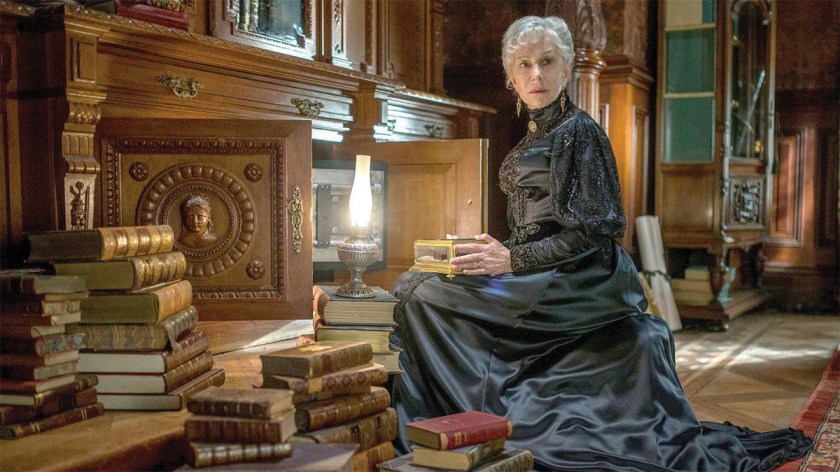
Winchester may not be the best horror film to be released in recent memory, but it really is nowhere near as bad as critics and audiences are suggesting. Based on the fascinating premise of the Winchester mansion in San Jose, California, the film follows heiress Sarah Winchester (Helen Mirren), who is haunted by spirits in the mansion. She is constantly extending or removing parts of the house, even going to the extent of installing staircases that lead to nowhere in an effort to confuse said spirits. Eric Price (Jason Clarke), a doctor who is hired to assess whether or not the elderly Sarah Winchester is fit to continue running her father’s company which she inherited, a gun manufacturing company.

This fascinating premise, coupled with the strong cast of Helen Mirren, Jason Clarke and Sarah Snook and The Spierig Brothers directing is a worthy collection of talent and bodes well for the film. The Spierig Brothers are interesting directors, consistently picking thoughtful projects and always inject some of their own ideas into their films. Predestination, in particular, is an original and twist-filled sci-fi that demonstrates their talent. This is why it was all the more surprising to see just how bad the reviews were.

Winchester gets off to a very shaky start with a terrible and unflattering introduction to Clarke’s character, who we first see dependent on laudanum and drink. It’s not exactly a great way to build sympathy for the character, particularly as Clarke is in fact, the main character in this film. Although Mirren is top-billed, Clarke is our eyes into this world, as we and him discover the Winchester mansion and the secrets it holds through the course of the film. Mirren isn’t in the film all that much but she does the best with what she’s given.

Luckily, the film picks itself up about half an hour in and the rest of the film is always entertaining. I actually think the film has some depth, which many people seem to have missed. The film questions the use of guns and has an anti-gun message, which is quite interesting and the ways in which it questions life after death and the act of death itself has some gravitas.  Without getting into spoiler territory, the ending is quite satisfying and neatly ties up some of the loose ends of the film, without being heavy-handed.

The main problem with Winchester is its reliance on jump scares, which are not scary in the slightest. Dead people constantly appear on-screen and The Spierig Brothers use all of the poor tropes associated with this aspect of the genre that have plagued horror films in the past. It’s simply not enough to whet a horror fan’s appetite anymore and means that the more heady ideas have less weight as they are cheapened by the jump scares.

But, Winchester does offer some chills in alternative methods. There is one quite powerful scene mid-way into the film involving a dead character which is executed quite well. I also question whether or not this film is even meant to be a horror film. I found it to be more of a psychological thriller, which just happens to have a horror element of the supernatural within it.

Ultimately, the sheer entertainment value of Winchester and its exploration of some key themes mean that the film is just about passable. The film does have a myriad of problems, chiefly that the film isn’t scary and its negative, awkwardly handled characterisations at the beginning of the film. If you can look past these elements and dig a little deeper into the film, there is enough in it to enjoy.

⭐⭐⭐ (Good)


‘Focus’ – Michael Stuhlbarg

Uncategorized

Michael_Stuhlbarg_at_Artios.jpg

MICHAEL STUHLBARG

Director Guillermo Del Toro’s Oscar nomination juggernaut, The Shape of Water, is finally released in the UK today. The film has recieved a whopping 13 Oscar nominations in many categories and it features a star-studded cast including Sally Hawkins, Michael Shannon, Richard Jenkins and Octavia Spencer. However, a cast member who is being overlooked is Michael Stuhlbarg, a brilliant actor who always elevates any film he’s in with his performances, but he’s never really recieved any real recognition for his work. This is the case again in The Shape of Water where he excels in a particularly meaty role.

Originally pursuing a stage career, Stuhlbarg made his film debut in a 1998 film called A Price Above Rubies featuring Renee Zellweger in a small role. He played in films intermittently in the decade that followed, the highest profile of which probably as an attorney in Ridley Scott’s 2008 thriller, Body of Lies.

Luckily, the Coen Brothers saw his talent and cast him in the lead role of Larry Gopnik in A Serious Man, which is where he first came to my attention. A Serious Man is one of the Coens’ most underrated films and whilst the film took me a few goes to really appreciate it, Stuhlbarg’s performance shone from the outset. Stuhlbarg plays a Physics Professor who faces peronal and professional problems throughout the course of the film and feels that his world is falling around him. Stuhlbarg manages to put in a performance with the perfect blend of sincerity, emotion and comedy and the film earned him a Golden Globe nomination. Unfortunately, Stuhlbarg has never seen the same amount of praise or recognition since.

Since A Serious Man, Stuhlbarg has taken small and sometimes supporting roles in many films.  He has a small, but important scene at the very beginning of Martin McDonagh’s Seven Psychopaths and also appears in Steven Spielberg’s Lincoln and Woody Allen’s Blue Jasmine.

Stuhlbarg is one of the best parts in Steve Jobs, a flawed film that occasionally soars. He plays Andy Hertzfeld, an original member of the Mac team. Also in 2015, he appeared in Trumbo as Edward G. Robinson, a biopic about the screenwriter who was blacklisted for his Communism. Although the film makes a woeful mistake with regards to Stuhlbarg’s character, Stuhlbarg gives another great performance as an individual who is conflicted and world-weary. 2016 saw Stuhlbarg continue to take small roles in films such as Arrival, Doctor Strange and Miss Sloane. In the two former films, he’s great in both of them and it’s frustrating that his characters only recieve the limited screentime they have.

I think this Awards season marks the rise of this actor back into recognition as he stars in three of the nine Best Picture nominees.Obviously, he’s in The Shape of Water and he has a very small role in The Post. However, (although I am yet to see the film), many have regarded his performance in Call Me By Your Name as astounding and some feel he was unfairly snubbed for a Best Supporting Actor nomination.

Stuhlbarg has always taken varied roles and consistently manages to impress, despite sometimes having very small roles. At best, he elevates already strong films and at worst, he elevates weaker films with his performances. With many seeming to appreciate his performance in Call Me By Your Name in particular and the fact that he has appeared in three high-profile Awards contenders this year, perhaps it is time for people to finally discover this great actor and I envy their discovery of him. So, if you do get a chance to watch The Shape of Water, take note of the performance Stuhlbarg gives and do check out these other films (in particular, A Serious Man) that I have really enjoyed him in as he elevates all of them.

The Shape of Water is released today in UK cinemas 

Downsizing (Review)

Uncategorized
downsizing-matt-damon-paramount

⭐⭐⭐ (Good)

Director: Alexander Payne
Starring: Matt Damon, Christoph Waltz, Hong Chau, Jason Sudeikis, Kristen Wiig, Maribeth Monroe, Udo Kier

Certificate: 15
Run Time: 135 mins

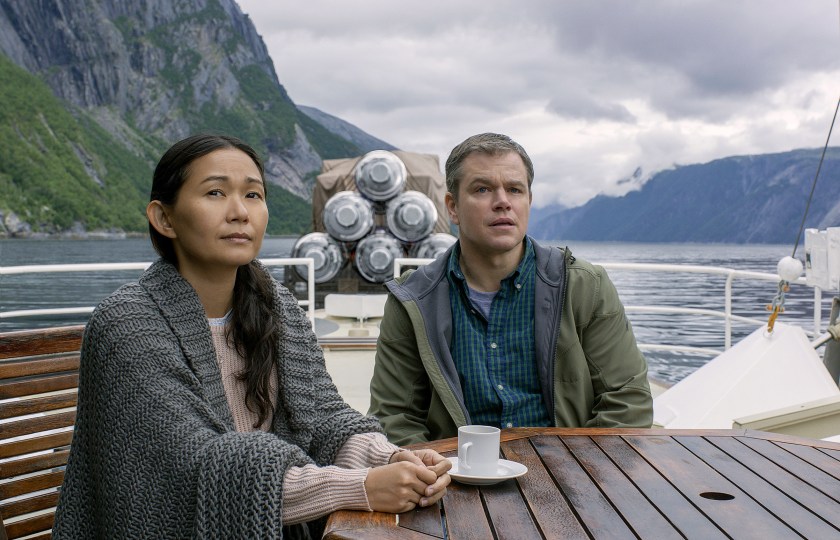
Downsizing, director Alexander Payne’s latest, is an interesting beast in a strong body of work. Set in a near future, the narrative utilises the lofty concept of ‘downsizing’, the irreversible process pioneered by Norwegian doctors of shrinking humans down to approximately five inches tall as a means of combatting overpopulation. Opening in a world where both normal and ‘downsized’ people co-exist, the film follows strapped-for-cash occupational therapist Paul Safranek (Matt Damon) who lives with his wife, Audrey (Kristen Wiig). They ponder ‘downsizing’ after meeting a friend at a reunion party, who reveals other benefits – chiefly, financial security. 

To reveal anymore would be a disservice to the film as this is what is sold in the marketing. However, Downsizing has a lot hidden up its sleeve, perhaps accounting for the film’s decidedly mixed reception. Downsizing is actually a lot better than the reviews would suggest and is a marvel in world-building. The little worlds that Payne creates are frequently awe-inspiring and the minutiae admirable, greatly elevating the verisimilitude of the film.

That said, a tonal shift mid-way through the film does feel like a switch-and-bait. There is still enjoyment to be had in the slightly more familiar, ‘finding oneself’ narrative route Payne explores, even though its moral messages are delivered heavy-handedly.

Downsizing balances comedy and emotion rather well and is bolstered by being thematically rich and chock-full of metaphors, right down to the very concept of the film itself that interrogates political and planetary notions. The performances are all generally sound with the highlights being Christoph Waltz and Udo Kier. Waltz deviates from playing a villain and to see both German-speaking stalwarts share the screen is very satisfying.

Downsizing is overall, a commendable effort by Alexander Payne with transfixing world-building but it requires one to have faith in the tonal shift in the second half. The first half is much stronger, but the direction it takes thereafter is probably why many have taken quite sourly to the film: you don’t exactly get what the trailers promised.

⭐⭐⭐ (Good)

The Post (Review)

Uncategorized
the_post_dom_nor_d30_071017_204253_204322_r_comp_rgb-0

⭐⭐ (Poor)

Director: Steven Spielberg
Starring: Meryl Streep, Tom Hanks, Sarah Paulson, Bob Odenkirk, Tracy Letts, Bradley Whitford, Bruce Greenwood, Matthew Rhys
Certificate: 12A
Run Time: 116 mins

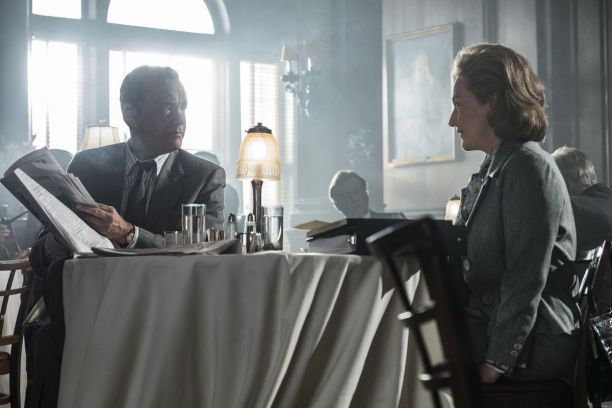
The Post depicts the true story of journalists in The Washington Post and their uncovering of the Pentagon Papers, classified documents associated with America’s involvement in the Vietnam War. These damning papers reveal the American cover-up of their progress in the Vietnam War, aware that their efforts were fruitless, yet still sent in more troops. The journalists then have to decide whether to publish or withold this sensitive information, risking prosecution by Nixon should they publish.

Directed by Steven Spielberg, this is a project he reportedly felt very passionate about and fast-tracked it into production, feeling that the story needed to be told now, especially in the current American climate. Spielberg managed to shoot the film very swiftly (basically, he needed to get it done in time for the Oscars…), whilst the same time managing post-production on the upcoming visual effects heavy, Ready Player One. At the same time, Spielberg has assembled a talented cast for this film comprising of Meryl Streep and Tom Hanks and of course, reunites with composer John Williams and cinematographer Janusz Kaminski.

Unfortunately, Spielberg’s rush to get the film has got the better of him as The Post is painfully mediocre. The film tries to make itself more important than it is and whilst the subject material is very compelling in itself, the way in which the film has been constructed is never gripping. Other than a strong scene near the beginning with acquisition of the documents, the first half of the film is very clunky and strangely, almost devoid of any tension. Whilst The Post does manage to find its footing a little more in the second half, the film is never as fascinating as it should be and feels very contrived.

The film isn’t all a shambles. In conjunction with a merely adequate second half, Spielberg clearly seems to love the act of newspaper printing and the film offers an insightful view into the world of journalism. There are numerous sequences of newspapers being printed and distributed and journalists working their socks off to get work done. There are some good performances here too, most notably Bob Odenkirk, Bruce Greenwood, Matthew Rhys and Jesse Plemons. All four actors play in supporting roles and all manage to inhibit their characters very convincingly.

Of the two main performances, it’s genuinely surprising to see Meryl Streep getting Awards attention for her performance. Streep is unconvincing in the role of Katharine Graham, the first female publisher of a major American newspaper who inherited the paper after the suicide of her husband. Streep’s performance lacks emotion. Her portrayal of her character never seemed so desperate to publish as the real figure was and she never felt particularly haunted or overwhelmed by her circumstance. Tom Hanks gives the better performance as the executive editor, but this is a role Hanks could play in his sleep.

The Post is ultimately a big disappointment, not just in Spielberg’s catalogue but principally, as a film. In a genre that boasts great films such as Zodiac and Spotlight, The Post pales in comparison and reaches nowhere near the giddy heights of both of those films. Spielberg’s lofty ambitions for Awards success seem to have got the better of him and had he taken more care to refine the finished product and the script, The Post would have been a much better film. Instead, the film we get is never gripping, awkwardly paced and too full of itself. The portrayal of The Washington Post felt like a pompous, pretentious dinner party audience, who believe in their own self-importance and I never really empathised with any of the characters. There can be no doubt of Steven Spielberg’s stature in the film industry, but even the great can fall.

⭐⭐ (Poor)

Coco (Review)

Uncategorized
coco

⭐⭐⭐⭐ (Excellent)

Director: Lee Unkrich
Starring: (voices of) Anthony Gonzalez, Gael García Bernal, Benjamin Bratt, Alanna Ubach, Renée Victor, Ana Ofelia Murguía, Edward James Olmos 

Certificate: PG
Run Time: 109 mins

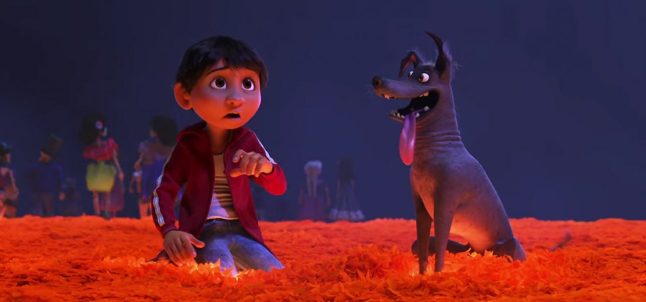
Coco is another triumph from the geniuses at Pixar, who continue to prove why they are the masters of animation. It is a memorable, captivating and heartfelt film set to the backdrop of the Mexican Day of the Dead festival. We follow Miguel, a sprightly but well-intentioned twelve year old boy who is obsessed with music. He is an avid devotee of Ernesto de la Cruz, the fictional most famous musician in Mexican history and a scene early on in the film reveals him essentially worshipping the musician through a makeshift shrine that he has created. Unfortunately for Miguel, his family have been torn apart by music and prosper in the shoe-making business and completely ban music out from their lives. This is rather problematic for Miguel, who after a series of events, finds himself transported to the land of the dead and must find his way back to reality before sunrise.

The characters in this film are wonderfully developed and Coco skilfully interrogates the themes of fame and family. After an opening that manages to balance exposition and visual storytelling almost perfectly, I felt part of Miguel’s family that had been introduced on-screen. Many of the personalities and traits of the eclectic family bear similarities to most families and the problems that they face. Once the film moves to the Land of the Dead, Miguel’s living family are largely absent in the film but by the time the end came, like Miguel, it felt like an authentic family reunion. The film also questions the importance (and legitimacy) of fame, from the famous to the infamous.

Coco isn’t quite perfect though. The film does feel rather familiar in its plotting and channels the narrative journey of Inside Out a little, but a couple of late twists manage to keep the narrative fresh. Furthermore, despite being one of Pixar’s longest films, the film could have been a little longer, which would have given it a little more time to breathe as it explores its themes. Instead, the film feels like it’s ticking a checklist, albeit a very good one!

Coco is yet another triumph for the animation giant and ranks as one of their strongest works. It is moving, life-affirming and should manage to appeal to both adults and children alike. It also goes without saying that the attention to detail in the animation is second to none, Pixar continuing to elevate animation to photorealist levels. Combined with the excellent narrative and emotional journey this film takes us through, Coco is a film fully deserving of its all praise.

⭐⭐⭐⭐ (Excellent)