Godzilla x Kong: The New Empire (Review)

Review

Rating: 3 out of 5.

Director: Adam Wingard
Starring: Rebecca Hall, Brian Tyree Henry, Dan Stevens, Kaylee Hottle, Alex Ferns, Fala Chen
Certificate: 12A
Run Time: 115 mins

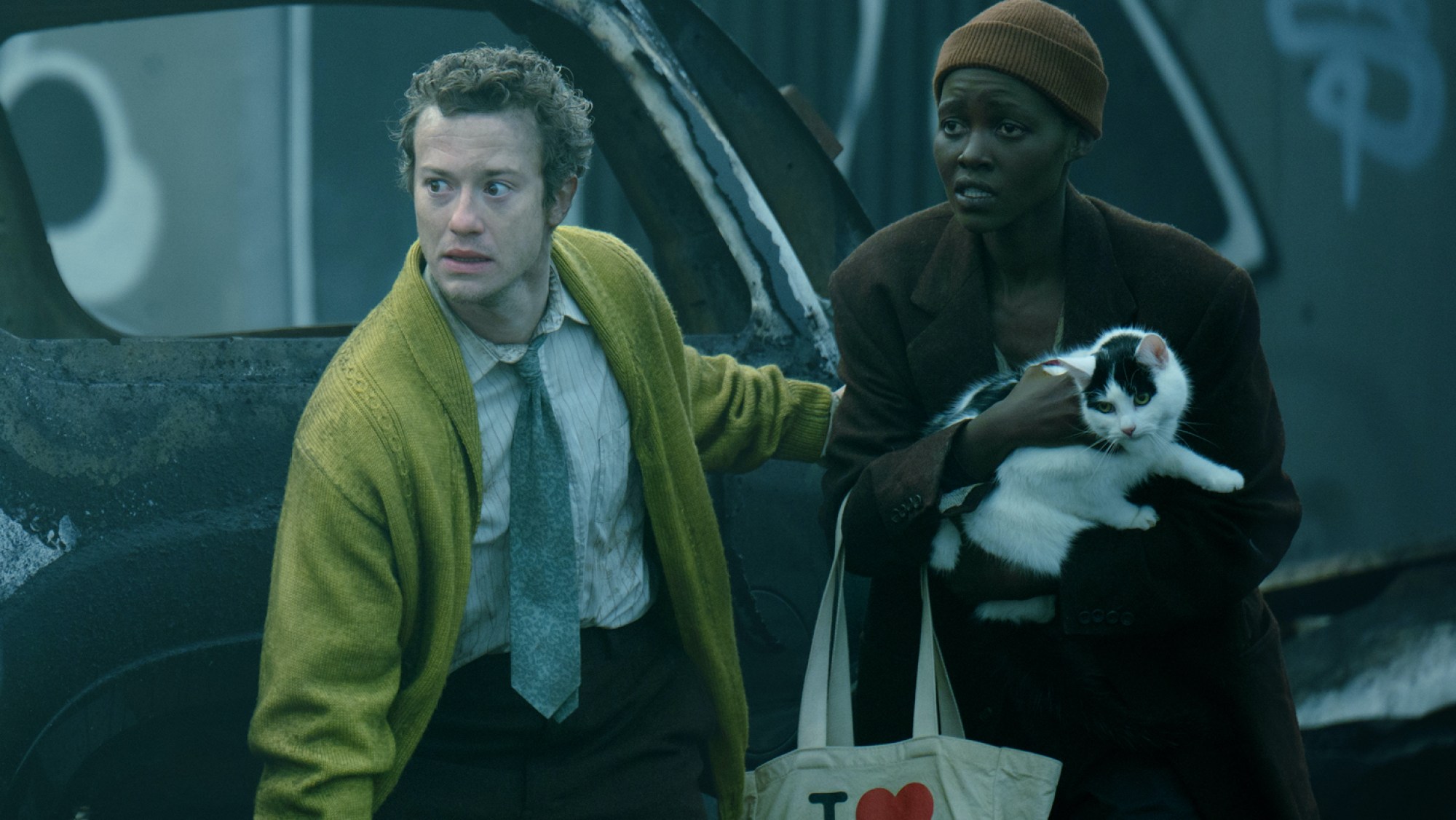
Godzilla x Kong: The New Empire is the latest in the Monsterverse series and the sequel to 2020’s surprisingly entertaining Godzilla vs KongYou’re Next and The Guest’s Adam Wingard is in the director’s chair again and this sequel picks up with Kong adjusting to life in the Hollow Earth as he searches for more of his kind. Godzilla, on the other hand, is dormantly sleeping in the Colosseum. However, this peace is short-lived and the two have to duke it out once again to stop a tyrannical leader destroying Earth. 

 Godzilla x Kong: The New Empire is a come-down from its predecessor, with an episodic quality not too dissimilar from what Marvel are currently churning out. That said, there are some striking images throughout and some of the action sequences really deliver. 

Wingard falls into the age-old trap yet again of the monsters being more exciting than the humans, with Rebecca Hall reprising her role as Dr Ilene Andrews from Godzilla vs Kong. Hall’s a fine actress but she’s saddled with some truly poor dialogue here that even she struggles to elevate. On the plus side, the wooden Alexander Skarsgard is nowhere to be found this time around. Wingard instead reunites with his The Guest frontman Dan Stevens, who plays the Hawaiian shirt-wearing veterinarian Trapper. Stevens has tons of charisma and although it’s a cheesy role, he manages to pull it off. 

 The script is pretty expository and certain plot elements aren’t fully coherent. While Junkie XL’s score for Godzilla vs Kong was largely successful, here he collaborates with Antonio Di Iorio and outside of the pre-existing themes, there’s not much here to latch onto. 

Godzilla x Kong: The New Empire isn’t as outright entertaining as its predecessor was but there’s just about enough here to make it work. If you’re after action sequences with the two titans, this film will certainly reward your appetite. But there’s not much substance here and it’s saddled with poor human characters and a weak script. Also not helping matters is the fact this film is releasing shortly after Godzilla Minus One, which proved you can have a monsters wreaking havoc and an emotional human core in the same film. In terms of the Monsterverse series, it sits somewhere in the middle of the pack but certainly well above Godzilla: King of the Monsters.

Immaculate (Review)

Review

Rating: 3.5 out of 5.

Director: Michael Mohan
Starring: Sydney Sweeney, Álvaro Morte, Benedetta Porcaroli, Dora Romano, Giorgio Colangeli, Simona Tabasco
Certificate: 18
Run Time: 89 mins

Immaculate is a religious psychological horror from director Michael Mohan centering on a young woman, Sister Cecilia, who is invited to reside at a picturesque Italian convent. Mohan reteams with his The Voyeurs lead Sydney Sweeney, who plays the troubled young nun, who has turned to religion after being convinced God saved her for a reason after she nearly drowned in a frozen lake and was declared dead for seven minutes. While the convent looks initially picture-perfect, Cecilia soon discovers more sinister forces are at play when she suddenly discovers she is pregnant, despite being a virgin.

Religious horror is a sub-genre that has struggled recently – The Nun was terrible, The Nun 2 a mild improvement and The Pope’s Exorcist was silly but very entertaining with Russell Crowe’s hammy lead performance.

Although Immaculate takes a little while to get going, once it shifts into gear, it’s a gonzo and gleefully blood-soaked ripride. The last forty-five minutes are particularly memorable, with a series of wild twists and turns, with more than a few influences from Dario Argento and Roman Polanski. Mohan knows how to build suspense and pile on the dread and the wince-inducing gore in its final act more than earns it its 18-certificate.

It’s a little ramshackle in construction – the script is a little creaky and aside from Cecilia’ backstory, we don’t really learn much about her. There are also some plot elements that don’t fully make sense by the film’s close.

Sydney Sweeney’s performance is interesting in that she appears unsettled and not fully convincing initially but once she’s tasked with the film’s more electrifying elements, her performance delivers. Álvaro Morte is the standout as Father Sal Tedeschi, who appears to be one of the only members of the convent who understands and empathises with Cecilia.

The film looks a lot more expensive than it is and it’s beautifully shot by DP Elisha Christian. I particularly appreciated a shot of a nun walking, while someone is visibly committing suicide in the background and the nun rushes over to examine the body once it splatters on the floor in the same shot. Will Bates’ score is effective too, with some memorable recurring themes, especially a scene in which Cecilia runs in a field.

Immaculate is ultimately much better than it has any right to be for a horror sub-genre that’s had its fair share of struggles. It’s not perfect but the mystery that Mohan weaves and the heightening tension and gore are more than enough to keep you invested and it’s a film that’s sure to leave you gasping in its closing moments.

Perfect Days (Review)

Review

Rating: 3 out of 5.

Director: Wim Wenders
Starring: Kōji Yahusho, Tokio Emoto, Arisa Nakano, Aoi Yamada, Yumi Asō, Sayuri Ishikawa, Tomokazu Miura, Min Tanaka
Certificate: PG
Run Time: 124 mins

Perfect Days is the new film by Wim Wenders, a German-Japanese co-production that’s up for the Best International Feature Film Oscar this year. Set in Tokyo, the film follows Hirayama (Kōji Yakusho) who cleans public toilets for a living. We see him following a structured routine each and every day. He listens to 1960/70’s rock and pop on cassettes in his car to work, including the Lou Reed song of the film’s title. He takes a bath at a local swimming pool and he takes a photo of the trees where he sits and eats the same sandwich for his lunch everyday. Even in an extended sequence where his niece, Niko (Arisa Nakano) comes to stay, he still sticks to the same routine.

Perfect Days is a pleasant slice of life film about seeing the beauty in the everyday. Kōji Yakusho is tremendous in the lead role, with his understated wisdom and presence and thoroughly deserving of his Best Actor win at the Cannes Film Festival, where this film premiered last year. 

Hirayama is clearly a very intelligent and cultured individual, who has seemingly chosen a monkish existence. We get hints throughout the film, for example his sister’s disgust at the job he’s doing, clearly thinking he is deserving of a more fruitful life. But Hirayama takes great pride in his work, almost obsessively cleaning the toilets until they are glistening, in contrast to his young co-worker Takashi (Tokio Emoto) who isn’t bothered, wanting to finish the job quickly and go off with his girlfriend. 

Wenders isn’t concerned with revealing too much and leaving the audience to piece everything together and the film only really comes alive in its second half, once we start to see his routine getting disrupted, allowing us to learn more about Hirayama’s character. 

The score is great too, a motif of the outdated cassettes Hirayama listens to and I appreciated Wenders’ comparison to the cherishing of physical media, in a touching scene where Takashi wants Hirayama to pawn his cassettes for cash. 

I didn’t love Perfect Days but it’s a very pleasant and engaging piece about seeing the beauty in the everyday with a terrific central performance. 

Dune: Part Two (Review)

Review

Rating: 3 out of 5.

Director: Denis Villeneuve
Starring: Timothée Chalamet, Zendaya, Rebecca Ferguson, Josh Brolin, Austin Butler, Florence Pugh, Dave Bautista, Christopher Walken, Léa Seydoux, Souheila Yacoub, Stellan Skarsgård, Charlotte Rampling, Javier Bardem 
Certificate: 12A
Run Time: 165 mins

Dune: Part Two is the headily awaited second part of Denis Villeneuve’s adaptation of Frank Herbert’s first novel in his sci-fi series. Unlike Alejandro Jodorowsky or David Lynch, Villeneuve proved he could do the impossible – adapt what was regarded as an ‘unfilmable’ novel. Dune won six Oscar’s for his efforts. Dune: Part Two picks up where the previous one left off, with Paul Atreides (Timothee Chalamet) and his mother Jessica (Rebecca Ferguson) settling into life with the Fremen, after House Harkonnen launched a devastating attack on House Atreides. With even stronger reviews than the first, can Dune: Part Two live up to the hype? 

While there’s no doubting the visual flair on display, Dune: Part Two is a mixed bag and not as strong as its predecessor. What really impressed me with Dune was how Villeneuve was able to maintain a clarity to the narrative, the key downfall of Lynch’s film who overstuffed the entire book in a 137 minute film. And while that’s still largely the case here, Dune: Part Two runs into all manner of pacing issues. On the one hand, there’s some good world building for the first hour where ultimately not a lot happens. But then, but the film completely rushes through its climax during its last hour. 

Much has been made of the final battle sequence in this film, with some comparing it to the Battle of Helm’s Deep in Lord of the Rings: The Two Towers. I must have seen a different film because Villeneuve rushes through it, and that costs the film much of its spectacle. 

The rushed pacing also comes at the expense of character development. I simply didn’t buy Paul and Chani’s (Zendaya) blossoming relationship at the very centre of the film – it simply feels like we’re expected to invest in their relationship with no natural development. I wonder if it’s to do with the fact Eric Roth doesn’t write the script this time around, with Villeneuve himself stepping in to co-write with Jon Spaihts. 

With a film this overstuffed, it’s inevitable some of the performances are going to suffer. Although Timothée Chalamet impressed me in the first film, I didn’t think the actor sold the increasing weight his character has to have in this film as he ascends to be a messianic-like figure. While the standout of Dune was Stellan Skarsgård’s Baron Harkonnen, Austin Butler is the highlight, who is tremendous as Feyd-Rautha. The nephew of Skarsgård villain, he isa particularly nasty piece of work and Butler really makes the most of the role, with a sinister personality and a convincing Scandinavian accent to try and match Skarsgård. Speaking of Skarsgard, he’s solid but some of the mystery that surrounded him in the first is now gone and he’s not as effective. 

Two of the performances really didn’t work for me. First is surprisingly Javier Bardem, who almost always elevates a film but he’s unfortunately saddled with some truly trite dialogue. Christopher Walken also doesn’t make the most inspiring choice for the Emperor because he just plays himself. 

The score by Hans Zimmer is pretty atypical of him and whilst it has its moments, it’s not his best work. While Greig Fraser deservedly won an Oscar for his Dune cinematography, because the locations are more limited this time around, it doesn’t feel quite as fresh. However, I loved one action sequence that’s almost made to look like it’s been shot in one take. I also loved the black-and-white imaging of the Harkonnen planet, one of the highlights of the film, as is a gladiatorial fight to the death. 

It’s a shame Dune: Part Two doesn’t live up to the first film with its odd pacing and lack of character development. But it’s still a fun ride, with some above average elements, such as the black-and-white sequence on the Harkonnen planet, Austin Butler’s performance and some exciting action sequences here and there. For a Denis Villeneuve film though, I think it’s his weakest effort and that’s a shame. While Villeneuve’s keen to adapt Dune: Messiah, I really hope he gets off the sci-fi train and does something completely different. Prisoners and Sicario still remain his best works for me, and while his foray into sci-fi has undoubtedly been successful, I want to see him breathe new life into a different genre. 

Spaceman (Review)

Review

Rating: 3 out of 5.

Director: Johan Renck 
Starring: Adam Sandler, Carey Mulligan, Paul Dano, Kunal Nayyar, Isabella Rossellini, Lena Olin  
Certificate: 15
Run Time: 107 mins

Spaceman is the new film by Johan Renck, most famous for the Emmy award-winning 2019 television series Chernobyl. This is a sci-fi drama based on a 2017 novel, Spaceman of Bohemia, by Jaroslav Kalfař. Adam Sandler plays Jakub Procházka, a Czech astronaut who is 189 days into a solo space mission on the outskirts of Jupiter. He’s sent to investigate the ‘Chopra cloud’, a vibrant cloud with a purple hue visible from Earth and he’s left behind his heavily pregnant wife Lenka (Carey Mulligan), who is no longer answering his video calls. The cloud may well hold the answer to the origins of everything and Jakub is one of a select few astronauts who’s willing to spend such a long time apart from a loved one. 

Things then get rather strange. A seemingly super intelligent arachnid (voiced by Paul Dano) suddenly materialises on the spacecraft, who tells Jakub of the destruction of his homeland. Over the course of the film, the two bond as the spider begins to better understand humans and more specifically Jakub’s memories. 

Spaceman is an interesting and occasionally visually arresting sci-fi that probably would have worked better as a short story than a feature length film. It becomes rather schmaltzy and doesn’t leave much to audience interpretation. The central core themes of love and feelings of remorse also aren’t particularly original. It feels like a less assured mash-up of Ad Astra, coupled with the stoicism of Damien Chazelle’s First Man

Still, the performances are worthy of praise. Adam Sandler turns in an atypically restrained performance and is pretty good as the astronaut slowly beginning to lose his mind. Renck does a good job of portraying the claustrophobic and lonely conditions Jakub lives in, with the malfunctioning toilet and cameras understandably driving Jakub round the bend. 

Carey Mulligan is promising as Lenka, but unfortunately underwritten but it’s still a redeeming choice of film after Maestro. Isabella Rossellini is excellent as Commissioner Tuma, the stern commanding officer of the mission who does her utmost to prevent Jakub from learning of Lenka’s diminishing feelings for him. 

While Spaceman is a little under-baked and missing a sense of awe, Renck’s second full-length film has some worthy elements. Sandler turns in a committed performance and there are some initial promising ideas but the film ultimately leans too heavily on obvious exposition and a rather underwhelming central overarching theme that doesn’t justify the full run time. 

The Settlers (Review)

Review
⭐⭐ (Poor)

Director: Felipe Gálvez Haberle
Starring: Camilo Arancibia, Mark Stanley, Benjamin Westfall, Alfredo Castro, Marcelo Alonso, Sam Spruell, Mishell Guaña, Adriana Stuven

Certificate: 15
Run Time: 97 mins

The Settlers (or Los Colonos in its native Chilean) caused quite the storm when it debuted at Cannes last year and is Felipe Gálvez Haberle’s directorial debut. It’s a revisionist Western that takes place at the turn of the 20th Century as settlers from multiple European nations arrive in the Tierra del Fuego archipelago, grabbing as much land as they can. 

Scotsman soldier Alexander MacLennan (Mark Stanley) leads an army under a reign of terror with his unpredictable nature and general drunkeness. He’s under the employment of Jose Menéndez (Alfredo Castro), who tasks him with leading an expedition to the coast to pave a way for his herd of grazing sheep. MacLennan cherrypicks the quiet Segundo (Camilo Arancibia), a mixed-race Chilean to join him and Menéndez also gives him a Texan mercenary called Bill (Benjamin Westfall). The three get on poorly together, with Bill’s disloyal and racist personality a clash with MacLennan’s unpredictability. They effectively set off into the Patagonian landscape where they rape, pillage and blunder the native tribes. 

Contrary to the near-unanimous praise, I didn’t find The Settlers to be particularly engaging, nor does it have much to say which hasn’t already been covered by stronger Westerns. It lacks a character to root for and I just didn’t care for any of the trio. The dialogue is on-the-nose and it never really explores the marginalised tribes. Haberle tries to go for a retro feel with grainy cinematography from Simone D’Arcangelo but it simply appeared grainy to me, rather than the arresting quality they had no doubt intended. Harry Allouche’s playful Spaghetti western inspired score is completely at odds with the grim events being portrayed on-screen.

While it still tells an obvious message, the last act of the film where it shifts to seven years after MacLennan’s expedition is where the film is at its most engaging. The newly formed Chilean government sends a government agent called Vicuña (Marcelo Alonso) to investigate the genocide and the film asks some interesting, if not fully developed questions on MacLennan’s barbarity. While The Settlers is effectively fierce and primitive, it lacks the thrills or playfulness of its Western contemporaries to be truly effective. 

⭐⭐ (Poor)

American Fiction (Review)

Review

Rating: 4 out of 5.

Director: Cord Jefferson
Starring: Jeffrey Wright, Tracee Ellis Ross, John Ortiz, Erika Alexander, Leslie Uggams, Adam Brody, Issa Rae, Sterling K. Brown
Certificate: 15
Run Time: 117 mins

American Fiction is the directorial debut of Cord Jefferson, a satirical comedy-drama adapted from Percival Everett’s 2001 novel Erasure. It’s up for five Academy Awards in the Best Picture, Actor, Supporting Actor, Adapted Screenplay and Original Score categories.

Theolonious ‘Monk’ Ellison (Jeffrey Wright) is an intelligent, middle-aged humanities professor in Los Angeles, whose novels receive academic praise but commercially perform poorly. He’s fed up of being pigeonholed as a black writer and his fury is only bolstered when he sees another African-American author, Sintara Golden (Issa Rae), being praised for her new bestselling novel We’s Lives In Da Ghetto, which panders to black stereotypes. Thrown into the mix are some family issues, primarily Monk’s mother Agnes (Leslie Uggam) showing early signs of Alzheimer’s, forcing him to spend more time with her and his wider family. In response to his pent-up anger, Monk ghost-writes a book called My Pafology, a satirical novel mocking literary cliches expected from black writers, only for him to be offered a $750,000 advance after he submits the piece to publishers out of contempt. 

American Fiction is a highly entertaining literary comedy with a blisteringly sharp script that in some ways, feels like a film a more muted Spike Lee would make. This is a tough genre to crack and there have been far more failures than hits but I genuinely laughed quite a few times at this. There’s also more than a few kernels of truth about the publishing industry and what it means to be a writer, exploring the highs and lows of both the creative process and critical reception. But Jefferson deftly balances his commentary on the media with a heartfelt treatment of the themes of loneliness and family. The family drama element of the film is equally riveting, with the treatment of Alzheimers touching and the mundane but necessary tasks of trying to get someone into a home. 

There’s some terrific performances here too, especially Jeffrey Wright who’s always been a reliable screen presence but doesn’t often take the lead role. Wright nails the prickly, depressing nature of his character as he struggles to fit in and open up to people but with an almost lovable quality. Leslie Uggams is terrific as the dementia-ridden mother and Sterling K. Brown turns in an atypical Oscar-nominated performance as Monk’s plastic surgeon brother who has recently come out the closet. 

To say the ending of the film puts a foot wrong would be unfair as it’s fitting for the themes that Jefferson explores, but I thought it was a little rough around the edges and I’d like to rewatch the film to see how it reframes what comes before it. Finally, while Laura Karpman’s score is often rousing, I didn’t think it was Oscar material.

I went into American Fiction with low expectations based on the genre but found it to be a thought-provoking film with plenty of heart and fat to chew on. Cord Jefferson walks a fine line between not being preachy but being effective and he manages it. This is a really strong piece of work and I can’t wait to see where he goes next. 

The Iron Claw (Review)

Review

Rating: 3.5 out of 5.

Director: Sean Durkin 
Starring: Zac Efron, Jeremy Allen White, Harris Dickinson, Maura Tierney, Holt McCallany, Lily James
Certificate: 15
Run Time: 132 mins

The Iron Claw is the new film by Sean Durkin, who’s career so far has been very promising. His debut feature Martha Marcy May Marlene was a fantastically prickly psychological thriller-drama, with a terrific performance by Elizabeth Olsen (also making her debut). The Nest was even better, a riveting character study of greed and perceived societal status, with powerhouse performances from both Jude Law and Carrie Coon. The Iron Claw is based on the life of Kevin Von Erich (Zac Efron) and the wider Von Erich family, who were beset by premature tragedies. 

The film opens on a younger Jack ‘Fritz’ Von Erich (Holt McCallany) performing his signature iron claw submission hold in a wrestling match. After what Fritz considers to be a failed career, the film moves moves to 1979, where he strictly raises his four sons, Kevin, Kerry (Jeremy Allen White), David (Harris Dickinson) and Mike (Stanley Simons). Kevin tries to confide in his distant mother, Doris (Maura Tierney) that Fritz is far too tough on his youngest brother Mike, who would rather pursue a career in music than wrestling. But Fritz is having none of it and like his finishing wrestling move, effectively holds his family in an identical submission hold. 

The Iron Claw is far more conventional fare in its execution compared to Durkin’s previous works but it tells a largely gripping and often grim recount of the Von Erich’s. The film’s bolstered by some terrific performances, with Efron reliably brilliant as Kevin, who has noble and instinctual family values but struggles to carve a life with his own ambitions. Efron has had a fascinating career after his High School Musical breakthrough, and like with his chilling portrayal of Ted Bundy in Extremely Wicked, Shockingly Evil and Vile, proves he is a versatile actor with buckets of range. 

Holt McCallany, who is often lumped with supporting roles in action films such as Wrath of Man, gives a career-best performance as the patriarch. He channels Marlon Brando in his butch, but tired and weary turn as Fritz, a stubborn man who cannot let get of his past and will go to brutal lengths to make a name for his family in wrestling, even if it eats at the quality of his relationship with his sons. Maura Tierney is also quietly brilliant as the quiet and sullen matriarch, who’s clearly faced her own despair. 

The performances of Kevin’s three brothers (technically, there are four but the film omits the youngest Chris) are also admirable. Jeremy Allen White is brilliant as Kerry, who is initially sidelined from wrestling before given a short-lived opportunity. While Harris Dickinson’s performance as David didn’t wow me, I hadn’t recognised The King’s Man and the Where The Crawdads Sing actor until his name appeared in the credits. 

While the film does a solid job of creating a gripping family portrait, the way it does is it is mostly conventional, except for a near-surreal ending sequence that won me over. The first half of the film is pretty standard wrestling fare, chock-full with the sub-genre’s generic constructs, until the darker elements are introduced at the half-way mark. Durkin’s trying to portray both the wrestling history of the family and deep-dive into a familial character study but he falls short on both accounts. Although the film is very entertaining, I kept thinking throughout how it could have done things differently and I think Durkin should have decided to fully explore one of these elements rather than short-change the audience with two.  

While Arcade Fire Richard Reed Parry’s original score is stirring, especially in the film’s gripping opening sequence, The Iron Claw’s music is somewhat squandered by the use of generic pop and rock songs that have simply been overused in too many films before. On the plus side, the film’s handsomely shot by Hungarian cinematographer Mátyás Erdély, who lenses the film with a smoky, grey quality. 

While The Iron Claw is another exciting entry in Sean Durkin’s burgeoning career and represents a decidedly bigger budget effort, the film falls into the trap of sticking too closely with the biopic and wrestling film tropes. Had Durkin decided to focus deeper into analysing the Von Erich familial dynamic or simply just go for their wrestling career, The Iron Claw would be a sharper and punchier piece. Still, what we have is an always entertaining and grim, if rather conventional biographical sports drama bolstered by some terrific performances and handsome visuals. 

The Zone of Interest (Review)

Review

Rating: 4 out of 5.

Director: Jonathan Glazer
Starring: Christian Friedel, Sandra Hüller
Certificate: 12A
Run Time: 105 mins

The Zone of Interest is director Jonathan Glazer’s new film, an uncomfortably long eleven year wait after Under The Skin. Loosely adapted by a 2014 Marin Amis novel of the same name, Glazer became intrigued by the book prior to being published. The novel tells the story of Rudolf Höss, the longest-serving commandant of the Auschwitz concentration camp, where he lived with his wife Hedwig (Sandra Hüller) in what they perceived as their idyllic home. Small catch – the garden wall with barbed wire atop it is shared with Auschwitz. 

Through extensive research into the Hösses, Glazer pieced together what their life looked like during the time they lived outside the camp through examining testimonies provided by survivors and individuals who had been employed in the household. It’s certainly commendable that Glazer has poured so much passion into a project and given how Sexy Beast, Birth and Under The Skin all occupy completely different genres, can he inject his magic into this dark point of history? 

The Zone of Interest is a fiercely original work from Glazer that’s uncomfortable viewing and really gets under your skin. The film possibly represents the most important use of sound I can think of in quite some time – the sound of the droning concentration camp with its whirring machinery is ever-present during mundane conversation and day-to-day life. Glazer never shows us the atrocities inside the camp and what we hear beyond the frame is another film in itself. I loved the surreal elements too, particularly a storyline shot with thermal cameras. 

The film is initially quite light on story but we start to learn more about and then follow Höss’ career as it progresses. Christian Friedel is sensational as the despicable SS officer – a cold, calculated yet frank and career-driven individual. His whole life becomes an obsession into how fast he can kill and there’s an everyday quality to the terrible schemes he is complicit in, which makes the film all the more chilling.  A scene where gas chamber designs are discussed akin to the design for a car is particularly effective. 

Sandra Hüller, so brilliant in Anatomy of a Fall (another Academy Award for Best Picture contender this year), is arguably even more despicable than her husband. She is deeply attached to their home and doesn’t think her life can be bettered. It doesn’t take a lot for her to lose her temper, with chilling threats of violence or death to the rotating roster of Jewish housemaids. 

The film is masterfully shot by Loving Vincent and Cold War cinematographer Łukasz Żal, an incredible shot of a chimney through a window that’s reflected on the glass will forever be ingrained in my memory. Mica Levi’s score, although sparse, is also deeply effective. Save for two doom-laden tracks at the beginning and end, the rest of the film uses more of a soundscape except for a recurring motif during the surreal sequences.  

The Zone of Interest is a fascinating work in Glazer’s career, despite its cold and intentionally bad taste that will leave you thinking long after the credits have rolled. The performances, cinematography and sound are all top-drawer and the innovative use of sound alone is reason to experience this film on the big screen. I’d quite like to see it again as I suspect it will improve on a rewatch. 

Argylle (Review)

Review

Rating: 2.5 out of 5.

Director: Matthew Vaughn
Starring: Bryce Dallas Howard, Sam Rockwell, Bryan Cranston, Catherine O’Hara, Henry Cavill, Sofia Boutella, Dua Lipa, Ariana DeBose, John Cena, Samuel L. Jackson  
Certificate: 12A
Run Time: 139 mins

Argylle is a spy action comedy by Matthew Vaughn, a director whose works often subvert their respective genres. Kick-Ass rejected the-then comic-book codes and conventions with its gleeful tone and Kingsman: The Secret Service was a raunchy and gory ultraviolet spy film. Even his less overtly subversive films have proven successful, with X-Men: First Class rejuvenating the X-Men series with its smart script. Like his Kingsman films, Vaughn takes another stab at the espionage thriller with Argylle

The film follows reclusive spy novelist, Elly Conway (Bryce Dallas Howard) who has found wild success with her Argylle book series. While she’s journeying to her mother, Ruth (Catherine O’Hara), she is saved from an attempted ambush by Aidan (Sam Rockwell), an actual spy who explains that she is being targeted by an organisation known as the Division, because her novels seemingly predict the future. 

While Argylle’s fresh concept in how it explores how a writer might see their creation come to fruition is to be commended, Vaughn’s latest isn’t his best work. It lacks the kinetic energy of his other films and the numerous twists don’t always work – the last act really ties itself in knots. Jason Fuchs’ script is on the wooden side and isn’t particularly funny. The score by Lorne Bale isn’t particularly memorable either and while there’s the trademark colourful pop to George Richmond’s cinematography, the film’s aesthetic has an artificial quality. 

None of the action sequences stand out either, arguably what should be the most thrilling element of a spy film. Vaughn’s last film, The King’s Man (a prequel to the mainline films) was also more a more inert effort but it at least had one memorable fight half-way through, which the rest of the film failed to top. 

The more family-friendly 12A rating really tames proceedings and what really propelled both Kick-Ass and Kingsman was its rejection of having to pander to a wide audience. While both Stardust and X-Men: First Class prove Vaughn is more than capable of crafting works with brain, as well as brawn, when toning his sensibilities down, Argylle just doesn’t quite succeed. 

There’s still some fun to be had though. Bryce Dallas Howard is excellent as the introverted author, who just wants the easy life and her home comforts. Samuel L. Jackson is also reliably brilliant and delivers most of the film’s limited laughs, particularly as he’s waiting to receive a file. It’s nice to see Catherine O’Hara, who is more selective in the roles she accepts these days and Bryan Cranston is also clearly having fun. While Sam Rockwell’s reliably charismatic and likeable, the role seemed like a slight waste of his talents and could have been played by someone else. Other than sporting a striking flat-top haircut, Henry Cavill fails to make much of an impression as the titular Argylle. 

Ultimately, while there’s fun to be had in the film’s first two thirds, Argylle fails to make the most of its unique concept. It’s lacking in energy in its forgettable action sequences and the film falls apart in its third act. Argylle would have been a stronger work if it had further dived into the fantastical nature of how a writer might imagine their world and if it wasn’t constrained by its more accessible age-rating. A frustrating post-credits scene promises we are going to see more of this world and I hope Vaughn returns to the drawing board and re-evaluates this film’s shortcomings.