Together (Review)

Review
Still from 'Together'

Rating: 1.5 out of 5.

Director: Michael Shanks
Starring: Dave Franco, Alison Brie, Damon Herriman  
Certificate: 15

Run Time: 102 mins

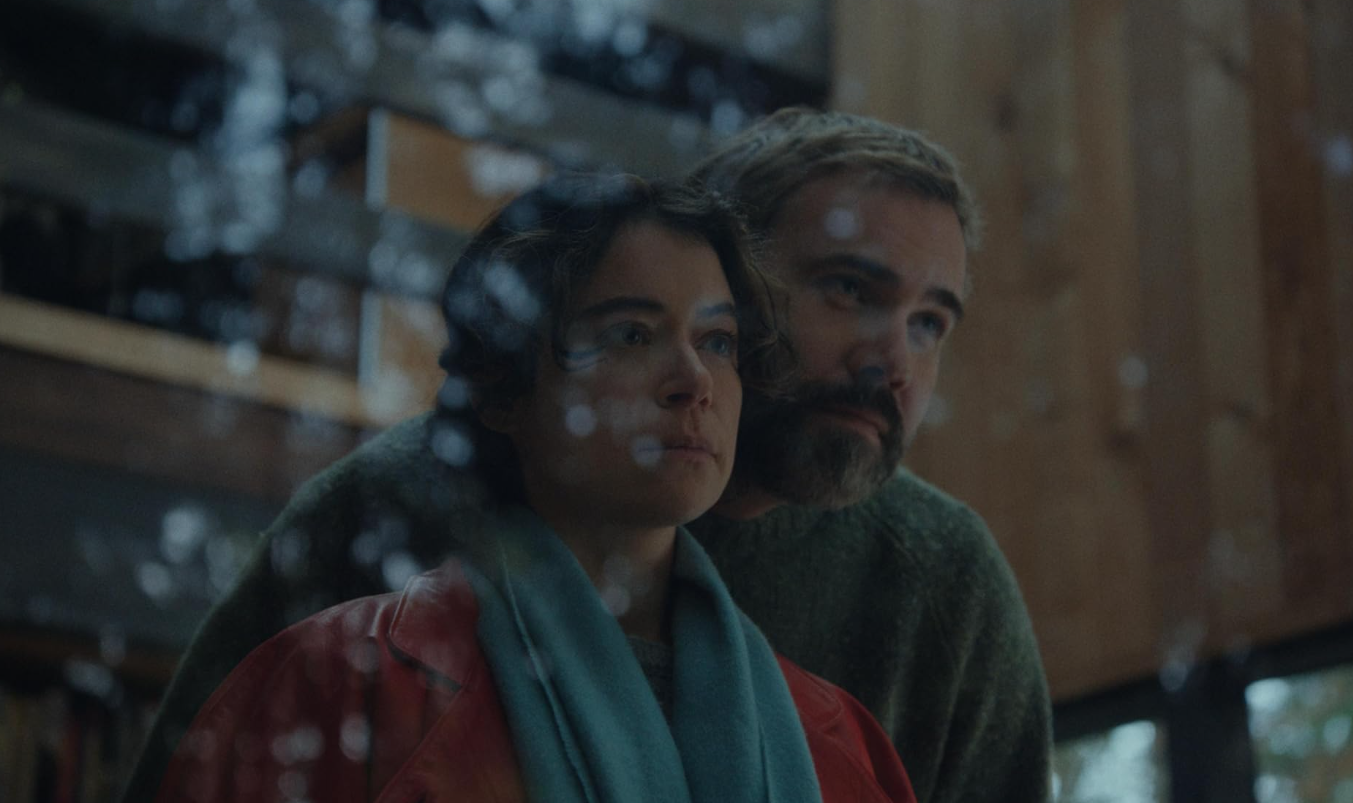
Together is the directorial debut of Michael Shanks, a body horror film starring real-life married actors Dave Franco and Alison Brie as a couple who move to a small town in the American countryside. Brie plays Millie Wilson, who has instigated the move because she has a new teaching job at a local school. Franco plays Tim Brassington, her longtime boyfriend Tim and aspiring musician who is emotionally distant after his parents passed away. Shortly after the move, the two fall into a cave while on a hike where they are forced to spend the night. In the morning, they find their legs partially stuck together and once they free themselves, they slowly find themselves being inexplicably physically drawn to one another to increasingly horrific results. The film has drawn a unanimously positive reception, with many citing it as one of the best horror films of the year.

Sadly, Together not only fails to live up to the hype but really drops the ball as a horror film – it’s an absolute stinker. The biggest problem is Shanks’ ear-scraping script, which completely catapults the film. The dialogue is consistently on-the-nose, the plotting clunky, and characters consistently act unnaturally.

Dave Franco and Alison Brie can try as all they might but both of their performances are terrible. Their characters are unlikeable with nothing to latch onto by way of any development. The film’s opening is particularly egregious where they’re at a party with their friends in an unnamed city before their move, with Shanks sticking to tired tropes – this is a film that will frustrate you right from the off, and it doesn’t let up. It’s Damon Herriman who somewhat steals the limelight from the central duo as an awkward and kooky fellow teacher, Jamie, who also happens to live next door to them.

The film is poorly directed by Shanks, who doesn’t seem to have a grasp of pace or tone, and as Together reaches its climax, there are several scenes which are unintentionally funny and groan-inducing. Some have described Together as a black comedy, but I would disagree because the tone and attempts at comedy are inconsistent and unsustained. The score is Cornel Wilczek is also all over the place and the film is murkily shot by Germain McMicking, and often rather ugly. Even the prosthetics and conjoining effects aren’t convincing, and I was never once frightened or disturbed by the events being portrayed on-screen.

It’s a real shame Together totally fails as a film, whatever genre it thinks it’s trying to explore. The unlikeable characters and dreadful script frustrated me right from the off and I was never able to immerse myself in Shanks’ world. He may well have had a reasonable original concept but the result is turgid, and Together is undoubtedly the most frustrating cinema experience I have had this year.

Weapons (Review)

Review
Still from 'Weapons'

Rating: 4 out of 5.

Director: Zach Cregger
Starring: Josh Brolin, Julia Garner, Alden Ehrenreich, Austin Abrams, Cary Christopher, Toby Huss, Benedict Wong, Amy Madigan
Certificate: 18

Run Time: 128 mins

Weapons is the new film by Zach Cregger, his follow-up to his excellent debut film Barbarian. Like Barbarian, Weapons is a high-concept horror-thriller that packs plenty of satisfying surprising its sleeve. The film opens with a child narrator explaining that one Wednesday, in the town of Maybrook, Pennsylvania, seventeen children from schoolteacher Justine Gandy’s (Julia Garner) third-grade class ran away from their homes at 2:17am and disappeared. Only one student, Alex Lilly (Cary Christopher) did not disappear and Gandy is immediately ostracised by the community who suspect her of being involved. To say anymore would be to veer into spoiler territory, but what follows is presented in a non-linear narrative told by certain character’s perspectives. Cregger has said the film is inspired by Paul Thomas Anderson’s Magnolia in structure, whereby there’s overlap between certain stories.

Weapons is a brilliant film and cements Zach Cregger as one of the most exciting up-and-coming talents. This is an assured, skilfully crafted film with some sensational set-pieces and clearly influenced by Magnolia and Prisoners in tone. amazing. Like Barbarian, Weapons hides some outrageous twists up its sleeve and is thematically rich, with lots of the symbolism and plot points up to interpretation. The way in which the film is split into chapters told by different character’s perspectives is an excellent way to tell the story, and it’s interesting to see how certain characters are likeable when portrayed from one perspective, but abhorrent from another.

It certainly helps that the cast are on the top of their game. Josh Brolin is brilliant as Archer Gaff, the father of one of the missing children, and really convincingly conveys his grief and his desperation to be reunited with his son. Julia Garner is also very strong as the meek teacher, and Alden Ehrenreich is particularly multi-layered as a corrupt police officer who’s Gandy’s ex-boyfriend. Austin Abrams is another highlight as James, a homeless drug addict and Benedict Wong excels as the school principal, deftly balancing comedic moments with berserk horror. And then there’s Amy Madigan as Alex’s eccentric great-aunt, for whom will surely experience a career revival after a slump.

The score is by Ryan Holladay, Hays Holladay and Zach Cregger is heart-stoppingly intense and it’s beautifully, and often disorientingly shot by Everything Everywhere All At Once cinematographer Larkin Seiple.

I was totally gripped from the moment Weapons opened to its finish with its enthralling story and pulse-raising setpieces. This is fiersomely original filmmaking and it’s expertly paced. Some might not like that the film has a reasonably neat explanation but I really brough the third act and found it particularly chilling and exciting. Weapons is a step-up from Barbarian (which was impressive in itself) for Zach Cregger and is one of the best films of the year.

The Fantastic Four: First Steps (Review)

Review
Still from Fantastic Four: First Steps

Rating: 3.5 out of 5.

Director: Matt Shakman
Starring: Pedro Pascal, Vanessa Kirby, Ebon Moss-Bachrach, Joseph Quinn, Julia Garner, Sarah Niles, Mark Gatiss, Natasha Lyonne, Paul Walter Hauser, Ralph Ineson
Certificate: 12A

Run Time: 114 mins

The Fantastic Four: First Steps is a reboot of the famous superheroes and marks the first time the quartet are integrated into the Marvel Cinematic Universe. It would be fair to say that previous efforts to bring these superheroes to the big screen have struggled. Tim Story’s 2005 film and 2007 sequel were high on cheese but low on substance and Josh Trank’s grimdark 2015 update was panned as one of the worst superhero films of all time. Although Trank’s Fantastic Four was undeniably flawed (and was subject to endless meddling by the studio), I found a lot to like in its first half, and I especially appreciated how Trank channeled David Cronenberg with the superheroes expressing disgust over their newfound powers.

Matt Shakman, who is best known for directing the MCU mini-series WandaVision, takes the helm. Like this month’s Superman, Shakman forgoes telling an origin story, instead throwing us straight into the action after a brief introduction in a retrofuturistic 1960s world. The Fantastic Four are well-established, with Sue Storm (Vanessa Kirby) learning she has a baby on the way, but all hell breaks loose when the Silver Surfer (Julia Garner) arrives on Earth, announcing the planet has been marked for destruction by the cosmic devourer Galactus (Ralph Ineson).

The Fantastic Four: First Steps is a rousing effort and it’s a hard film not to like with its warm tone. It’s eerily similar to Superman in its story structure and themes, but Shakman’s film does a much better job of establishing its heroes, giving us a brief rundown of their adventures to date rather than just dropping us in the middle of the action. I loved the retrofuturistic 1960s colour palette, which really stands the film apart from other Marvel Cinematic Universe films which are tied to a certain house-style aesthetic. Since the film is set in a different reality in the Marvel multiverse, it’s also freed from the shackles of having to tie itself to other Marvel properties – which is all for the better. While First Steps has typical end-of-the-world antics in its final act which really hurt Superman, I didn’t mind this here because this film has real stakes and earns its climax.

There’s a lot to like with the central quartet, with Vanessa Kirby and Ebon Moss-Bachrach the standouts as Sue Storm and The Thing. Kirby brings a real humanity and pathos to Storm and I really got on board with The Thing’s multi-layered character arc as someone who just wants to fit into society and not be seen as an other. Pedro Pascal also puts in a strong performance as Reed Richards, but it’s a shame that his character’s powers of flexibility are often ignored and he doesn’t go through much of an arc. Say what you want about Josh Trank’s Fantastic Four, but at least Miles Teller really nailed the role of Richards. Finally, while Joseph Quinn’s Johnny Storm’s powers are properly showcased, I found Quinn’s performance quite shallow and not as charismatic as the rest of the quartet.

Outside of the superheroes, Ralph Ineson makes for a great villain as Galactus with a real commanding presence. However, it’s a shame that a villain so powerful hasn’t been saved for a later film because this will be a hard antagonist to top. Julia Garner makes for a solid Silver Surfer with an atypical arc, but it’s Ineson that steals the show here on the villain front. It’s a shame John Malkovich’s role was cut as Red Ghost to improve the film’s pacing, though.

The score by Michael Giacchino is also strong, and I particularly liked the theme for Galactus, even if it’s not the best composer’s best work in the superhero genre – that accolade would go to The Batman. Jess Hall vibrantly shoots the action and there’s a real range of colourful setpieces that distinguish themselves from one another.

The Fantastic Four: First Steps is a really admirable entry in the Marvel canon and succeeds with its likeable cast and tone. It might be a little light on plot but it’s brilliantly paced and the economical 114 minute run time flies by (even if it’s at the expense of John Malkovich). This is certainly the strongest Marvel effort of the year – I enjoyed it more than Captain America: Brave New World and it’s streets ahead of Thunderbolts* – and I’m looking forward to seeing how the Fantastic Four are integrated into the wider canon with Avengers: Doomsday next year.

Superman (Review)

Review
Still from Superman (2025)

Rating: 3 out of 5.

Director: James Gunn
Starring: David Corenswet, Rachel Brosnahan, Nicholas Hoult, Edi Gathegi, Anthony Carrigan, Nathan Fillion, Isabela Merced 
Certificate: 12A

Run Time: 129 mins

Superman is the hotly anticipated reboot that kick-starts the new DC Universe, after the variable quality of films in the DC Extended Universe made the studio rethink their strategy. James Gunn is fronting this new cinematic universe, along with producer Peter Safran, with Gunn directing this initial outing. Gunn has had plenty of success in the superhero genre with his Guardians of the Galaxy series in the Marvel Cinematic Universe, as well as The Suicide Squad, which was undoubtedly one of the best entries in the DCEU. He’s consistently proven his chops and particularly excels with establishing well-rounded (often C-list) comic book characters.

Pearl and Twisters star David Corenswet inherits the Man of Steel mantle from Henry Cavill and he is pitched against arch-nemesis Lex Luthor (Nicholas Hoult), who has plans to turn public opinion against the superhero. Interestingly, Gunn decides to drop audiences straight in the action three years after Superman has established himself on Earth, bypassing the typical comic book origin story. As you’d expect, Clark Kent (Superman’s human identity) holds a job as a reporter for the Daily Planet in Metropolis, where he works alongside Lois Lane (Rachel Brosnahan) – who already knows his identity and they are in a burgeoning relationship – and Jimmy Olsen (Skyler Gisondo).

While Superman has many of James Gunn’s hallmarks and its fair share of entertaining moments, it is also very ramshackle in its construction. The film begins horribly, then somewhat finds its feet after 40 minutes or so and is entertaining enough before an overlong third-act end-of-the-world climax. I totally understand that Gunn wants to avoid the typical origin story and instead drop the viewer right in the middle of the action. While commendable in its ambition, I found it difficult to really connect with any of the characters at first and to get around the lack of back story, there’s a ton of really clunky exposition. If you want to set up a wider cinematic universe and this is your first film, it needs to lay some kind of framework down and remind you why you love these characters in the first place. While I’m not saying that needs to be in the form of an origin story, what Gunn’s settled on instead just doesn’t work.

The overblown CGI-heavy third act climax is another element that doesn’t deliver – and it’s something that Gunn has struggled with before, especially with Guardians of the Galaxy Vol. 2 and even The Suicide Squad, to an extent, which was pretty perfect up to that point. Typical big city end-of-the-world antics just don’t cut it anymore in comic book films. If this is the best Gunn can come up with the series’ inaugral film, how are the stakes going to be topped in future films?

I also never really connected with Superman as a character and I think that’s because there are three plots going on at once and how they intertwine is very messy. While David Corenswet is certainly very likeable, the way he’s characterised is thin – he’s always just a good guy, but with no meat to the bone. For all its flaws, I much prefer Zack Snyder’s depiction of the superhero in Man of Steel, who gives the character bundles of pathos and makes him break his moral code (which proved highly controversial).

Rachel Brosnahan fares much better as Lois Lane – this is possibly the strongest rendition of the character to date, with the actress giving a nuanced performance. While Nicholas Hoult makes for a sinister Lex Luthor and I liked that Gunn tried to vary the character by having a dedicated team of supporters that genuinely believe in his mission, he needed more humanising to really empathise with his intentions. As things stand, like Superman, Lex Luthor is rather empty.

On the positives, Gunn does a great job of introducing empathetic C-grade comic book characters, such as Mister Terrific (Edi Gathegi) and an abrasive Green Lantern (Nathan Fillion), who make a strong impression. I also liked how Gunn tries to vary Superman’s origins, with an interesting portrayal of his Kryptonian parents, Jor-El (Bradley Cooper) and Lara Lor-Van (Angela Sarafyan), as well as Jonathan and Martha Kent (Pruitt Taylor Vince and Neva Howell). Finally, Gunn makes more of a deal of the The Daily Planet, and a sub-plot involving Jimmy Olsen is an inventive piece of storytelling.

The film’s interestingly shot too by Gunn’s regular cinematographer Henry Braham. He shoots the film in almost Hunter S. Thompson-like fashion, with the camera often roving and swirling around characters in an unbroken take. Visually, Superman has all of Gunn’s usual heightened aesthetics and a sequence in a portal in the second act is the film’s highlight and just the darkness the film needs.

While John Murphy and David Fleming’s score has its moments, the duo never develop any memorable themes and although some would disagree, the referencing back to John Williams’ score felt lazy and tired. At least Hans Zimmer tried something different with his exceptional score for Man of Steel and didn’t feel the need to revisit the past.

While Superman is ultimately an enjoyable watch with a lot of plus points, I didn’t exactly love it either. It suffers from cluttered storytelling, a script rife with exposition in the first act and many of the characters are underdeveloped. As a James Gunn film, it certainly feels like he’s been reined in a bit and just like with Guardians of the Galaxy Vol. 2 and 3, he’s a director that thrives when he’s not constrained to a 12A rating. Still, there’s a lot of good here and I’m interested to see how this cinematic universe is going to develop.

F1 (Review)

Review
Still from F1 (2025)

Rating: 3 out of 5.

Director: Joseph Kosinski
Starring: Brad Pitt, Damson Idris, Kerry Condon, Tobias Menzies, Javier Bardem 
Certificate: 12A

Run Time: 156 mins

F1 is the hotly anticipated Apple TV-fronted mega-budget film about the race circuit, with Lewis Hamilton credited as a producer who prances onto screen at one point, alongside other big racing names. The film’s directed by Joseph Kosinski, who has plenty of experience with big-budget fare and is riding on a high after Top Gun: Maverick (and the little seen but excellent Spiderhead). The story is very simple – an aging American racing driver and former Formula One prodigy, Sonny Hayes (Brad Pitt) is approached by his former Lotus teammate Rubén Cervantes (Javier Bardem), who offers him a test drive to fill their spare seat on the APXGP F1 Team he now owns. The team have been performing badly and Cervantes reveals the investors will sell it unless they win one of the remaining Grand Prix races that year. If you’ve watched a racing sports drama before, it doesn’t take a genius to work out the story beats the film is likely to take you through.

Although F1‘s story feels like it was written on the back of a cigarette packet, it’s Joseph Kosinski’s kinetic direction that ultimately makes the film work, along with some committed performances. There’s nothing here to rival the dogfight at Top Gun: Maverick‘s climax, but the race sequences here are vividly shot by Kosinski’s regular cinematographer Claudio Miranda and exciting to watch unfold. It’s testament to the quality of the direction that I was never bored (despite the paper-thin story) during the lengthy 156 minute run time. And although it’s far from his best work, Hans Zimmer’s score has its moments.

Brad Pitt is effortless as the has-been racer, who has made a bit of a mess of his life with a gambling addiction and three marriage breakdowns, as he grapples with the changing landscape of the Formula One scene. The chemistry he shares with Damson Idris’s hotshot rookie Joshua Pearce, is excellent and develops at a fine pace. After being nominated for her brilliant performance in The Banshees of Inisherin, Kerry Condon also stands out as the race team’s female technical director and is given a strong story arc. Then, there’s Javier Bardem who always elevates anything he’s in and Killing Eve‘s Kim Bosnia is also having fun as the team’s principal.

Although I’d have liked F1 even more if it had some meat to the bone, what Kosinski’s made is perfectly entertaining, if rather shallow. His energetic direction and exciting race sequences make this a perfectly passable way to spend two-and-a-half hours, and Brad Pitt’s slightly cocky but empathetic racer is sure to put a smile on your face.

28 Years Later (Review)

Review
Still from 28 Years Later

Rating: 4 out of 5.

Director: Danny Boyle
Starring: Jodie Comer, Aaron Taylor-Johnson, Jack O’Connell, Alfie Williams, Ralph Fiennes
Certificate: 15
Run Time: 115 mins

28 Years Later is the long-awaited third instalment in the 28 Days Later series, director Danny Boyle’s 2002 post-apocalyptic horror that was novel for introducing the fast-moving zombie (even if Boyle famously doesn’t consider it to be a zombie film). The film arrives 18 years after 28 Weeks Later, which was directed by Juan Carlos Fresnadillo and although it received positive reviews, it isn’t anywhere near as highly regarded as the original – a shame, in my opinion, because it has plenty of bright spots. Not only is Danny Boyle back in the director’s chair, Alex Garland is on screenplay duties (he also wrote the original), and Garland’s seen plenty of success in his recent directorial career with thoughtful films such as Ex_Machina, Civil War and Warfare. The duo have envisaged 28 Years Later as the first of a new trilogy, and was filmed back-to-back with 28 Years Later: The Bone Temple (although Candyman‘s Nia DaCosta is in the director’s chair), which conveniently releases in 28 weeks’ time.

Outside of what I consider to be a prologue (which involves a chilling appearance of The Teletubbies – yes, really!) and a final scene that is certainly a choice, the film is formed of three distinct acts. 28 years after the outbreak, the Rage Virus has been eradicated from continental Europe but is still running rife in the UK. A survivor community live on Lindisfarne, an island separated by a fortified causeway. 12 year old Spike (Alfie Williams) lives with his scavenger father, Jamie (Aaron Taylor-Johnson) and mother Isla (Jodie Comer). Jamie takes Spike to the mainland for a coming-of-age ritual, while Isla stays at home and suffers from an unknown illness. Jamie and Spike’s mainland escapade forms the first act. The second act then follows what Spike considers to be a rational decision to head off the island again and then the third introduces a former doctor and survivor, Dr Ian Kelson (Ralph Fiennes).

28 Years Later is a very exciting and ambitious sequel that was worth the long wait and it often really soars. This is a Danny Boyle film through-and-through, so expect the grainy feel of the original (this time, lots of the film is shot on iPhones), coupled with seriously kinetic cinematography from Boyle’s regular collaborator Anthony Dod Mantle. This is a film that’s full of ideas, and one that refuses to take obvious choices and like some of Garland’s recent filmography, there are plenty of influences from the UK’s recent political turmoils as the duo paint a picture of a national identity crisis.

When we get to the action, 28 Years Later is absolutely bursting with adrenaline and you’re constantly looking around the screen (when Mantle chooses to settle the camera for a second) for danger. The first act is where the film is strongest, especially a sequence where Spike and Jamie find themselves cornered in a house and a white-knuckle chase along a causeway. I love the way Mantle chooses to briefly pause a shot when an infected is killed and replay the kill from a different angle, and there are some stunning shots of the lush Northumbrian countryside, as well as the sadly-no-more Sycamore Gap tree near Hadrian’s Wall.

The film makes a choice in the second act, which prompts Spike to return to the mainland and this stretch felt a little clunky to me, even if it’s still very entertaining. But the third act when Ralph Fiennes’ character enters the fray sees the film back on firmer footing and there’s plenty of the folkloric and elegiac elements clearly inspired by Garland’s Annihilation and Men. Garland says he was inspired by Ken Loach’s Kes when he wrote the film and that’s certainly an apt observation because the coming-of-age element of Spike as a character really shines through.

Speaking of the performances, they’re uniformly excellent. This is a barnstorming debut from Alfie Williams as Spike, who really nails the part and convincingly portrays the teenager’s development into being fully independent. I’ve not been kind on Aaron Taylor-Johnson in the past – the actor needs the right role to thrive and he really was terrible in Nosferatu at the start of this year. But 28 Years Later represents his best performance since Nocturnal Animals – he’s brilliant here as the world-weary and unpredictable father who’s rather handy with a bow and arrow. Jodie Comer’s usually the highlight of whatever she plays in but I’d say she’s outperformed by Williams and Taylor-Johnson in the central trio, but it’d also be fair to say her character has the least amount of meat on the bone. Finally, Ralph Fiennes always elevates anything he’s in and he’s brilliant here as Dr Kelson, a cross between Apocalypse Now‘s Colonel Kurtz with the well-spoken nature of his concierge from The Grand Budapest Hotel, or the acclaimed film director in Hail, Caesar!.

28 Years Later is a really thrilling sequel filled to the brim with ideas and represents a thoroughly strange but satisfying melding of Danny Boyle’s filmmaking attributes with the grand ideas of Alex Garland. It might not always work but when it peaks, 28 Years Later is transcendent. I’m very excited to see where the story heads next and although many have expressed dissatisfaction at the intentionally befuddling final scene, fear not because I’m confident we’re in safe hands.

Elio (Review)

Review
Still from Elio (2025)

Rating: 3 out of 5.

Director: Madeline Sharifian, Domee Shi & Adrian Molina
Starring: (voices of) Yonas Kibreab, Zoe Saldaña, Remi Egerly, Brandon Moon, Brad Garrett, Jameela Jamil
Certificate: PG

Run Time: 98 mins

Elio is the new Disney Pixar film and the first original work from the studio since Elemental in 2023, with Inside Out 2 a big win for the brand last year. Neither of those films were top-tier Pixar, in my opinion, with the last standout hit Soul all the way back in 2019. Elio has had a bit of a troubled direction, with Adrian Molina originally in the director’s chair but then vacating in August 2024 to go and work on the forthcoming Coco 2 (now there’s a sequel that really doesn’t need to happen). Domee Shi, who directed Turning Red and Madeline Sharafian, best known for her Pixar short film, Burrow, replaced Molina, with all three ultimately receiving a credit.

Elio follows the 11-year-old titular character, an orphaned boy (Yonas Kibreab) who doesn’t fit in among his peers and has a strained relationship with his Air Force major aunt Olga (Zoe Saldaña). He’s obsessed by the idea of discovering life in space and wishes he was abducted by aliens. After much effort, he achieves his wish when he’s picked up by the Communiverse, mistaken as the leader of Earth. He is swiftly tasked with proving his worth when a warlord named Grigon (Brad Garrett) wields trouble.

This is a bizarre film –  while on the one hand, Elio feels schmaltzy, predictable and tonally jumbled, it also has its tender moments and an amiable message. Unlike the photorealist animation Pixar has become famous for, this film is more vivid in its visuals, with a real clash of colours that borders on psychedelic. The script is sincere and the development of the relationship between Elio and his aunt sweet-natured, but it’s a shame the filmmakers feel the need to tell rather than show.

What I liked most about the film was how it explores the theme of loneliness and how this manifests within disability (Elio displays many autistic traits but the film doesn’t explicitly label him as such). This is the daring Pixar that’s seen so much success with its original concepts, and much in the vein of Inside Out 2 (in how it explores puberty), might explain why Elio is rather shambolically constructed because it’s being told from an unconventional perspective.

I can’t say Elio is representative of Pixar at its best – and I’m unlikely to rush to rewatch it. But you can’t deny that Elio is certainly original and ambitious, even if the film doesn’t completely land.

Tornado (Review)

Review
Still from Tornado film

Rating: 3.5 out of 5.

Director: John Maclean 
Starring: Tim Roth, Jack Lowden, Takehiro Hira, Joanne Whalley, Rory McCann, Alex Macqueen, Kōki
Certificate: 15

Run Time: 91 mins

Tornado is the new film by Scottish director John Maclean, 10 years since he burst on the scene with his Michael Fassbender-starring Western masterpiece, Slow West. His hotly anticipated Western-inspired follow-up is a revenge thriller set in 1790s Scotland about a young Japanese woman called Tornado (Kōki), who’s rather handy with a samurai sword. The film opens with Tornado fleeing with a small boy from a gang of highwaymen, led by the merciless Sugarman (Tim Roth), who suspect her of stealing their gold. After a tense stakeout in a mansion, we head into a flashback and learn how these characters came to be in this cat-and-mouse situation, before said revenge is enacted. It’s a simple set-up but like Slow West, this is lean and mean and only clocks in at an economical 91 minutes. Was Tornado worth the 10 year wait?

The answer is a resounding yes, and Tornado has a near-perfect, hypnotic first half. Just like Slow West, Maclean transposes genre elements into a setting you wouldn’t expect and Robbie Ryan’s cinematography is beautiful, giving the lawless landscapes a mythic quality. The second half of Tornado doesn’t quite work quite as well because it starts to introduce a whole host of characters without much development, but it’s still a very entertaining time, especially once we reach the inevitable bloodshed.

There’s some brilliant performances here, with Kōki the standout in the lead role. You wouldn’t know she originated as a Japanese model and songwriter, and manages to really sell the protagonist through her body language – there isn’t masses of dialogue. This is also true of Tim Roth, who skilfully underplays the world-weary villain in another role that’s sparse of speech. There’s entertaining turns too from Jack Lowden as the wickedly evil Little Sugar, Sugarman’s son, and both Rory McCann and Alex Macqueen always elevate anything they star in. The film’s complimented by a brilliant Jed Kurzel score (his Slow West score was magnificent) that’s full of memorable themes that add tension or emotion to the events on-screen.

All in, while Tornado isn’t quite as assured a film as Slow West, this sophomore effort still wears Maclean’s fingerprints with his deconstructive, barebones yet atmospheric style – it’s very clear this is by the same filmmaker. That first half in particular shines and I’m very much looking forward to rewatching Tornado again.

Dangerous Animals (Review)

Review
Still from Dangerous Animals

Rating: 3.5 out of 5.

Director: Sean Byrne
Starring: Hassie Harrison, Josh Heuston, Rob Carlton, Ella Newton, Liam Greinke, Jai Courtney
Certificate: 15
Run Time: 93 mins

Dangerous Animals is the new film by Tasmanian horror filmmaker Sean Byrne, best known for The Loved Ones and The Devil’s Candy. Jai Courtney plays Tucker, an eccentric ship captain who runs a shark cage tourist attraction business. But as we very quickly learn, he’s also a serial killer with a seriously twisted mind, with his latest victims Heather (Ella Newton), an Englishwoman on a gap year and a feisty American drifter, Zephyr (Hassie Harrison). He likes to harness women up and slowly dunk them into shark-infested waters, and film the results. This genre mash-up of a crime thriller and a shark film is certainly clever, especially the latter where virtually all recent efforts in the genre haven’t landed, such as The Shallows, The Meg (and its dreadful sequel) and 47 Meters Down to name a few.

For about 70 minutes of its run time, Dangerous Animals is a near-perfect genre mash-up that’s deliciously nasty – a blending of Jaws meets Peeping Tom, but turned up to eleven. Nick Lenard’s script is sharp and deftly develops the characters, so it’s easy to care for them later into proceedings. The film’s also gorgeously shot by cinematographer Shelley Farthing-Dawe, with some stunning ocean vistas and blending the turquoise waters with blood red. Until that 70 minute mark or so, I’d go as far as to call Dangerous Animals the definitive shark film.

It’s such a shame that in the last 20 minutes, the film really jumps the shark (pun fully intended) – neither Byrne or writer Nick Lenard have the strength to act on their sadistic convictions and you really have to suspend disbelief.

This is easily career-best work from Jai Courtney – unfortunately, he’s been an actor who’s been easy to poke fun at, with terrible performances in films such as A Good Day To Die Hard, Terminator Genisys and Suicide Squad. But Byrne really makes the most of his talents here, with a role that requires him to be equally charming and disconcerting that he completely laps up. I hope Dangerous Animals is the film that revamps Courtney’s career.

Hassie Harrison as the aloof American drifter is also excellent, reminiscent of a young Jennifer Lawrence, and completely sells her plight as a seemingly impenetrable young woman who doesn’t quite understand the world and how she fits in. Based off this performance, I wouldn’t be surprised to see her earn higher-profile work.

Many films have been trying to chase the success of Jaws, but without success. For the most part, Dangerous Animals smartly demonstrates why simply copying that format doesn’t work, by reframing the sharks as not being the predator but a force of nature. This is a wonderfully demented film with a sadistic edge that builds and sustains its tension until that 70 minute mark. But what a shame that Byrne can’t work out how to end the film.

Predator: Killer of Killers (Review)

Review
Still from Predator: Killer of Killers

Rating: 2.5 out of 5.

Director: Dan Trachtenberg
Starring: (voices of) Lindsay LaVanchy, Louis Ozawa, Rick Gonzalez, Michael Biehn
Certificate: 15
Run Time: 90 mins

Predator: Killer of Killers is the first of two Predator films releasing this year, an adult animated anthology film filmed in secret ahead of the live action Predator: Badlands. Dan Trachtenberg, who made the excellent Prey, is once again in the director’s chair (and is also behind the upcoming Predator: Badlands). This animated film is split into four sections – three which tell the stories of human warriors throughout various points of history who face off against a Predator and a final section which ties the preceding stories together. The first chapter, ‘The Shield’ follows a fearsome Viking queen Ursa (Lindsay LaVanchy), the second ‘The Sword’ is centered around a ninja (Louis Ozawa) in feudal Japan and in the third chapter, ‘The Bullet’, we see a World War II pilot (Rick Gonzalez) battle with Nazi fighters and a Predator.

Predator: Killer of Killers is an odd film – the three standalone stories are rather undercooked but the final section that then ties them together is rather excellent, with some fascinating concepts. The film is balls-to-the-wall action and holds nothing back when it comes to gore, which I’m sure many will appreciate.

But I like some meat to the bone, and the standalone stories feel as if they’re feature film concepts that have been distilled into their final climax Predator face-off sequence. They feel like distinct films that Trachtenberg wanted to make – much like how Prey was a period piece – only condensed into 20 minute shorts. As a result, character development is virtually non-existent and the leads of each respective story feel like caricatures. Micho Robert Rutare’s rote and on-the-nose screenplay certainly isn’t helping proceedings (fortunately Patrick Aison, who wrote Prey, is also writing Predator: Badlands). I also found the animation style rather disorienting, although considering the story Trachtenberg tells, this would have been one very budget-heavy live-action feature.

Although the lack of substance of the three stories failed to properly engage me, it’s the final section which really elevates proceedings. How Trachtenberg ties these stories together is like a child playing in a sci-fi sandpit, with a thrilling set piece and some tantalising teases that hint towards the future. It’ll be interesting to see if Predator: Badlands further develops these concepts – and that’s what Predator: Killer of Killers really functions as in a nutshell – a teaser towards something more exciting in the future.

Predator: Killer of Killers is an ambitious film in the series, and you have to hand it to Trachtenberg for his innovative concepts. But the three separate stories that make up the majority of the film’s runtime don’t cut the mustard and are sorely lacking in a reason to care for the characters, partly down to how they are condensed into 20 minutes without any substance and a generic script. Fortunately, it’s not all for nothing if you can stick out the first hour.