


Director: David Robert Mitchell
Starring: Anne Hathaway, Ewan McGregor, Maisy Stella, Christian Convery
Certificate: 12A
Run Time: 99 mins
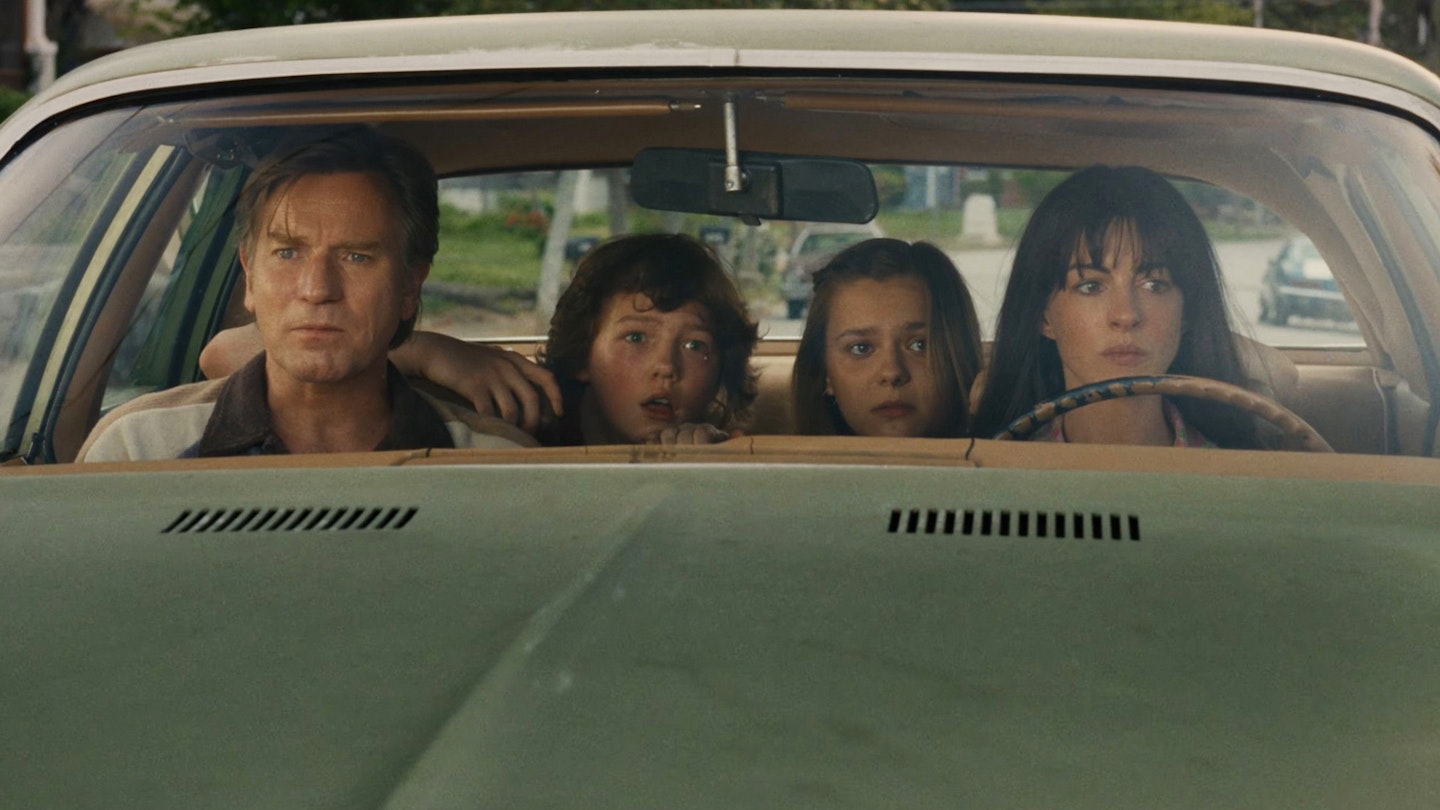
The End of Oak Street is the first film to be directed by David Robert Mitchell in almost a decade, after (the highly underrated) Under The Silver Lake, his follow-up to It Follows, landed him in director’s jail. Teaming up with J. J. Abrams’s Bad Robot production company, The End of Oak Street follows a family in 1982 whose suburban neighbourhood is transported back to prehistoric times. Anne Hathaway plays the matriarch, Denise Platt, who’s an aspiring novelist, while Ewan McGregor is her husband, who’s recently been laid off from his job and is working as a pizza delivery driver. Maisy Stella plays Audrey, the older teenage daughter, and The Monkey‘s Christian Convery stars as the younger son, Brian.
Much like his previous work, The End of Oak Street sees the director embrace classic older genre tropes, leaning into 1980s creature features and the nuclear family. It often has a warm Steven Spielberg-like tone, although it’s a little darker and stranger at times, especially a scene with two dinosaurs having sex.
Unfortunately, it’s David Robert Mitchell’s weakest film by a long shot. The script is oddly poor with shonky dialogue between the family, and while there’s a couple of interesting subtle moments, the film resorts to long bouts of exposition too. It also doesn’t manage to land the correct tone, feeling overly warm and that, plus the combination of a 12A rating, waters the film down and means it’s completely devoid of tension.
The film’s first half is all over the place, and although it takes less than 25 minutes for the dinosaurs to appear, its opening feels like it takes an age. Some of the set pieces feel episodic, although there are two excellent sequences in the second half, which is much stronger than the first – especially a nightmarish scene with a snake-like creature that finds its way into the house.
Mitchell reunites with his regular cinematographer, Mike Gioulakis, and while the action is crisply shot, Gioulakis oddly embraces the split diopter shot (which plagued Lee Cronin’s The Mummy earlier this year) in a terrible family conversation scene in the middle of the film. There’s also a honking Michael Giacchino score that apes John Williams, but isn’t particularly memorable and is too upbeat for the devastation unfurling on screen.
It’s a shame The End of Oak Street isn’t the return to form David Robert Mitchell deserves. Although he’s working with a thrilling concept, the film is messily constructed and doesn’t land the right tone. I never felt any jeopardy or peril, and the oddly wooden script hurts the film because I couldn’t connect to its characters. It’s not a bad film though – there’s a couple of excellent sequences in the second half. But it’s not consistently engaging, and that’s a red flag for what should be a thrilling creature feature.

