The Limitations of Rotten Tomatoes

Uncategorized

HAR_DM_FIRST LOOK RND F04

With Justice League currently playing in cinemas, the controversy of the critical reception to the films in the DCEU canon continues. One important aspect to many people is the Rotten Tomatoes score of the film, which people have been keen to follow. For those unfamiliar, Rotten Tomatoes is a site that measures how many critics gave a favourable review to a film, in the form of a percentage. If 60% of the reviews are deemed positive, the film is rated as ‘fresh’ and anything less, ‘rotten’.
hero_mother-tiff-2017

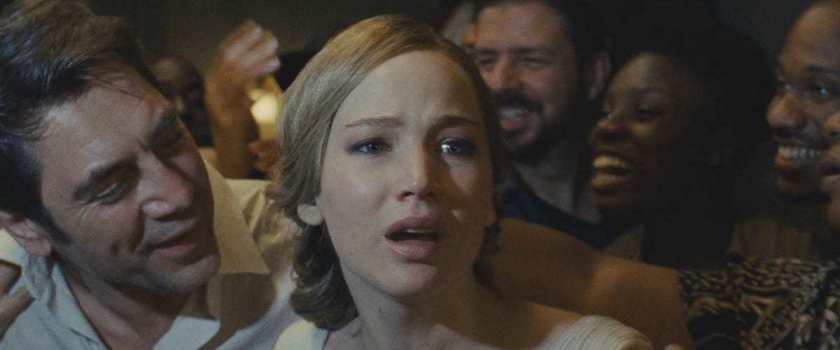
Of course, there are limitations with this model with the notion that a films can be reduced to scores and also the score doesn’t inform generally how much people liked or disliked a film. Take the recent release of Darren Aronofsky‘s mother! for example, a film that is intentionally designed to be divisive, which attained a 68% (fresh) score from critics. To those unaware, 68% would suggest that the film was pretty good but perhaps flawed in some way. What the score fails to divulge is that mother! is a film which people either loved or loathed or were, like myself, somewhere in between. How are you supposed to gauge from a score the varying attitudes and opinions to these reviews? All 68% tells you is that 68% of the critics featured in this poll would give a positive review to the film.

Screen Shot 2017-11-28 at 14.23.19.png

When Batman v Superman: Dawn of Justice (BvS) opened towards the beginning of last year, the famous critical backlash to the film lead to fans losing their heads over the damning 27% score (therefore, judged as ‘rotten’). This was furthered by Suicide Squad‘s also less-than-stellar critical reception, also scoring a measly 27%. Petitions were even created to “close the site down”, from dismayed fans who thought these scores had been rigged and  also believed that these scores may damage the legacies of these films.

Although the reception of Wonder Woman served as a U-turn for the critical reception of the DCEU with a 92% ‘fresh’ score, the reception to Justice League was still one of trepidation due to the turbulent production of the film and the fact that it serves as a follow-up to BvS, largely featuring the same cast and crew.
Screen Shot 2017-11-28 at 14.21.18.png

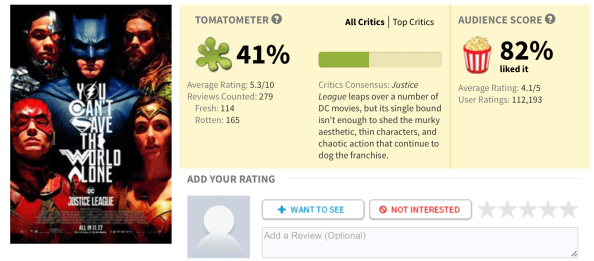
The scores came in and Justice League has been deemed as ‘rotten’ and currently sits on a disappointing 41%. But before the scores were revealed in what was in my opinion, a long drawn-out affair with a very late embargo, it became very apparent to me that a lot of people (even a couple of YouTubers that I have respect for) didn’t seem to know what Rotten Tomatoes is. I have heard things such as “Justice League deserves at least a 70%” and “27% is too harsh for BvS“.

I would like to point out that a film cannot deserve a score. In the case of BvS, all 27% means is that just over a quarter of people who watched the film thought it was at the very least, good. Like with my previous example of mother!, 27% doesn’t tell you how skewed the reviews were in either direction.

As flawed a system as Rotten Tomatoes is, I think people need to understand that it is just an indication of the general consensus to a film and not something that dishes out its own score. And please, no more of this shutting down business – it’s petty and childish and the so-called ‘fans’ that petitioned for this need to grow up.

Rotten Tomatoes is definitely useful as a tool, but should in no way affect your opinion of a film. Watch Justice League for yourself to form your own verdict – don’t judge it by a statistic. As film critic Mark Kermode puts it, aggregate scores “aren’t criticism, they’re just number-crunching”.

Justice League is out now in UK cinemas. 

The Florida Project (Review)

Uncategorized
the_florida_project-3c_marc_schmidt_h_2017

⭐⭐⭐ (Good)

Director: Sean Baker
Starring: Willem Dafoe, Brooklynn Prince, Bria Vinaite, Valeria Cotto, Christopher Rivera, Caleb Landry Jones

Certificate: 15
Run Time: 115 mins

After universally impressing with Tangerine, a film shot on an iPhone 5S, director Sean Baker is back with another insight into society, this time in the deprived areas surrounding Disney World in Florida, hence the film’s title derision from the working name for Walt Disney’s project. But where the film also takes place is in effect, not unlike American “project” communities. Although Baker’s film is now shot on more conventional film, The Florida Project is an equally unconventional, searing look at society.

We follow six year old Moonee and her twenty two year old mother, Halley, both brilliantly played by Brooklynn Prince and Bria Vinaite, who are equally stars in the making. They are both ‘residents’ at The Magic Castle motel. Although the motel’s name might connote expectations of happiness and fantasy, these connotations can be discarded as the majority of the people who reside there are in effect tenants, only to legally work, they have to move themselves and their belongings out for a day intermittently. Moonee is a highly inquisitive girl, whose playful character often gets the better of her as she pranks others with her friends from these residences. Her heart is in the right place, however, and she only ever wants the best for everyone. Her mother, Halley, is struggling both emotionally and with money and the film follows how she is becoming increasingly unhinged and how this is putting strain on her daughter until a crescendo of tension in the film’s finale. But she still clearly has a motherly love for her daughter and wants the best for her, despite knowing how best to raise her child. Willem Dafoe puts in a career-best performance as Bobby Hicks, the manager of this particular hotel, who effectively acts as a father figure to the children. He comes across to them as stern, even bordering on unfriendly at times but he so clearly wants what is best for his tenants welfare.

At times, The Florida Project is a fascinating character study and explores the juxtaposition of adulthoood and childhood and its climax is particularly moving. But the film panders along more than enough to get there, it is definitely a good twenty minutes too long. That said, it is a film that warrants repeat viewings as it leaves a lot of questions for its audience, something that more casual viewers may perhaps feel rather underwhelmed. Although deeply flawed, Baker’s film is certainly a story worth watching unfold.

⭐⭐⭐ (Good)

Murder On The Orient Express (Review)

Uncategorized
branstache-650x366

⭐⭐ (Poor)

This piece was further developed and submitted as part of my portfolio for a university project. 

Director: Kenneth Branagh
Starring: Kenneth Branagh, 
Penélope Cruz, Willem Dafoe, Judi Dench, Johnny Depp, Josh Gad, Derek Jacobi, Leslie Odom Jr, Michelle Pfeiffer, Daisy Ridley
Certificate: 12A
Run Time: 114 mins

Murder on the Orient Express is yet another adaptation of Agatha Christie’s crime novel, only this one is directed by and starring Kenneth Branagh as famous Belgian detective Hercule Poirot. After solving a theft by the Wailing Wall in Jerusalem, Poirot feels he has earned a well-earned holiday and one would be inclined to agree with the sheer amount of cases Christie has challenged him with in her many novels. However, this is short-lived when his presence is required in London so instead of an exotic holiday, he gets to travel in luxury aboard the lavish Orient Express. However, somebody is murdered on the journey and the train derails after an avalanche, effectively forcing Poirot to put his plans of a holiday on hold again. Branagh faces some strong competition from other adaptations and performances of the character – my personal favourite would be David Suchet in the television series, who is pretty much note-perfect.

Luckily, Branagh more than ably steps up to the task and his iteration of Poirot is outlandish and theatrical but with grace and respect for the character as well. In addition, he has also crafted the most fabulous yet outrageous moustache for Poirot!  However, Branagh puts his character so front and centre that he neglects to develop the rest of the cast. Branagh has perhaps one of the most star-studded casts of the year with actors such as Johnny Depp, Judi Dench, Michelle Pfeiffer and Penelope Cruz, but pretty much all of them just chew the scenery because they are given virtually nothing to work with. All of the suspects feature in introductory moments in the film as Poirot learns who he is travelling with and in an interrogation scene once the murder occurs. It’s a real shame and it makes the film quite oddly uninvolving and cold at times as there is nothing to latch on to. Branagh certainly has the ability, with his 2007 thriller remake, Sleuth, being a very gripping experience but this is weirdly not the case here.

Musically, Patrick Doyle’s score is a disaster. Doyle has composed pretty much all of Branagh’s directorial efforts and they’re generally a great match but what Doyle has come up with here aggressively does not fit with the film.

The other big issue I have with the film is its ending which I really didn’t like and felt cheated by it. It also then begins to reveal, in my opinion, plot holes in the entire concept of the narrative, practically undoing the film. I won’t be discussing spoilers but this is probably the biggest factor as to why my ultimate reaction is more negative than positive.

On the plus side, as well as Branagh’s performance, the film looks great. The cinematography by Haris Zambarloukos is excellent and a lot of shots almost feel as if they are an unnamed passenger, watching on the events unfolding. There are also some breathtaking, sweeping shots of the train and surrounding landscapes. The film certainly stylistically and visually looks the part.

I’m afraid I’m rather reticient to be overall positive on Murder on the Orient Express as is style over substance and its narrative and development of characters is very unsatisfying. Although perhaps a crude comparison, say what you will about The Snowman but at least that had the guts to be nasty at times and as silly as it was, I was more interested in it. The film is not a complete failure though – to give credit where it’s due, Branagh at least has the right building blocks should a sequel be made, which the film sets up in its final scene. I’d happily watch his iteration of the character solve a more satisfying mystery, coupled with the fact that the film is visually pleasing. Murder on the Orient Express is ultimately not the slamdunk on paper it should have been and its wasted journey should never have really left the station.

⭐⭐ (Poor)

Breathe (Review)

Uncategorized
Breathe_170816_Day37_ 1428.jpg

⭐⭐⭐ (Good)

Director: Andy Serkis
Starring: Andrew Garfield, Claire Foy, Tom Hollander, Hugh Bonneville, Dean Charles Chapman, Miranda Raison, Ed Speelers, Jonathan Hyde, Diana Rigg 

Certificate: 12A
Run Time: 117 mins

Breathe marks the directorial debut of motion capture maestro Andy Serkis and recounts the important, true story of Robin Cavendish, an individual whose content life is brought to a halt after he is stricken down with polio. Cavendish is played by the ever-talented Andrew Garfield, who put in two brilliant performances already this year in Silence and Hacksaw Ridge. Breathe is arguably the most physical of the three performances for Garfield, who very much has to act with his facial expressions. Serkis is no stranger to the theme of disability, putting in a brilliant performance in Ian Dury biopic, Sex and Drugs and Rock and Roll. 

Breathe is a decidedly safe film, mind, and is a neat, concise account of Cavendish’s life. Andrew Garfield, again demonstrates why he is one of the best actors working currently, towering over the rest of the cast. I’m reluctant to call it ‘Oscar-bait’ as that would be a disservice to its powerful story but Serkis would have really benefitted from crafting a more dark and daring film that explored more of Cavendish’s pains and feelings rather than every single character being portrayed as so upbeat, a quintessentially British mood. The swooning score by Nitin Sawhney fits the film neatly too and there are some nice moment in Robert Richardson’s cinematography.

Serkis runs into big problems late into the film as he simply doesn’t know where to end it. In my opinion, Serkis has two great opportunities (one after a powerful speech and another, after a shot of the ventilator working) but he squanders it and the film becomes overlong and increasingly emotionally manipulative. The final scenes are obviously intended for audiences to shed a tear but it left me cold, threatening to undo the good work he had done in the first 90 minutes.

For all its flaws, I was never bored by Breathe and for its first 90 minutes or so, it is particularly strong and tells a timely story of Cavendish’s life. It’s just a shame that Serkis chose not to be more risk-averse. If he did, the film could have been particularly special and that would justify its existence more for the relevant Awards.

⭐⭐⭐ (Good)

Kevin Spacey Replaced By Christopher Plummer In Ridley Scott’s Upcoming Film

Uncategorized

screen-shot-2017-09-14-at-11-27-14-am

This piece was further developed and submitted as part of my portfolio for a university project. 

It was recently announced that famed actor, Kevin Spacey, would be replaced by actor, Christopher Plummer, in Ridley Scott’s upcoming biographical crime drama, All The Money In The World. The news came following serious allegations of sexual assault and after Netflix dropped the actor too from hit TV series, House of Cards and a Gore Vidal biopic that the streaming giant had picked up to distribute.

Spacey was set to star in Scott’s film as American industrialist J. Paul Getty, who was named the richest living American in 1957 by Fortune Magazine and who famously negotiated the ransom of his then 16 year old grandson who was kidnapped. In an unprecedented move, director Ridley Scott has managed to hire Christopher Plummer, who reportedly was his initial choice for the role but the studio pressure the director into hiring somebody more famous. The film was supposed to have premiered on the 16th November ahead of its 22nd December release date in America and the 5th January next year for the UK. Although the reshoots with Plummer will reportedly only take 10 days, it’s still a very ambitious thing to do, especially when the film is so close to general release. That said, if it were to happen to anyone’s film, let it be Ridley Scott as he is one of the most economical directors of our time – All The Money In The World will be his seventh film this decade – that’s a film a year and particularly impressive seeing as he is nearing eighty!

Not only is this an gutsy move for the film, but it also serves as an important moment for the film industry as a whole. As well as Hollywood waking up to the realisation that not all of its filmmakers may be saints, it’s a nail in the coffin for those individuals who sexually take advantage of others. It will not be tolerated and although Spacey has not officially been found guilty, clearly both Netflix and Ridley Scott don’t want their products to have any associations (and also inevitably to avoid controversy and protect themselves) with this unacceptable behaviour. In particular with Scott’s film, it seems that he is intent on campaigning for the upcoming Awards season (reviews are yet to be published and probably not for a while with this major hiccup) and if audiences had remembered the film more for the fact Spacey was in it and didn’t pay attention to the actual film Scott had made, it could have severely diminished returns. If anything with Scott’s film, this move may even boost bums on seats with people associating the film with recasting Spacey.

98288971_harveyparty_getty

The other thing that could happen of course, is the film recieves negative reviews if Plummer’s performance is not up to scratch and this then begs the question – should one jeopardise their film for the sake of one individual? On a much larger scale, Harvey Weinstein’s recent ousting from Hollywood has much bigger implications for the film industry. As The Weinstein Company, co-run with his brother, Bob Weinstein, they are the distributors of many film releases and have multiple films that were set for Awards contention. One notable example includes Benedict Cumberbatch-starring Thomas Edison biopic, The Current War. Paddington 2, which is currently doing excellently in the UK is having trouble in the US acquiring a distributor to meet its 12th January release date. Is it fair that every single member of the cast and crew behind these films has to suffer in that their film isn’t even scheduled for release yet due to one individual’s conduct?

It’s certainly a thorny issue and one that raises a lot more questions than it does answers. It would certainly be ironic if Plummer gets nominated or even wins the Academy Award for Best Supporting Actor, which surely would be a kick in the teeth for Spacey. But for better or worse, All The Money In The World will surely be remembered for this groundbreaking move and shows that Hollywood will not stand anymore for any such despicable behaviour.

All The Money In The World will be released in UK cinemas on 5th January 2018


What are your thoughts? Tweet @TheFilmMeister or leave your ideas in the comments

Thor: Ragnarok (Review)

Uncategorized
thor-ragnarok-photo-chris-hemsworth

⭐⭐⭐⭐ (Excellent)

Director: Taika Waititi
Starring: Chris Hemsworth, Tom Hiddleston, Cate Blanchett, Idris Elba, Jeff Goldblum, Tessa Thompson, Karl Urban, Mark Ruffalo, Anthony Hopkins 

Certificate: 12A
Run Time: 130 mins

Thor: Ragnarok is the latest in the Marvel Cinematic Universe canon and the third solo outing for the God of Thunder. The previous films (Thor and Thor: The Dark World) have generally been regarded as lesser entries in the collection but I moderately enjoyed both of them. Kiwi director Taika Waititi is in the director’s chair, having previously directed What We Do In The Shadows and Hunt For The Wilderpeople, two films that I love. Waititi is a genuine and growing talent and Thor: Ragnarok is his first big-budget film. It is quite surprising in itself that Marvel were even able to sign such a talented director up for a film after famously losing key figures such as Edgar Wright from Ant-Man and Patty Jenkins from Thor: The Dark World to avoid compromising their vision. Waititi has a daunting task on his hands – firstly, to elevate himself up to a behemoth of a project as this and secondly, to make a universally appealing Thor film to overturn the notion of them being lesser films around. There is always the danger of these smaller directors having their visions corrupted by the studio (or worse destroyed like Josh Trank on Fantastic Four for example) so it will be interesting to see how much of Waititi’s style seeps its way into the film.

Waititi decides to make multiple changes to the format of the narrative the first two films took. Firstly, by ditching Earth. The first two films were heavily set on our planet, mostly to perform the function of serving Thor’s love interest, Jane, capably played by Natalie Portman. This is truly a film set in the cosmic realms, where Chris Hemsworth’s Nordic God must prevent the titular Ragnarok (end of the worlds in essence) after his evil half sister, Hela, the Goddess of Death played by Aussie Cate Blanchett wreaks havoc. Thor finds himself on Planet Sakaar, a garbage-filled yet colourful location where it is being run in a dictatorship by Jeff Goldblum’s zanily tyrannical Grandmaster. Thor finds himself quickly becoming a “contender” where he’ll have to battle to claim his victory against an unknown entity but unless he makes a mutinous escape, he’s pretty much locked in the Grandmaster’s clutches. You can probably see how this all comes together. Tom Hiddleston’s fan favourite Loki also returns and Waititi introduces new characters alongside Blanchett and Goldblum’s villains with Karl Urban as Skurge and Tessa Thompson as a Valkyrie, a warrior who had previously battled Blanchett’s unstoppable villain but is now a deflated, moody drunkard working for the Grandmaster.

Thor: Ragnarok is a Taika Waititi film through and through – it retains his signature humour and really inverts expectations on what a Thor film should be. This feels refreshingly different from the first two films, more vibrantly coloured and more comical. The film is extremely entertaining and puts the characters that we have grown to like over the course of the films in rather vulnerable positions throughout the film and there is a real sense of danger prevalent. Unlike recent comic book films which have a great, big (and boring) action climax at the end of the film to save the world, Thor: Ragnarok actually earns its finale. The marketing for this film has also been extremely impressive upon viewing the final product – there’s a lot that Marvel have managed to withold from its audiences which is very satisfying.

The cast are expectedly great, with Chris Hemsworth, Jeff Goldblum and director Taika Waititi himself making the biggest impressions. When not given the right material, Hemsworth’s performances dangerously verge on wooden but Waititi’s switch to a more comical film is a task that Hemsworth leaps up to and he proves a very deft hand at comedy (in addition to a well-needed haircut). Goldblum essentially plays himself as the Grandmaster and has many great lines and scenes with the characters. Waititi appears himself as Korg, a rock monster of sorts who trains the Grandmaster’s contenders before they fight and Waititi’s performance, based on Polynesian club bouncers, is extraordinary, managing to balance both rib-tickling humour and required heart. The rest of the cast all generally fare well but Blanchett’s villain isn’t given all that much to do sadly but when she is on-screen, she’s good enough. There is one exception though. Bizzarely, Mark Ruffalo’s performance as Bruce Banner / Hulk. Whilst Ruffalo is great as Hulk who Waititi really develops as a character, Ruffalo is terrible in this film as Bruce Banner. Following the events of Avengers: Age of Ultron, Banner has been permanently living in his Hulk guise. When he becomes Banner, Ruffalo’s performance feels oddly dejected from the film – it’s very strange and is the first time Ruffalo has ever underperformed in my book.

Waititi’s tone is frequently brilliant throughout the film and Thor: Ragnarok takes itself much less seriously than Thor’s previous outings. If there’s an issue with the film, it’s with the opening (although not the very first scene which is brilliant) before Thor finds himself on Sakaar. Waitit’s influence isn’t felt quite as much here and the film feels a bit choppily edited in a brief escapade back to Earth. Once Thor reaches Sakaar, the film never really lets go of its grip and it doesn’t let its foot off the gas until the credits roll.

Thor: Ragnarok is a big success for Marvel and a seamless leap to big budget fare from Taika Waititi. I was constantly entertained by it and its ending reminded me of the magic Marvel can pull off which makes Avengers: Infinity War look a very promising prospect next year, particularly with how the film surprisingly ends. Along with Spider-Man: Homecoming this year, Marvel have had 2/3 successes in my book – it’s just a shame Guardians of the Galaxy Vol. 2 was a disappointment. Otherwise, I can’t wait for where the characters are taken from here and what Taika Waititi goes on to direct next.

⭐⭐⭐⭐ (Excellent)

The Death Of Stalin (Review)

Uncategorized
deathofstalin_02

⭐⭐⭐ (Good)

Director: Armando Iannucci
Starring: Steve Buscemi, Simon Russell Beale, Paddy Considine, Rupert Friend, Jason Isaacs, Michael Palin, Andrea Riseborough, Jeffrey Tambor 

Certificate: 15
Run Time: 106 mins

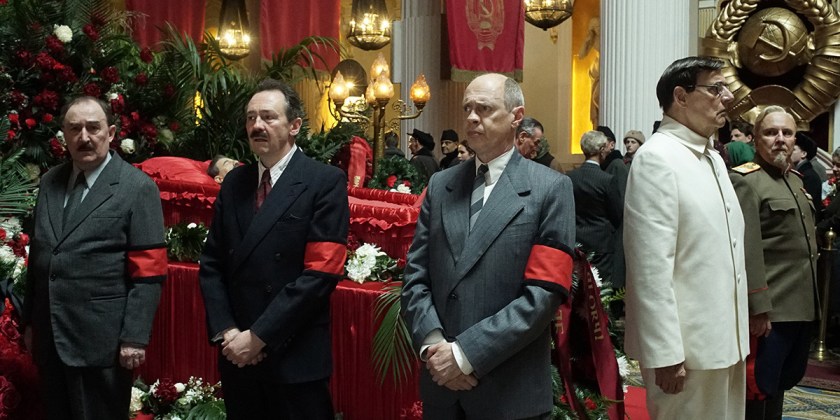
After a rather long hiatus from last directing In The Loop, Armando Iannucci is back with a film about Soviet Russia about the titular death of Stalin and the power battle between his confidante’s that ensues. Iannucci has great flair for coming up with sweary, sophisticated insults with his larger-than-life characters and certainly, the connection between him and Soviet Russia is one that is ripe for invention, strengthened by an A-list cast.

The Death of Stalin begins in barnstorming fashion with a brilliant extended sequence set in a radio station where Paddy Considine’s character is asked by Stalin to hand him a recording of the Mozart concert currently being performed – which bemusingly, he hasn’t been recording it and has to find alternative methods to escape not only humiliation, but more importantly his life. Although nothing can match this superb sequence, there are still some other fairly memorably amusing sequences between its buffoonish characters. The film is really quite dark at times and offers a particularly bleak view of Soviet history. This squanders the overall tone and Iannucci’s film suffers from never being quite mean-spirited or funny enough.

Fortunately, the cast more than make up for Iannucci’s shortcomings. Jeffrey Tambor perhaps gives the best performance as Georgy Malenkov, Stalin’s deputy who clearly seems to be having fun in the role and has some great lines. Simon Russell Beale’s repulsively nasty but humorous head who is in charge of eliminating Stalin’s threats is an equal pleasure of the film, as is Jason Isaac’s sweary Yorkshire-accented Army Chief.

The Death of Stalin is certainly an enjoyable experience which is sophisticatedly funny in parts but suffers from an unbalanced tone and not pushing the boundaries more than what the film could and should have been, based off Iannucci’s past works.

⭐⭐⭐ (Good)


The Snowman (Review)

Uncategorized
snowman

⭐⭐⭐ (Good)

Director: Tomas Alfredson
Starring: Michael Fassbender, Rebecca Ferguson, Charlotte Gainsbourg, Toby Jones, Val Kilmer, J.K. Simmons

Certificate: 15
Run Time: 119 mins

Based on Norwegian crime writer Jo Nesbø’s hit novel and bolstered by a strong director and all-star cast, I found a lot to like in The Snowman despite universally poor reviews. It requires one to totally suspend all manner of disbelief –  plot holes and plot threads that end up being frustratingly redundant are aplenty and the killer’s (unfortunately easy to guess) motives are laughable. It also requires one to overlook a couple of terrible performances from Charlotte Gainsbourg (in particular a laughable sex scene where she merely gyrates on a character momentarily), Val Kilmer and Chloë Sevigny in a dual role. What is entertaining is watching how Michael Fassbender’s alcoholic and unorthodox Detective Harry Hole and his colleagues, including Rebecca Ferguson’s new recruit with a troubled past, attempt to solve a ludicrous case with the film’s overripe premise of a murderer who constructs snowmen as his calling card. The film is also laden with enticing Nordic imagery and some sweeping, atmospheric landscape shots by cinematographer Dion Beebe and an occasionally thoughtful score by Marco Beltrami.

There’s no questioning Tomas Alfredson’s credibility as a director, responsible for Let The Right One In and Tinker Tailor Soldier Spy. Once the first wave of negative reviews began to surface, Alfredson claimed that approximately 10-15% wasn’t shot – this would account for some of the plot holes and it’s clear he’s tried to the best job he can with the resources he’s had. The film sets itself up for a sequel rather explicitly in its final scene which I’m sure will nark people off who have suffered through the film but I’d happily watch another film with Fassbender’s Detective again. There’s a hell of a lot wrong with The Snowman but I’d be lying if I said I didn’t enjoy the sheer absurdity of it all.

⭐⭐⭐ (Good)

Top Five Roger Deakins-shot Films

Uncategorized

MCDVILL EC035

With Blade Runner 2049 out in cinemas and Roger Deakins’ spectacular cinematography within it, I thought now would be a suitable to list my favourite work of his. Deakins is one of the best cinematographers of our time, all of his works rich in memorable imagery and scope. To prove my point, Deakins still hasn’t earned an Oscar for his work despite being nominated 13 times, who along with George J. Folsey, holds the record for the most Oscar nominations for Best Cinematography without a win.  I’m hoping Blade Runner 2049 corrects this crime as he does some fantastic work again and it would be a nice amalgamation of his work if he were to win. Please note that I am not ranking the following films based on their quality, I am ranking them based on the quality of Deakins’ cinematography. Without further ado, here are my Top Five Roger Deakins-shot films:

fargo-1996

5) Fargo 

I really, truly struggled on what to have as my 5th choice. I debated between Prisoners, Skyfall, Kundun and The Shawshank Redemption, I ultimately chose Fargo, one of two Coen Brothers’ films that feature on this list. Not only is Fargo one of their best works, a rich and darkly comic crime thriller with some fantastic performances, it is heightened by Deakins’ awe-inspiring cinematography that perfectly encapsulates the isolated community both through the characters that live within it but also its chilly climate. Out of the five films on this list, this seems as though it was probably the easiest film to shoot but Deakins does so much with so little and manages to attain the sense of a boring, bland habitat of America the Coens wanted to shoot this gem of a film on.

head-photo-e1494267811280

4) Blade Runner 2049

Deakins’ latest project sees him reteam with Denis Villeneuve (the first of two films directed by him on this list) and whilst I have some problems with the film on first viewing, I have no problems with Deakins’ cinematography at all. His work truly elevates the film and distinguishes between the macro and micro elements of the world created. A fight sequence in a theatre is particularly wonderfully staged as is a three-way sex scene. Every single shot by Deakins feels meticulously crafted throughout the film and there are many instances in the film where my jaw dropped in amazement. Deakins was the perfect choice to take over from Jordan Cronenweth’s work on the original and he takes respectful inspiration from him. Surely this must earn him the Oscar this year? (My review here)

sicario

3) Sicario

The second of the two Denis Villeneuve films on this list, Roger Deakins’ work on Sicario is sublime. The film contains some exhilarating action sequences to its merit, the highlight being Deakins’ shooting of what is possibly one of the most intense traffic jams in cinematic history and very creative use of night vision for an action sequence set underground. Deakins is able to distinguish between the binary oppositions of good and bad, light and dark, urban and rural, America and Mexico through his use of lighting and contributes to the panic-inducing, kept-in-the-dark feeling the film manages to sustain throughout its run time. For Deakins’ sake, it’s a shame that The Revenant was released in the same year which cinematographer Emmanuel Lubezki blew all the other nominees out of the water but any other year, Sicario would be a fine winner. (My review here)

54mtduytphs-9lci_2fli6ppcs2ekfbq_h264_3800_640x360_360437827814

2) No Country For Old Men 

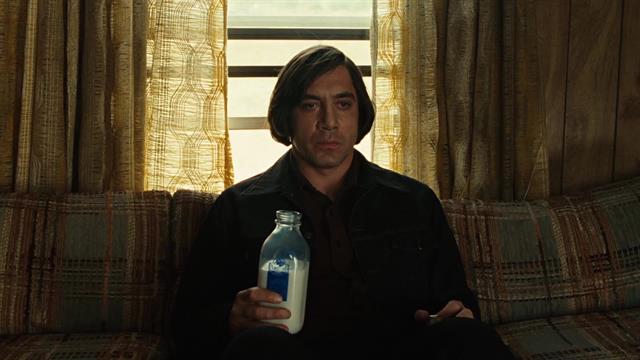
The second of the two Coen Brothers films on this list, No Country For Old Men is Deakins at his best. In this revisionist Western, Deakins beautifully contrasts the light and dark, both physically and metaphorically with the rich and vivid characters portrayed on-screen. There are multiple instances where Deakins’ work is just jaw-dropping, particularly in Javier Bardem’s scenes and an extremely intense shoot-out in a hotel and the surrounding vicinity late on into the film.

8-3

1) The Assassination Of Jesse James By The Coward Robert Ford 

For me, there was never really any competition – my favourite Roger Deakins-shot film is The Assassination of Jesse James by the Coward Robert Ford. Deakins makes maxiumum effect of this Western period setting and his cinematography is dream-like. A train robbery sequence early on in the film at night is simply staggering and Deakins maximises and juxtaposes the use of lights (through lanterns and natural light) and shadows. It’s a very sensory and human experience. Deakins also makes use of his self-titled ‘Deakinizers’, blurred effects around the border of a frame by taking old wide angle lenses and mounting them onto other cameras which really help attain the period feel of the film. Both this film and No Country For Old Men were nominated for the Best Cinematography Academy Award but lost out to Robert Elswit for his work on Paul Thomas Anderson’s There Will Be Blood. This is the film that should have won and not only is the actual film incredibly underrated, this by far is Deakins’ best work.


So there we go, there’s my personal Top Five. It was an extremely tough task and there are a lot of other works of his that are fully deserving to be of mention. What are your opinions of his work? What are your favourite Deakins-shot films? Let me know in the comments or tweet @TheFilmMeister


Blade Runner 2049 is currently playing in UK cinemas 


Loving Vincent (Review)

Uncategorized
loving-vincent

⭐⭐⭐⭐ (Excellent)

Director: Dorota Kobiela & Hugh Welchman
Starring: Douglas Booth, Jerome Flynn, Saoirse Ronan, Helen McCrory, Chris O’Dowd, John Sessions, Eleanor Tomlinson, Aidan Turner 

Certificate: 12A
Run Time: 97 mins

Loving Vincent is the first of its kind – a fully painted animated feature film, about the life of famous painter, Vincent Van Gogh. Every frame (approximately 65,000 of them in the film) has been handpainted on oil canvas by a team of 115 artists, using the same technique as Van Gogh’s art. It’s certainly a bold experiment and a wholly original concept, furthering the parameters of the creative process.

The film follows protagonist, Armand Roulin (Douglas Booth), the son of a Postman (Chris O’Dowd) who delivered and distributed Van Gogh’s famous letters. Ironically, Armand is tasked to deliver Vincent’s final letter to his brother, Theo who famously corresponded via this format. Armand’s journey takes him to Auvers-sur-Oise, a rural town just outside of Paris where Van Gogh had spent his final days.

I must confess I didn’t really know all that much about Van Gogh other than the obvious going in to the film and was unsure if this film was going to be a big gimmick or if it could balance both the technical aspects whilst also working as a film in its own right.

Loving Vincent is quite extraordinary – it is a haunting, elegiac and mournful account of this late artist’s life and the struggles he faced. The film is profoundly humane in the way it portrays him and at times, inhumane in his treatment by other characters in the film. Once Armand arrives in Auvers, the film transforms into a detective-thriller as Armand learns from the citizens what kind of character the artist was and the particulars leading to his suicide. The film also works as a morality tale and has knowing odes to Citizen Kane with the notion of people’s experiences and perceptions of others. There are many scenes that are just perfectly judged and on a technical level, the paintings are spellbinding. The ever-dependable Clint Mansell’s score is also worthy of commendation – it is the glue that holds this film together and features many memorable cues and themes.

The film was originally meant to be live-action before the switch to animation and I think it is to the film’s benefit it originally tried to pursue itself in live-action. The costume design and performances by the film’s cast are superb and in the credits, we get to see what the actors were meant to originally look like and the way this has been realised through the paintings is just magnificent. Douglas Booth, who also appeared earlier last month in The Limehouse Golem, I think gives a career-best performance. He is totally committed to the character and none of Booth’s mannerisms are lost in the paintings. Eleanor Tomlinson and Aidan Turner also standout as two figures of the town as does Jerome Flynn in a pivotal role.

If there’s a problem with the film, the script occasionally feels rather mechanical  and doesn’t particularly feel realistic in terms of what characters say. It’s a minor problem that is not a detriment to the overall film and perhaps another edit would have ironed out this problem.

Loving Vincent is pretty much flawless in all other respects and it is generally a wonderful experience to have. It’s a film that feels so lovingly put together and well-judged and the ghost of Vincent Van Gogh looms over the entire film. We’ll never know exactly what happened but the film offers many plausible opinions but it always has the utmost respect for this artist. Loving Vincent is one of the very best films of the year and has made up for a generally middling Summer.

⭐⭐⭐⭐ (Excellent)