The Exorcist: Believer (Review)

Uncategorized
⭐⭐ (Poor)

Director: David Gordon Green
Starring: Leslie Odom Jr, Lidya Jewett, Olivia O’Neill, Jennifer Nettles, Norbert Leo Butz, Ann Dowd, Ellen Burstyn
Certificate: 15
Run Time: 111 mins

The Exorcist: Believer is the latest in the horror series of variable quality, and is directed by David Gordon Green. Green is no stranger to reinvigorating a horror franchise, having recently overseen a trilogy of Halloween sequels. Halloween (2018) was excellent and demonstrated both Green and Danny McBride (yes, the comedian, who co-wrote the script) understood what made the original work. They should have stopped there though – Halloween Kills was an outright disaster and Halloween Ends took some risks but was ultimately a mixed bag. 

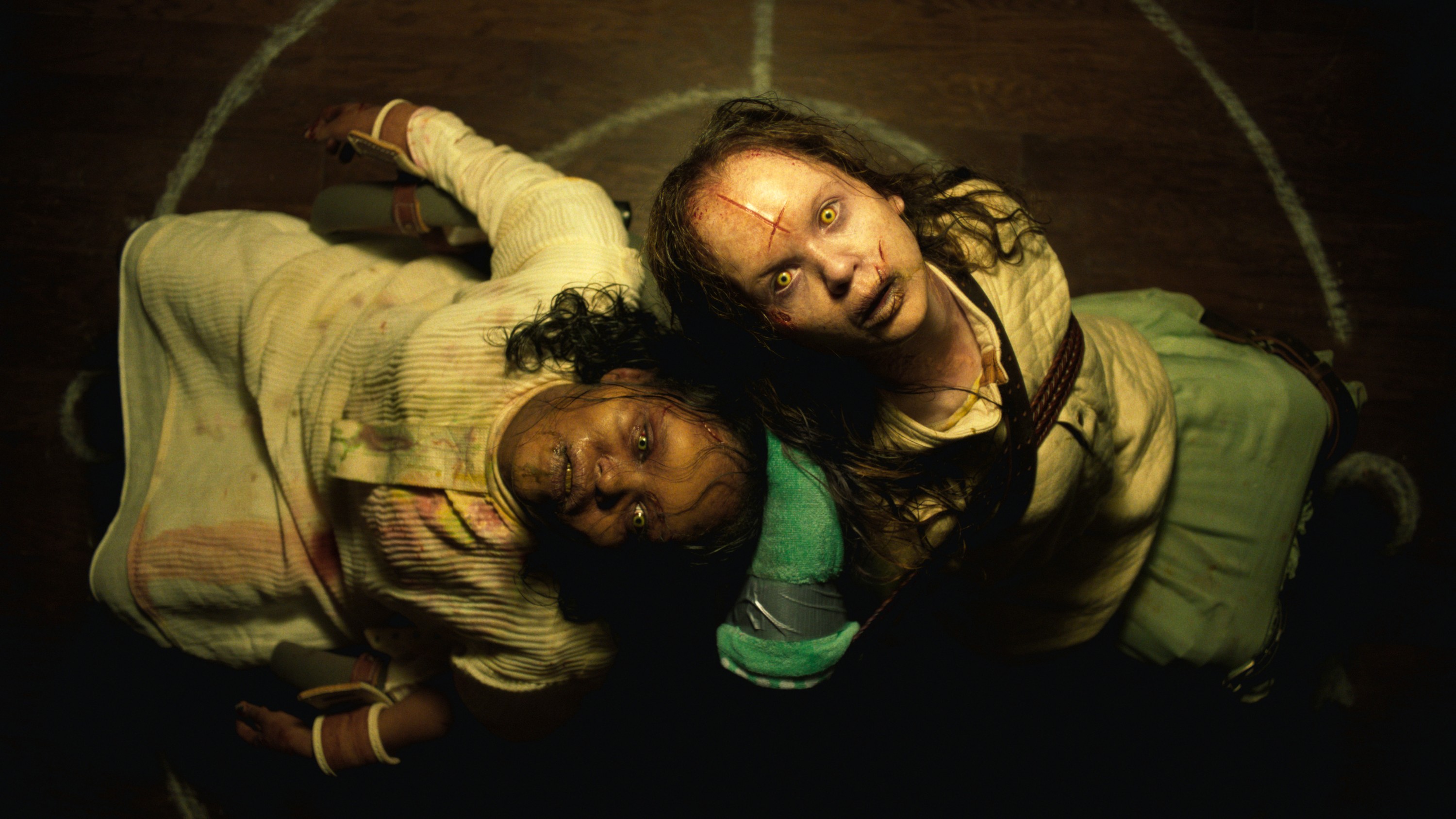
Like Halloween (2018), The Exorcist: Believer ignores all of the other films in the series and functions as a direct sequel to William Friedkin’s 1973 highly influential original. Victor Fielding (Leslie Odom Jr.) is a photographer who loses his pregnant wife in an earthquake. Fortunately, his child, Angela (Lidya Jewett) is saved and the film is set thirteen years later, Victor having lost his faith in God. When Angela wanders into the forest with her best friend Katherine (Olivia O’Neill) to perform a seance to contact her mother, they go missing for three days and once they are found, something is not right… 

The Exorcist: Believer is an ambitious sequel and has a very strong first half. The idea of a child going missing is really well-handled and the investigation is riveting, Green sustaining tension and dread. Green knows he can’t simply transpose what he did with Halloween and apply it to The Exorcist and I really appreciated his decision to take his time in letting the enveloping story breathe. 

Unfortunately, as soon as Ellen Burstyn’s legacy Chris Macneill is introduced into the fray, things go downhill. Any prior subtlety is thrown out of the window and the film is even unintentionally comedic at times. Whilst the idea of a simultaneous possession is interesting, the exorcism finale is second-rate and isn’t scary in the slightest.

The script in general is rather creaky – the story was concocted by Green, McBride and Scott Teems but the screenplay itself was written by Green and Peter Sattler. I couldn’t detect the Danny McBride influence – Halloween (2018) had a sardonic edge to it and this doesn’t. 

The performances are also a mixed bag. Leslie Odom Jr is great as the weary and internalised father, who bottles his anxieties. Both Lidya Jewett and Olivia O’Neill give it a good go as the possessed girls but both could have done with more development prior to their incident. Ellen Burstyn is largely wasted, saddled with large amounts of exposition and some will take umbrage at the story’s treatment of her. The supporting characters are generally underdeveloped and Ann Dowd is surprisingly terrible as Victor’s nurse neighbour. 

On the plus side, the score by David Wingo and Amman Abbassi is excellent and I loved how they developed and varied Mike Oldfield’s Tubular Bells. The film’s also handsomely shot by Michael Simmonds and the sound design is also strong. 

It’s unfortunate Green can’t make lightning strike twice in rejuvenating The Exorcist. Still, there are some interesting ideas here, particularly in the first half, and the film isn’t fully deserving of the critical pummelling it’s receiving. For a film that’s supposed to follow what was supposedly the scariest film ever made, it’s rather tame on release and the exorcism is completely lacking in novelty. 

The Exorcist: Believer is supposed to be the first in a trilogy and I’m sceptical whether it will continue. I suspect it will, given the high $400 million investment fee Blumhouse had to pay for the rights. But it’s rather telling how even Green doesn’t seem to be confident in his own film, seeing as it ends rather neatly without a hint of a sequel’s seeds being sown.

⭐⭐ (Poor)

The Creator (Review)

Uncategorized
⭐⭐⭐ (Good)

Director: Gareth Edwards 
Starring: John David Washington, Gemma Chan, Ken Watanabe, Sturgill Simpson, Allison Janney, Madeleine Yuna Voyles
Certificate: 12A
Run Time: 133 mins

The Creator is an original sci-fi from visionary director Gareth Edwards. Edwards attracted acclaim for his debut feature Monsters, which he shot on a shoestring budget and overlaid the 250 visual effects the film required in his bedroom over footage he had shot on location beforehand. He was quickly tapped to direct Godzilla, which had a fantastic opening only to self-combust in its second half. Edwards then directed Rogue One: A Star Wars Story, which sounded like a stressful project with extensive reshoots close to release. In my opinion, this was to the film’s benefit as the final result struggled with an uneven first act and then found its feet later on. It’d be fair to say Edwards has always been a better visionary than a storyteller and it’s striking that his follow-up to Rogue One arrives seven years later. 

Co-written with Chris Weitz but based on an original story from Edwards, The Creator is set in 2055. After a nuclear warhead is detonated in Los Angeles by an artificial intelligence created by the US government, the US and its Western allies want artificial intelligence eradicated. However, a region in Southeast Asia called New Asia resists attacks from the US and continue to embrace the technology. John David Washington plays Sergeant Joshua Taylor is tasked with returning to New Asia (after previously working undercover with devastating consequences) to locate ‘Nirmata’, New Asia’s chief architect behind its AI advancements.

The Creator is an enjoyable and thoughtful watch, although uneven in its execution. Although the storytelling may be flawed, Edwards has concocted an adventurous narrative and really showcases the most of some breathtaking locations. Edwards has clearly been by influenced Blade Runner, Apocalypse Now and District 9, with infusions of his own war imagery in Rogue One and strangely, Martin Scorsese’s religious epic Kundun. It doesn’t sound like it should work, but it mostly does. Although Edwards doesn’t really make his intentions clear, The Creator seems to perhaps be trying to compare this futuristic fight for humanity to the Vietnam War, suggesting Americans treated the natives as if they were robots. 

Despite the mixed messaging,as you’d expect for a Gareth Edwards film, The Creator is visually stunning with breathtaking cinematography. I was blown away by the fact the film had a $80 million budget – I’d have put it up there with the $250+ million budgets many blockbusters now have. Like Monsters, Edwards proves he’s masterful at dressing up footage with state-of-the-art visual effects. 

Edwards reunites with Greig Fraser, who served as Director of Photography through pre-production only for Oren Soffer to then take over. This film is sure to put Soffer on the cinematographer’s road map. A shot with a security camera guy inspecting footage who is then killed as we witness a solider enter the room on the CCTV recording and kill him is novel, as is a shot from the perspective of a child looking out an escape pod to see an explosion, the camera then dipping downward in the direction of the pod. There’s some phenomenal action sequences too, especially an early raid on a house. 

While the performances are serviceable, Edwards struggles with fleshing out the human characters. John David Washington is decent in the lead role but the character is a bit of a cypher and doesn’t have a lot of charisma. It’s a similar story with Gemma Chan, who is criminally underused. That said, Allison Janney’s a surprise highlight as a cutthroat Colonel and Ralph Ineson also impresses as a domineering General. Newcomer Madeleine Yuna Voyles fares well as the robotic simulate Joshua has to guide to safety.

Hans Zimmer’s score is very fitting at times but I wish the film cut back on some of the diegetic needle drops, which detract from the sombre tone it’s trying to go for. It was interesting to hear the film was originally edited without music, Edwards citing it was to allow the story to flow, with Zimmer being brought in late in post-production. 

Although The Creator’s plot doesn’t flow seamlessly, I appreciated Edwards’ ideas and ambition. It’s a remarkable-looking film and for an original sci-fi like this to exist without ties to existing properties is a miracle in and of itself. Despite its flaws, The Creator is an entertaining ride that has something to say.

⭐⭐⭐ (Good)

Saw X (Review)

Uncategorized
⭐⭐⭐ (Good)

Director: Kevin Greutert 
Starring: Tobin Bell, Shawnee Smith, Synnøve Macody Lund, Steven Brand, Renata Vaca, Michael Beach
Certificate: 18
Run Time: 118 mins

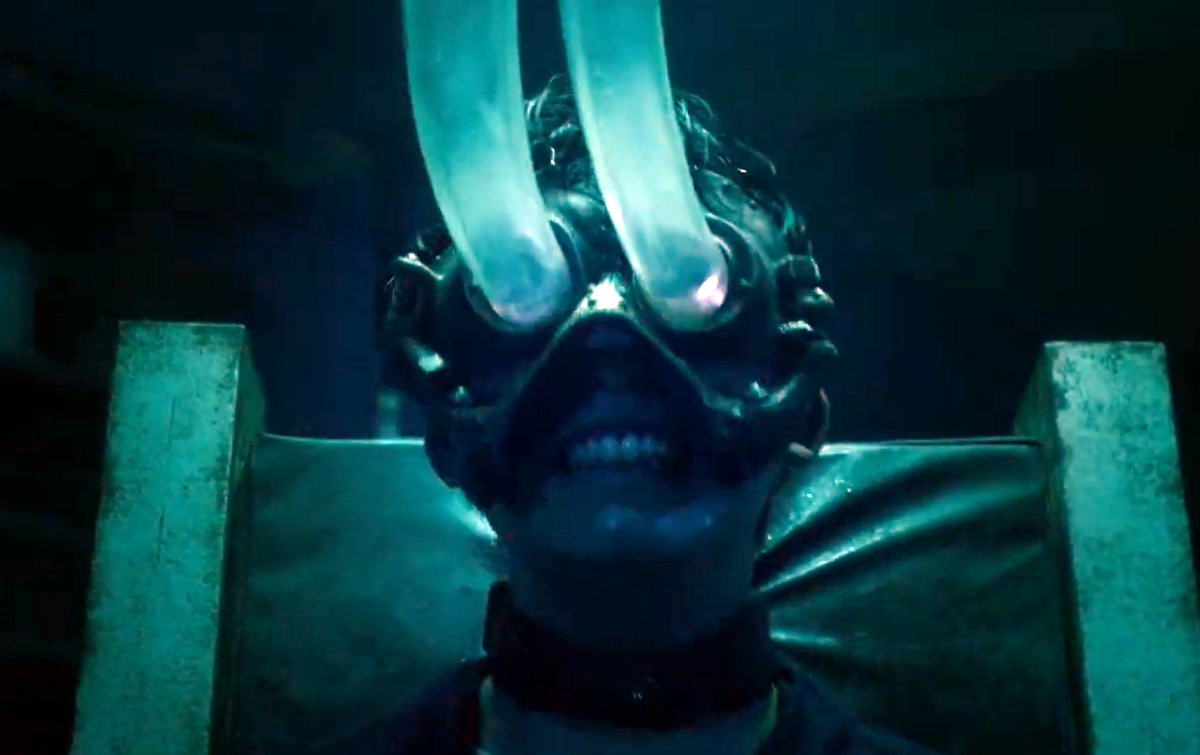
Saw X is the latest in the splatter horror series and a third attempt at a reinvigoration after Jigsaw and Spiral: From The Book of Saw. Ten films in and so far, none have been able to surpass James Wan’s 2004 original. That said, I certainly admired the effort Chris Rock made with Spiral even if it was obfuscated by Darren Lynn Bousman’s poor direction. 

Saw X takes the series back to its roots and is set between the original and Saw II. Despite being the architect of the series, Tobin Bell’s John Kramer is satisfyingly brought front and centre (it only took ten attempts!). Kramer travels to Mexico for an experimental procedure that he hopes will cure his brain cancer. Shortly after surgery, he discovers it all to have been a hoax and he sets on enacting his elaborate and twisted revenge on those responsible. 

The film is directed by Kevin Greutert, who edited the first five entries and Jigsaw. Greutert then went on to direct Saw VI, one of the better sequels which had an interesting commentary on the insurance industry and Saw: The Final Chapter (that title clearly didn’t work out), the worst in the series by quite some distance. Given his mixed track record, can he jump-start the series back to life? 

For the most part, yes. Saw X is quite possibly the best sequel, its success largely based on Bell’s expanded role, a surprising amount of heart and a truly nasty villain. The film satisfyingly takes its time to develop the situation Kramer finds himself in – the first 40 minutes is largely devoid of any traps or violence. This is all to Saw X’s benefit because once we get to the torture sequences, we can surprisingly empathise and understand why an individual that inflicts torture on others does so. Bell is expectedly terrific in the lead role and could play the role in his sleep. 

There’s also a decent amount of development for the con artists and when they meet their match in Kramer, we can also understand their position. This is definitely the turning point for Synnøve Macody Lund’s career. She plays Dr Cecilia Pederson, who leads the experimental cancer treatment group and is one truly vile, twisted individual. 

It wouldn’t be a Saw film without the sadistic traps and it’s a positive to see Greutert return to some of the more simpler traps given this is set between the original and Saw II. Still, the traps work well and are pretty wince-inducing. It is a shame that the traps peak early, with some of them not being as grisly in the final act. 

With the exception of Jigsaw, all the Saw films resort to frenetic editing for the traps, which was often very distracting. While Saw X’s editing isn’t as clinical as Jigsaw, Greutert shows a degree of restraint and encompasses a happy middle ground between the two extremes. 

Charlie Clouser returns to score the film and although he doesn’t do much to shake up the tried-and-tested formula, it works. Nick Matthews is on cinematography duties this time around and shoots the film with a more sepia tone. While Saw X looks fine, it’s not as visually arresting as Spiral.

Saw X is a surprisingly strong tenth instalment to a once-waning franchise. While it doesn’t reach the heights of Wan’s original as it lacks the sheer simplicity of its plot and novelty, it still stands head and shoulders above many of the sequels. The decision to centre the film around Jigsaw is an obvious winner and Greutert deftly develops the characters so that once all the chess pieces are in position, the stakes are well-earned. 

⭐⭐⭐ (Good)

A Haunting In Venice (Review)

Uncategorized
⭐⭐ (Poor)

Director: Kenneth Branagh
Starring: Kenneth Branagh, Kyle Allen, Camille Cottin, Jamie Dornan, Tina Fey, Jude Hill, Ali Khan, Emma Laird, Kelly Reilly, Riccardo Scamarcio, Michelle Yeoh
Certificate: 12A
Run Time: 103 mins

A Haunting In Venice is the latest Poirot property directed and starring Sir Kenneth Branagh, loosely based on Agatha Christie’s 1969 novel Hallowe’en Party. This is Branagh’s third outing as the Belgian detective – Murder on the Orient Express was fine but failed to make the most of its star-studded cast. Death on the Nile better developed its characters but suffered with an ear-scraping script, blatant and distracting green screen and poor pacing. Branagh changes tact for A Haunting In Venice, with a lower $60 million budget and introducing supernatural horror elements.  The film opens with Poirot living in retirement in Venice until mystery writer Ariadne Oliver (Tina Fey) turns up at his door and convinces him to attend a Halloween party. At the party, famous psychic Joyce Reynolds (Michelle Yeoh) is performing a seance and the two plan to expose the medium as a fraud. 

While A Haunting In Venice is a major improvement over Death On The Nile, Branagh sadly still hasn’t managed to quite strike the right chord tonally and the film has its fair share of issues. On the plus side, Branagh tones down his Poirot performance (even the moustache itself this time has shrunk) and seems to have better settled into the role. It’s visually the best-looking film of the trio and is beautifully shot by Haris Zambarloukos, resplendent with Dutch angles. Venice is stunningly captured in the daylight, even if its canals aren’t typically in as pristine a condition as Zambarloukos conveys here. 

Branagh has also ditched his regular composer Patrick Doyle, in exchange for Hildur Guðnadóttir, who won an Oscar for her sensational Joker score. Her string-based score is more effective both of Doyle’s previous efforts, although it’s under-utilised and therefore not developed enough for there to be any distinct and memorable themes. 

A Haunting In Venice is also better paced than its predecessors, coming in at a more economical 103 minutes (the previous entries hovered around the 120 minute mark). While the script, once again penned by Logan and Blade Runner 2049 screenwriter Michael Green isn’t of Academy Award calibre, it’s a stark improvement over Death on the Nile.  

Unfortunately, the horror tinged feel Branagh tries to go for just doesn’t really work – there’s the odd attempt at a jump scare but the film lacks the claustrophobia and the nastiness for it to be truly effective. A Haunting In Venice also has the least interesting mystery of the three films – we know the supposedly supernatural elements can be explained rationally and it all feels a bit tedious having to go through the motions of the mystery to get to the underwhelming reveal. The characters also aren’t particularly well developed, with John Wick: Chapter 2’s Riccardo Scamarcio probably fairing the best as an ex-police officer who acts as Poirot’s bodyguard. Tina Fey doesn’t get a lot to work with and the usually great Kelly Reilly turns in an overly catatonic performance. 

It’s a shame that Branagh still isn’t able to crack the correct formula for a Poirot film. While A Haunting In Venice improves on its predecessors in many ways, particularly with its pristine visuals, it’s let down by its reticence to fully commit to its horror influences and a largely uninvolving story.

⭐⭐ (Poor)

The Nun 2 (Review)

Uncategorized
⭐⭐ (Poor)

Director: Michael Chaves
Starring: Taissa Farmiga, Jonas Bloquet, Storm Reid, Anna Popplewell, Bonnie Aarons
Certificate: 15
Run Time: 110 mins

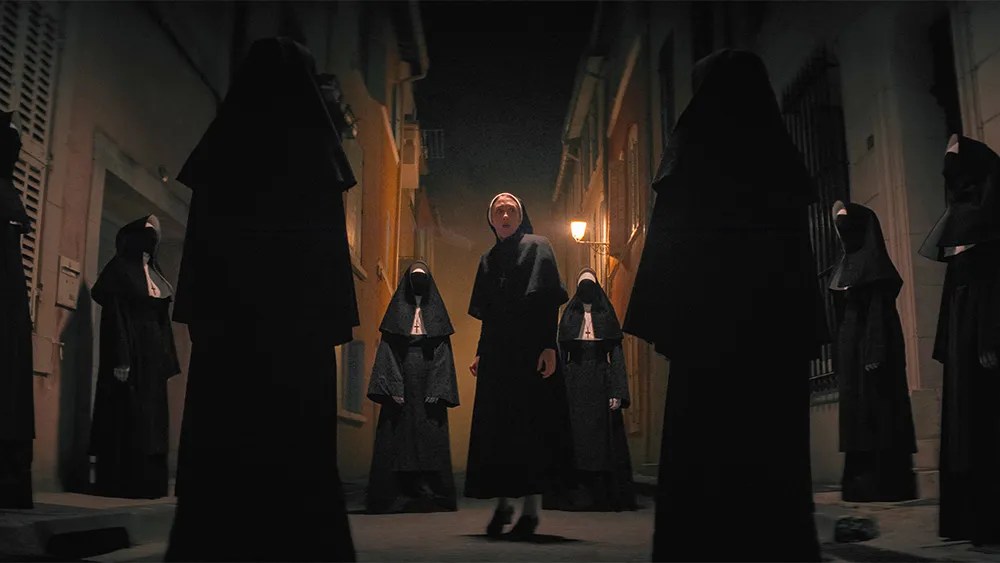
The Nun 2 is the latest in The Conjuring universe and a sequel to the 2018 spin-off. Valak (Bonnie Aarons), the titular demonic nun was first introduced in The Conjuring 2 to chilling effect but despite a talented cast and crew, The Nun was a trainwreck. The film’s jump scares were mechanical and weak, its editing extremely poor and the narrative paper-thin. Its only saving grace was its chilling atmosphere that director Corin Hardy failed to fully utilise. 

Director Michael Chaves helms this sequel, having already two films in the series under his belt – The Curse of La Llorona and The Conjuring: The Devil Made Me Do It. Chaves has proven a solid hand and there was a lot to like particularly with mainline Conjuring effort, but it’d be fair to say his scares are a few rungs below series mastermind James Wan or Annabelle: Creation director David F. Sandberg. 

The Nun 2 is set four years after the events of the first film and moves the action to France. Both Taissa Farmiga and Jonas Bloquet return as Sister Irene and Maurice, with Irene now serving in an Italian convent and Maurice in a French boarding school. Maurice is friendly with a young Irish girl named Sophie (Katelyn Rose Downey) and her mother and teacher Kate (Anna Popplewell). After a priest is brutally murdered in a church in Tarascon, France, Sister Irene is set to investigate with Sister Debra (Storm Reid), a young novice.

The Nun 2 is a much stronger film than the first in the storytelling department but it still suffers from its fair share of problems. Starting with the positives, the film is edited coherently, unlike the first, where the scenes were often so short that the film felt like an extended trailer. Chaves also makes a much stronger effort to develop the characters and put them through an arc, even if they’re still rather generic. It’s also a reasonably good-looking film, slickly shot by cinematographer Tristan Nyby and although it’s not as memorable as it could have been, Marco Beltrami’s score has some exciting moments. Finally, the second half is entertaining in places and the concept of Malignant and M3gan writer Akela Cooper’s story is strong, even if the execution is rather ramshackle. 

Unfortunately, Chaves’ scares aren’t particularly effective and the film’s first hour is quite boring, as Sisters Irene and Debra try to catch up with the fact Valak still lives on in Maurice, which we learned at the close of The Nun. Much has been made of the more gory nature of elements of the film’s horror, but I didn’t find the film particularly violent or blood-curdling at all, even compared with other series entries. 

Although there’s a reasonable amount of ambition in Cooper’s story, the screenplay (Cooper in collaboration with Ian Goldberg and Richard Naing) is clunky. There’s some inexcusable exposition, an all-knowing librarian the nuns meet in their investigation who conveniently happens to know all the particulars of a Macguffin device they need and exactly how to defeat the demon is incredibly lazy. A revelatory line in the film’s climax relating to a mother’s eyes is also unintentionally laughable.  

Several characters are also severely short-changed. Despite a potentially interesting introduction where it is revealed Sister Debra has been sent to the church as a means of escaping the racial hell of 1950s Mississippi, the character isn’t given anything to do.  Anna Popplewell is also surprisingly awful as Kate with an unconvincing Irish accent. 

While The Nun 2 represents an improvement over its predecessor, it’s plagued by mostly ineffective scares, a tedious first hour and clumsy execution of the somewhat amiable storyline. It’s Chaves’ weakest effort in the series and the film’s existence as both a sequel and a prequel to The Conjuring hurts it as we already know the outcome of some of the film’s characters, which lessens one’s investment in the jeopardy they’re faced with. 

⭐⭐ (Poor)

Blue Beetle (Review)

Uncategorized
⭐⭐⭐ (Good)

Director: Angel Manuel Soto
Starring: Xolo Maridueña, Bruna Marquezine, Adriana Barraza, Damián Alcázar, Raoul Max Trujillo, Susan Sarandon, George Lopez  
Certificate: 12A
Run Time: 127 mins

Blue Beetle is the third of four entries in the DCEU this year as it dwindles down prior to James Gunn’s relaunched DCU and is the only film in the quartet to not be a sequel. Directed by Angel Manuel Soto, Blue Beetle is an origin story of the Mexican superhero, effectively a suit with a wide array of armaments.

Jaime Reyes (Xolo Maridueña) returns from Gotham Law school to the fictional Palmera City to  discover his tight-knit family are at danger of losing their home in an increasingly gentrified area. Kord Industries, co-founded by Victoria Kord (Susan Sarandon) effectively rule the city, with Victoria on the hunt for an ancient alien artefact known as the Scarab, so she can develop her own range of law enforcers. Her niece, Jenny (Bruna Marquezine) doesn’t believe in her nefarious intentions and Jaime, who takes a shine to her and is entrusted with keeping the Scarab safe, ends up getting fused with the artefact transforming him into an armoured exoskeleton. Think a Latin-infused Iron Man meets Ant-Man equivalent. When Victoria learns that Jaime has the Scarab, it’s safe to say she wants its out of him and will go to depraved depths to achieve her goal. 

Blue Beetle is a pleasant surprise and by far and away its biggest asset is the amiable family dynamic which although affectionate, is fiercely positive. The characters are generally very well developed and by the half way point when there is a pivotal moment in the narrative, it’s safe to say we’ve really come to care for them. Angel Manuel Soto’s film feels like a fusion of Iron Man, Ant-Man, Spy Kids and Coco and he does a great job of making Palmera City seem like a real place, with its Miami-esque new town juxtaposed against the suburbs that are undergoing gentrification, signifying an economic inequality. The film does a great job of showing you the mansions and the neighbourhood Jaime lives in, and it feels like an actual Central or South American city.  

There’s some thrilling action sequences too with believable CGI, an achievementcompared to the poor visual effects in The Flash or last year’s Black Adam. Although there is a final act battle, I appreciated the film didn’t outstay its welcome, a common problem that plagues a number of superhero films. 

Gareth Dunnet-Alcocer’s script sometimes resorts to cliche but I appreciated the links to present day Latin politics, such as when Jaime’s younger sister, Milagro (Belissa Escobedo) remarks they are invisible to Sarandon’s villain. These lines didn’t feel shoehorned in.

Xolo Maridueña is very charismatic as Jaime, a young adult trying to carve a way for themselves who doesn’t know how to stand out. George Lopez also stands out as Rudy, Jaime’s Uncle, and the comedian brings an excellent level of cynicism and eccentricity. Although Bruna Marquezine initially serves as an expository machine, once her character is absorbed into the Reyes family, she also shines and shares a palpable chemistry with Maridueña. 

It’s just a shame the film is let down by a poor villain. Although Sarandon turns in a nasty performance, the script doesn’t really delve into her psyche. The film could also have been a little edgier, such as incorporating the body horror and resulting sense of disgust of being fused with a foreign entity. 

On the plus side, Bobby Krlic’s score is excellent and he crafts some memorable themes. I was really excited to see how Hereditary and Beau is Afraid cinematographer Pawel Pogorlezski would lens the film. Although the cinematography isn’t quite as innovative as I was hoping it would be. I appreciated him holding onto shots a little longer than is standard

Although it’s not going to set the superhero genre alight, I appreciated Blue Beetle’supbeat energy and it manages to stand out in a crowded genre. The characters are well developed and easy to root for, with the film supported by a class commentary of what it’s like to grow up in a Latin American family. I hope Gunn integrates these characters into the relaunched DCU as it would be a shame to chuck away this film’s good work. 

⭐⭐⭐ (Good)

Gran Turismo (Review)

Uncategorized
⭐⭐⭐ (Good)

Director: Neill Blomkamp 
Starring: David Harbour, Orlando Bloom, Archie Madekwe, Darren Barnet, Geri Halliwell Horner, Djimon Hounsou
Certificate: 12A
Run Time: 134 mins

Gran Turismo is the latest by director Neill Blomkamp, an adaptation of the PlayStation race simulator video game of the same name. It tells the true story of Jann Mardenborough, a devoted teenage gamer who is given an opportunity to turn his racing driver dreams into reality when he is invited to take part in a Nissan-funded competition. This initiative startled the racing world, after all, you can’t just press the reset button if you wreck a car in reality. 

Blomkamp made his name in sci-fi and ever since his startling debut District 9, his career has been on a downward trajectory. The reception to his follow-up Elysium was rather ambivalent and CHAPPiE effectively killed his career, with the director removed from an Alien project. I thought the icy reception to Elysium and CHAPPiE was rather unfair, both brimming with ideas and CHAPPiE, in many ways, represented a bombastic culmination of his work.  

After a six year hiatus, Blomkamp directed the found-footage horror Demonic, which received the worst reviews of his career and now here we are. A video-game-cum-sports-drama seems like an odd fit for the sci-fi director, so how does the film fare?

Despite the underwhelming marketing, Gran Turismo fares surprisingly well. Although formulaic, Blomkamp manages to blend the genres reasonably well and he mostly hits the right notes with an underdog story that’s full of heart. Some of the race sequences are quite tense, if not predictable, although there is an over-reliance on CGI as Blomkamp tries to bridges the gap between Mardenborough racing on the console and on a real track. A late sequence in Le Mans sees the racer visualise he is back in the comfort of his home playing in the simulator, with the car digitally deconstructing around him, which is executed rather clumsily. The film’s generally lacking in subtlety, be it from the clunky script and domineering score by Lorne Balfe and Andrew Kawczynski. 

Best known for Midsommar, Archie Madekwe gives an earnest and grounded performance as Mardenborough. David Harbour’s the highlight, however, as Jack Salter – the hardened, grizzled coach who trains the gamers and effectively forms a surrogate father bond with Mardenborough as the film progresses. Orlando Bloom isn’t brilliant as a slimeball marketing executive, with a wandering accent and hammy delivery, but it doesn’t detract too much from the film. Djimon Hounsou’s reliable as Mardenborough’s footballer father, although it’s a shame the bond between them isn’t further developed. 

It’s also a little disappointing Blomkamp doesn’t inject much of his authorial stamp on the film. Although an early sequence where Mardenborough and his brother head out on a drinking session is set in an industrial, grimy location, it lacks the grit of Blomkamp’s other work. It also feels uncharacteristic of Blomkamp to lack an over-the-top villain, although Bloom is the closest-fitting performance. 

Still, the fact Gran Turismo has received mixed-to-positive reviews can only be beneficial for Blomkamp to getting back to his sci-fi roots if it acts as a stepping stone. Although it’s content to not reinvent the wheel, I had fun with Gran Turismo and it tells a reasonably gripping story. It’s a lot better than it has any right to be by racing video game standards – one only needs to cast their mind back to Need For Speed or Speed Racer.

⭐⭐⭐ (Good)

Oppenheimer (Review)

Uncategorized
⭐⭐⭐⭐⭐ (Perfect)

Director: Christopher Nolan
Starring: Cillian Murphy, Emily Blunt, Matt Damon, Robert Downey Jr, Florence Pugh, Josh Hartnett, Casey Affleck, Rami Malek, Kenneth Branagh, Benny Safdie, Jason Clarke,
Certificate: 15
Run Time: 180 mins

Oppenheimer is the latest by Christopher Nolan and nominally a biopic on the father of the atomic bomb. Although $100 million is a relatively high budget, it’s his smallest film since The Prestige. Inspired by the 2005 novel, American Prometheus, the film opens on exploring Oppenheimer’s (Cillian Murphy) early academia life, his recruitment by Leslie Groves (Matt Damon) and direction of the Manhattan Project to the 1952 security hearing which cemented his fall from grace.

As you’d expect, Nolan doesn’t stick to storytelling convention and Oppenheimer is told in a non-linear fashion.  The colour sequences (titled ‘Fission’) are from the perspective of Oppenheimer and the black-and-white sequences (‘Fusion’) from Lewis Strauss (Robert Downey Jr.), the driving force of the revoking of Oppenheimer’s security clearance.

Whilst Nolan is one of, if not my favourite working director, neither Dunkirk or Tenet rank among his best work for me and both left me feeling empty. I was worried Oppenheimer was going to fall into the same camp (and was prepared to lay the blame on Kenneth Branagh who features in all three) but luckily, my apprehension was unfounded. 

Oppenheimer is a tension-fuelled, thought-provoking minor-key masterpiece and is straight up there with Nolan’s best work. It’s an incredibly rich piece of work and it left me feeling stone-cold with its characters haunting deliberation over the consequences of their work. This is a largely dialogue-heavy film for its lengthy three hour running time and except a breathtaking sequence depicting the Trinity test (even more impressive considering the minimal CGI), is largely bereft of action. 

The script is brilliantly written (although I’m sure some will take umbrage that the characters speak like Nolan), constantly ramping in tension and Jennifer Lame’s editing is a monumental achievement. This is a film that will be studied in academia and Nolan cleverly first portrays fragments of a scene to then revisit and develop the image later on is a stroke of genius. Many filmmakers make the mistake of telling rather than showing but Nolan has always treated his audience as being intelligent. 

Cillian Murphy has often represented one of the mechanisms to a successful Nolan film, and steps up to the lead role for Oppenheimer. His performance is simply sensational and a career-best. He conveys many of the emotions Oppenheimer is feeling in any given moment with his facial expressions, his mannerisms note-perfect. I particularly appreciated how Murphy’s demeanour changes when the character realises the consequences of his actions.

It’s not all Murphy’s show and Oppenheimer is stacked with A-list actors. Emily Blunt puts in a terrific performance as the pioneer’s wife, Kitty and Robert Downey Jr is surely going to be Oscar-nominated for his slippery, yet atypical portrayal of Lewis Strauss. 

Elsewhere, Josh Hartnett is great as Ernest Lawrence, a scientist who regularly reminds Oppenheimer “theory will only take you so far” and Benny Sadie is another highlight as  charismatic Hungarian theoretical physicist Edward Teller.  Tom Conti quite literally becomes Albert Einstein and Gary Oldman makes for a chilling President Truman in a memorable scene. I mentioned earlier Kenneth Branagh being the weak point of both Dunkirk and Tenet but he’s great as Niels Bohr, who was an influential influence on Oppenheimer in his early studies. 

The film is beautifully shot by now-Nolan regular Hoyte van Hoytema and Ludwig Göransson’s score is the glue that holds the film together. Both the sound and music are a character in themselves, Göransson’s predominantly string-based score unnerving and beautiful – I will be very surprised if there is a better soundtrack in cinema this year. Some have complained it’s overused but I disagree and the moments where there is silence on the screen are only made more impactful. Many have also criticised the sound mixing on some of Nolan’s past work, in that the sound can often drown out the dialogue, but I didn’t have a problem with it here and it only heightened the drama unfolding on-screen. 

Oppenheimer is a masterpiece in Nolan’s already remarkable career and an unconventional but bold take on the biopic genre. This is especially impressive considering many recent biopics released in the last decade or so have suffered from being formulaic. Effectively Nolan’s JFK, Oppenheimer is not only a riveting and fascinating deconstruction of the nuclear mastermind but an emotional wallop.

Much of what cements Nolan’s best works as cinematic classics is their rewatchability and having seen Oppenheimer twice, I want to see it again. It’s a film so dense and rich that you’ll pick out a new detail each time you revisit it and the three hour length passes by in a flash. In a summer where we’ve had disappointments such as The Flash and Indiana Jones and the Dial of Destiny, which have been ugly, big-budget sequels that tarnish their legacy, Oppenheimer has restored my faith in cinema. It’s one of the best films of the year and a must-see. 

⭐⭐⭐⭐⭐ (Perfect)

Barbie (Review)

Uncategorized
⭐⭐⭐ (Good)

Director: Greta Gerwig
Starring: Margot Robbie, Ryan Gosling, America Ferrera, Kate McKinnon, Michael Cera, Issa Rae, Rhea Perlman, Will Ferrell
Certificate: 12A
Run Time: 114 mins

Barbie is the hotly anticipated live-action film centred around the familiar Mattel doll. The film is directed by actress and screenwriter Greta Gerwig, who is two-for-two with the coming-of-age dramas Lady Bird and Little Women. Both of her efforts were polished and insightful character studies, with Lady Bird having a particularly strong impact with its hard-hitting portrayals of loneliness, depression and uncertainty.  

This decidedly bigger-budget film sees Stereotypical Barbie (Margot Robbie) reside in Barbieland, a matriarchal society where all women are self-confident and successful. Meanwhile, their Ken counterparts spend their days lounging around the beach. Beach Ken (Ryan Gosling) takes a particular shine to her, but Barbie rebuffs him in favour of her independence. 

One day, she is suddenly overcome with worries about mortality and visits Weird Barbie (Kate McKinnon) for advice. Weird Barbie advises her to visit the real world and find the child who is playing with her to remove these feelings. Things, however, take a twist when Barbie discovers Ken stowed away in the convertible as she drives towards reality. 

Barbie has a well-paced and energetic first half. Unfortunately, the latter half struggles in incorporating too many ideas are thrown and I found its message overly preachy. Starting with the positives, Gerwig explores some interesting themes, including existentialism and the impact both Barbie and Ken have had on modern culture. There are obvious references to Groundhog Day, Toy Story, The Wizard of Oz and The Lego Movie in its storyline and I also appreciated Gerwig’s personal and loving nods to her Sacramento roots, which also worked wonders for Lady Bird. Despite its 12A rating, Barbie isn’t particularly suitable for children and I suspect most of the themes and jokes will go over their heads. 

There’s some great performances here too. Margot Robbie is perfectly cast as the titular character, deftly balancing the likeability, humour and pathos needed for the crisis she undergoes.  Even Helen Mirren’s satirical narration points to her suitability. 

Ryan Gosling’s an excellent match for Robbie, who explodes with charisma but also convinces in the character’s darker moments. We already know Gosling can sing well from his Oscar-nominated turn in La La Land and he has a phenomenal sequence in the film’s final act called ‘I’m Just Ken’.  Other highlights include Rhea Perlman as Ruth Handler, Barbie’s creator and Mattel co-founder and Simu Liu shines as an alternative Ken who belittles Gosling. 

It’s a shame Will Ferrell is rather wasted in what is essentially a reprisal of his role from The Lego Movie as the CEO of Mattel. All of the character’s jokes felt forced and distracted from the focal relationship between Barbie and Ken.

Barbie also looks top-notch for its relatively high $145 million budget, with excellent production and costume design. The film is lusciously shot by Martin Scorsese-regular Rodrigo Prieto with its bright and vivid colour palette. 

The film’s second half just didn’t work for me. It introduces too many ideas and ties itself in knots and it struck me as preachy in tone. In fact, there is one character who delivers an extended speech late into the film about what it means to be a woman in current society which although inspirational, is incredibly heavy-handed. It doesn’t leave any room for nuance whatsoever. While its exploration of gender is interesting on the surface, the resolution the film ultimately reaches borders on unsettling and sexist. 

Barbie is the first film to be directed by Gerwig where she has collaborated with another individual on the script, in this case her partner and fellow filmmaker Noah Baumbach. While I can tolerate Marriage Story, I’ve not been a fan of the vast majority of Baumbach’s filmography. That lots of Barbie’s humour didn’t work for me, nor did it seem to work for large swathes of the audience in the packed cinema screening, suggests his contributions to the script are why the film falters. The film feels as if Gerwig was in charge of the film’s first half, with Baumbach piloting the second, although this isn’t necessarily the case. 

Ultimately, Barbie is a real mixed bag with a fun and energetic first half that then fizzles out. There’s a lot to admire, especially the performances, visuals and the fact Gerwig has effectively created a feminist fantasy comedy under the guise of a corporate property. It’s just a shame it cannot hold its momentum throughout and the film would have worked a lot better if it had dropped some of the themes and tangents it takes in its second half. 

⭐⭐⭐ (Good)

Insidious: The Red Door (Review)

Uncategorized
⭐⭐⭐ (Good)

Director: Patrick Wilson
Starring: Ty Simpkins, Patrick Wilson, Sinclair Daniel, Hiam Abbass, Rose Byrne
Certificate: 15
Run Time: 107 mins

Insidious: The Red Door is the fifth instalment in the highly profitable series and actor Patrick Wilson’s directorial debut. Director James Wan and writer Leigh Whannell kickstarted the series in 2011, with Insidious attracting a positive critical reception and banking a cool $100 million from a $1.5 million budget. Wan and Whannell are still on hand in a producing capacity, with Whannell also contributing to the story along with Halloween Kills’ Scott Teems. 

The film is set nine years after the events of Insidious: Chapter 2, returning back to the Lambert family who fronted the first two films. Both the highly underrated Insidious: Chapter 3 and the disappointing Insidious: The Last Key were prequels and largely focussed on Lin Shaye’s charismatic psychic Elise Rainier. It’s impressive how even five films in, there is yet to be an outright bad entry, which you can’t say about many other horror franchises. 

Insidious: The Red Door opens on the funeral of Lorraine Lambert (Barbara Hershey) and we learn shortly after that both Josh (Patrick Wilson) and Renai (Rose Byrne) are now divorced. It’s time for 19-year-old Dalton (Ty Simpkins) to head to college and Josh attempts to heal their strained relationship by driving him to college. Of course, it wouldn’t be an Insidious film without a venture into The Further, the vast and dark dimension where many souls are damned to remain forever, instigated by Dalton’s first college art class.

While in many ways, Insidious: The Red Door is a step-up from the disappointing fourth instalment, Patrick Wilson’s directorial debut is a mixed bag. It’s quite different from its predecessors, and all the better for it, in that it’s a drama film at its core rather than a horror. Although it’s been done plenty of times before, Wilson successfully crafts a gripping family dynamic and takes his time with the characters. The first two acts are very much a slow burn and I particularly appreciated the small detail, for example, of a father struggle to know what to write to his son via text message. Wilson deftly explores the theme of generational trauma and to some extent, it provides a satisfying closure to the Lambert family’s story. It’s not perfect – an extended sequence in a frat house simply doesn’t belong in the film – but you have to admire Wilson’s ambition to take the series in a different direction. 

There’s some excellent performances here too. Ty Simpkins makes for a gripping lead as the brooding Dalton, who struggles to fit in with his family and society. Patrick Wilson’s also reliably brilliant as the weary, worn-down father who doesn’t want to repeat history with his own family that’s held him back. Newcomer Sinclair Daniel is also great as Chris, Dalton’s charismatic college roommate who befriends him, although one does need to suspend belief a little at her choice to remain with him in certain scenarios. 

The film’s competently shot by Autumn Eakin too, an inverted opening shot of a gravestone particularly effective in setting the dour opening. 

Unfortunately, where Insidious: The Red Door falls short is its sudden rush to the finish and the film falling short as a horror. After the admirable first two acts, the venture back into The Further is unsatisfactorily rushed for the story Wilson’s trying to tell. 

This is by far, the least scariest film in the franchise and while there are perhaps two intriguing ideas, the jump scare itself is poorly executed. Both Wan and Whannell understand the art form of how to achieve an effective jump scares with their Insidious entries and Wilson fails in establishing a tension. The Red Door also seems to undermine the previous film’s logic as to how The Further operates, which I found quite frustrating. 

Although returning composer Joseph Bishara reuses uses some of his effective original themes, the score is overused and certain sequences, such as Josh walking out of Dalton’s room in an upset state, would have been more impactful without music. A scene featuring Josh and Dalton attempting to converse in a car also doesn’t really land an impact as the dialogue is drowned out by a backing track.

While Insidious: The Red Door has its fair share of problems and doesn’t reach the heights of the first three films, there’s still plenty to admire here. I liked Wilson’s attempt at a familial exploration and the cast are all game for it. It’s a shame the horror elements of the film are weak and a rewrite would have been the only logical solution for the underwhelming and rushed finale. On an initial viewing, I think The Red Door has more going for it than The Last Key and although deeply flawed, this fifth (and supposedly final) entry into the enduring series has some bright spots. 

⭐⭐⭐ (Good)