Director: Jonathan Glazer Starring: Christian Friedel, Sandra Hüller Certificate: 12A Run Time: 105 mins
The Zone of Interest is director Jonathan Glazer’s new film, an uncomfortably long eleven year wait after Under The Skin. Loosely adapted by a 2014 Marin Amis novel of the same name, Glazer became intrigued by the book prior to being published. The novel tells the story of Rudolf Höss, the longest-serving commandant of the Auschwitz concentration camp, where he lived with his wife Hedwig (Sandra Hüller) in what they perceived as their idyllic home. Small catch – the garden wall with barbed wire atop it is shared with Auschwitz.
Through extensive research into the Hösses, Glazer pieced together what their life looked like during the time they lived outside the camp through examining testimonies provided by survivors and individuals who had been employed in the household. It’s certainly commendable that Glazer has poured so much passion into a project and given how Sexy Beast, Birth and Under The Skin all occupy completely different genres, can he inject his magic into this dark point of history?
The Zone of Interest is a fiercely original work from Glazer that’s uncomfortable viewing and really gets under your skin. The film possibly represents the most important use of sound I can think of in quite some time – the sound of the droning concentration camp with its whirring machinery is ever-present during mundane conversation and day-to-day life. Glazer never shows us the atrocities inside the camp and what we hear beyond the frame is another film in itself. I loved the surreal elements too, particularly a storyline shot with thermal cameras.
The film is initially quite light on story but we start to learn more about and then follow Höss’ career as it progresses. Christian Friedel is sensational as the despicable SS officer – a cold, calculated yet frank and career-driven individual. His whole life becomes an obsession into how fast he can kill and there’s an everyday quality to the terrible schemes he is complicit in, which makes the film all the more chilling. A scene where gas chamber designs are discussed akin to the design for a car is particularly effective.
Sandra Hüller, so brilliant in Anatomy of a Fall(another Academy Award for Best Picture contender this year), is arguably even more despicable than her husband. She is deeply attached to their home and doesn’t think her life can be bettered. It doesn’t take a lot for her to lose her temper, with chilling threats of violence or death to the rotating roster of Jewish housemaids.
The film is masterfully shot by Loving Vincent and Cold War cinematographer Łukasz Żal, an incredible shot of a chimney through a window that’s reflected on the glass will forever be ingrained in my memory. Mica Levi’s score, although sparse, is also deeply effective. Save for two doom-laden tracks at the beginning and end, the rest of the film uses more of a soundscape except for a recurring motif during the surreal sequences.
The Zone of Interest is a fascinating work in Glazer’s career, despite its cold and intentionally bad taste that will leave you thinking long after the credits have rolled. The performances, cinematography and sound are all top-drawer and the innovative use of sound alone is reason to experience this film on the big screen. I’d quite like to see it again as I suspect it will improve on a rewatch.
Director: Matthew Vaughn Starring: Bryce Dallas Howard, Sam Rockwell, Bryan Cranston, Catherine O’Hara, Henry Cavill, Sofia Boutella, Dua Lipa, Ariana DeBose, John Cena, Samuel L. Jackson Certificate: 12A Run Time: 139 mins
Argylle is a spy action comedy by Matthew Vaughn, a director whose works often subvert their respective genres. Kick-Ass rejected the-then comic-book codes and conventions with its gleeful tone and Kingsman: The Secret Service was a raunchy and gory ultraviolet spy film. Even his less overtly subversive films have proven successful, with X-Men: First Class rejuvenating the X-Men series with its smart script. Like his Kingsman films, Vaughn takes another stab at the espionage thriller with Argylle.
The film follows reclusive spy novelist, Elly Conway (Bryce Dallas Howard) who has found wild success with her Argylle book series. While she’s journeying to her mother, Ruth (Catherine O’Hara), she is saved from an attempted ambush by Aidan (Sam Rockwell), an actual spy who explains that she is being targeted by an organisation known as the Division, because her novels seemingly predict the future.
While Argylle’s fresh concept in how it explores how a writer might see their creation come to fruition is to be commended, Vaughn’s latest isn’t his best work. It lacks the kinetic energy of his other films and the numerous twists don’t always work – the last act really ties itself in knots. Jason Fuchs’ script is on the wooden side and isn’t particularly funny. The score by Lorne Bale isn’t particularly memorable either and while there’s the trademark colourful pop to George Richmond’s cinematography, the film’s aesthetic has an artificial quality.
None of the action sequences stand out either, arguably what should be the most thrilling element of a spy film. Vaughn’s last film, The King’s Man(a prequel to the mainline films) was also more a more inert effort but it at least had one memorable fight half-way through, which the rest of the film failed to top.
The more family-friendly 12A rating really tames proceedings and what really propelled both Kick-Ass and Kingsman was its rejection of having to pander to a wide audience. While both Stardust and X-Men: First Class prove Vaughn is more than capable of crafting works with brain, as well as brawn, when toning his sensibilities down, Argylle just doesn’t quite succeed.
There’s still some fun to be had though. Bryce Dallas Howard is excellent as the introverted author, who just wants the easy life and her home comforts. Samuel L. Jackson is also reliably brilliant and delivers most of the film’s limited laughs, particularly as he’s waiting to receive a file. It’s nice to see Catherine O’Hara, who is more selective in the roles she accepts these days and Bryan Cranston is also clearly having fun. While Sam Rockwell’s reliably charismatic and likeable, the role seemed like a slight waste of his talents and could have been played by someone else. Other than sporting a striking flat-top haircut, Henry Cavill fails to make much of an impression as the titular Argylle.
Ultimately, while there’s fun to be had in the film’s first two thirds, Argylle fails to make the most of its unique concept. It’s lacking in energy in its forgettable action sequences and the film falls apart in its third act. Argylle would have been a stronger work if it had further dived into the fantastical nature of how a writer might imagine their world and if it wasn’t constrained by its more accessible age-rating. A frustrating post-credits scene promises we are going to see more of this world and I hope Vaughn returns to the drawing board and re-evaluates this film’s shortcomings.
Director: Alexander Payne Starring: Paul Giamatti, Da’Vine Joy Randolph, Dominic Sessa Certificate: 15 Run Time: 133 mins
The Holdovers is the new Alexander Payne film and his first since 2017’s Downsizing. While Downsizing received a mixed reception, I found a lot to like in it, especially its ambitious first half. I certainly vastly preferred it over Nebraska, which was nominated for six Oscar’s in 2014 and never understood the love for it.
The Holdovers reunites Payne with his Sideways lead Paul Giamatti who stars as Paul Hunham, a strict classics teacher at Barton Academy, a New England boarding school that he attended back in his youth. Hunham is a curmudgeon and is despised by the students and most of his fellow teacher. In one of the film’s first scenes, we hear him happily humming when he dishes out some bad grades to his students. After Hunham gives an important donor’s son a failing grade, as punishment, he is forced to supervise the ‘holdover’ students left on campus over the holidays. One such student includes Angus Tully (Dominic Sessa), whose mother has abruptly cancelled a family holiday to go on a honeymoon with her new husband. Hunham and Tully are both at each other’s necks but soon learn to tolerate each other – it’s a familiar comedy set-up.
The Holdovers is Payne at his best and is a tender delight from start to finish, but it deftly balances its warmth with a bittersweet tone. The performances are terrific all around, especially Giamatti, and the film perfectly evokes classic 1970’s cinema with its intentionally rustic aesthetic – it looks and feels like a work made at the time. It’s beautifully shot by In Bruges cinematographer Eigil Bryld, especially the wintry landscapes during the opening credits and some disorienting frames that feature late into the film. The Holdovers marks the second film of Payne’s career that he doesn’t write, with David Hemingson taking the reins in his feature length debut. And what a strong impression Hemingson makes with the sharp, peppery script, with Hunham’s eloquent insults especially rib-tickling.
Paul Giamatti turns in what I’d probably consider a career-best performance as Hunham. Hunham is both lovable and loathsome and an easy character to relate to with the hardships he’s faced in life. In fact, there are many similarities between Hunham and Miles Raymond, the character Giamatti plays in Sideways, both characters that have been hard done-by in life. Giamatti rarely takes leading roles and he showcases just what an underrated screen talent he is, from his line delivery to his mannerisms and lazy eye. He fully deserves all the Awards praise he is receiving and possibly even the win.
Dominic Sessa is also electrifying in his debut performance as Tully, who’s also faced a difficult upbringing and is able to begin to relate to Hunham as the film progresses. Da’Vine Joy Randolph is another highlight as Mary Lamb, the school’s head cook who also stays over the holidays to mourn her recently deceased son. Watching Hunham, Tully and Mary interact and come to grips with their situation as the film progresses is incredibly satisfying and it’s hard to not to watch the film with a grin on your face but Payne balances this with the story’s darker undertones.
I absolutely loved The Holdovers and was completely swept up by the film throughout, with its intelligent script and committed performances. It’s Payne’s best film since Sideways and I predict it will become a Christmas classic, with its perfectly judged bittersweet tone. They certainly don’t make films like this anymore.
Director: Yorgos Lanthimos Starring: Emma Stone, Mark Ruffalo, Willem Dafoe, Ramy Youssef, Christopher Abbott, Jerrod Carmichael Certificate: 18 Run Time: 142 mins
Poor Things is a science fiction romantic comedy by Yorgos Lanthimos, who’s had an impressive career so far. Dogtooth was my first introduction to the fiercely original director and he went on to hone his craft with The Lobster, which was terrific and the even-better The Killing of a Sacred Deer. I wasn’t so hot on The Favourite, which garnered ten Oscar nominations, with Olivia Colman picking up the Best Actress gong. Whilst there’s no doubt it was also bawdily original, it was the first film to not be written by Lanthimos and it showed, lacking his signature arch dialogue.
Poor Things is an adaptation of the 1992 Alasdair Gray novel, a Frankensteinian tale of a woman, Bella Baxter (Emma Stone), whose brain has been replaced by that of her unborn baby, giving her a child-like mind, by the eccentric surgeon Dr Godwin Baxter (Willem Dafoe). Like a child, Bella’s brain rapidly develops and becomes more physically and mentally agile. One of Godwin’s students Max McCandles (Ramy Youssef) quickly falls in love with her and Bella accepts his hand in marriage but then soon runs off with debauched lawyer Duncan Wedderburn (Mark Ruffalo) on a grand journey around Europe.
Poor Things is Lanthimos back on track with a brilliantly twisted, uncomfortable yet multi-layered triumph. There’s so much going on here, both from a thematic and visual standpoint and it’ll take multiple rewatches to fully understand its message but it’s a film that gets better on each viewing. Lanthimos recaptures his bizarre yet oddly moving tone, which is what made his earlier efforts really shine, combined with lavish yet evocative production design. Robbie Ryan’s cinematography is a career-best, with every frame a painting worth pausing to analyse, which is interesting considering some of his work can be quite vanilla. The film boldly experiments with colour and perspectives are often shot through a fish-eye lens and it’s supported by the lavish production design. I also loved the retrofuturistic vision, with the Victorian London setting contrasting with succeeding elements.
The script by Tony McNamara is witty and sharp, with many laugh-out-loud and quotable moments, although it does somewhat lack the arch nature of Lanthimos’ writing. There will always be a part of me that wonders what could have been if Lanthimos had contributed.
Emma Stone turns in a career-best performance as the Frankenstein-like Bella Baxter, who opens the film as an inquisitive and brash child and ends as a self-made woman. I’ve sometimes struggled with her performances in the past and couldn’t believe she won the Best Actress Oscar for La La Land but not so here. Willem Dafoe is also reliably brilliant as the eccentric surgeon, who has to belch bubbles at the dinner table due to a health condition. Mark Ruffalo provides much of the comic relief as Wedderburn, who becomes increasingly child-like as the film progresses, although his British accent is rather wandery.
Jerskin Fendrix’s score is terrific and deeply effective, in keeping with the film’s bizarre tone yet crescendoing at key moments. It’s one of the most original works I’ve heard in a while and is fully deserving of its Awards praise.
Poor Things is an absolute riot and packed full of details to analyse on further viewings. It’s Lanthimos on top form and stuns with its distinctive performances, script, visuals and score. The Killing of a Sacred Deer remains his best work, in my opinion, but Poor Things is fully deserving of its praise and is a sensational experience to begin the year.
Director: J. A. Bayona Starring: Enzo Vogrincic, Matías Recalt, Augustín Pardella, Felipe González Otaño, Luciano Chatton, Valentino Alonso, Francisco Romero, Agustín Berruti, Andy Pruss, Simón Hempe, Juan Caruso, Esteban Bigliardi, Rocco Posca, Esteban Kukuriczka, Rafael Federman, Manuela Olivera, Agustín Della Corte, Tomas Wolf Certificate: 15 Run Time: 144 mins
Society of the Snow is a survival thriller centered around the 1972 Uruguayan Andes plane crash where a commercial plane crashed in the mountains and 16 of the 45 passengers managed to survive over nearly three months by resorting to cannibalism. It’s directed by Spanish filmmakerJ. A. Bayona, behind films such as The Orphanage, The Impossible and A Monster Calls, all of which received heaps of praise. While there’s elements to be admired in all, I do think he’s vastly overrated. In fact, controversially I’ve probably enjoyed Jurassic World: Fallen Kingdom the most out of his work, even though the film received mixed reviews, perhaps because I went in with very low expectations and I appreciated the original horror elements.
Bayona’s got experience with the disaster film genre with The Impossible, a film which was set during the 2004 Indian Ocean tsunami. Although The Impossible has many tonal issues, Bayona adeptly recaptured the visuals of the tsunami. Surely Society of the Snow is a surefire hit, considering he’s working with particularly riveting material?
Sadly not. While Society of the Snow has a nail-biting first half-an-hour leading up to the crash, the rest of the film is a misguided mess. The film is strangely overlong and inert of energy for a film about trying to stay alive and Bayona fails to convey the literally chilling atmosphere of the snow-covered mountain. The victim’s clearly aren’t wearing very many layers but at no point in the film do they look desperately cold and by the time we reach the film’s end, they don’t look overly malnourished considering they’ve lived off human flesh for the best part of three months. Bayona’s depiction of cannibalism fares better though, and it was enough to put me off the thought of eating meat for a couple of days after viewing, even if the human meat looks distinctly like prosciutto ham.
After retrospectively researching the details of the disaster, how lazy is it that Bayona omits the fact the plane first landed in Mendoza for a stopover due to a storm. The crew decided to wait for meteorological conditions to improve and apparently made a difficult decision to delay the flight initially until gone 14:00. Bayona’s deliberate act to omit the decision between flying or not is very odd, considering it’s the reason why the event unfolded the way it did.
The cast is composed of Uruguayan and Argentine actors, most of whom are newcomers. While there’s some good performances, such as Enzo Vogrincic as the ill-fated Numa Turcatti, unfortunately Bayona fails to develop any of them meaningfully. Although there are too many characters to fully visit all of them throughout the 144 minute run time, Bayona would have fared better picking two or three as the audience’s segue into the disaster.
Bayona reteams with his Jurassic World: Fallen Kingdom composer Michael Giacchino, and this is the music maestro’s first foreign language feature. At his best with films such as Up, Inside Out and War for the Planet of the Apes, Giacchino is a very exciting composer but he also has the tendency to phone some of his work in, examples including Jurassic World, Rogue One: A Star Wars Storyand Spider-Man: Homecoming.
Unfortunately, despite a stirring main theme, Giacchino fails to make much of an impression here with an emotionally manipulative score that like the film, is all over the place. Strangely, Giacchino says Society of the Snow is the most emotional film he’s worked on since Up (has the composer seemingly forgotten that he scored Coco?) but the score just doesn’t really convey the desperation or the desolate atmosphere the passengers find themselves in.
Despite a near unanimously positive critical and audience reception, Society of the Snow is another disappointing film from J. A. Bayona. The result is an overlong mess that fails to meaningfully develop any of its characters or convey the frosty, cutthroat nature of the increasingly desperate situation and it omits key historical details. Still, there are some bright spots such as a tense and visually arresting first 30 minutes and the cannibalism element of the narrative is ickily executed. But it’s a real shame Society of the Snow isn’t the slam-dunk it could have been, especially given the fascinating details of the real-life event.
Director: Sofia Coppola Starring: Cailee Spaeny, Jacob Elordi, Ari Cohen, Dagmara Domińczyk Certificate: 15 Run Time: 114 mins
Priscilla is the new Sofia Coppola film, based on the 1985 memoir Elvis and Me by Priscilla Presley, who also gets an executive producer credit. It follows the life of Priscilla and her complicated relationship with Elvis Presley, from 1959 when she’s 14 years old to 1973. The film opens on Priscila living on a West German military base with her mother and army father. She’s invited to a party where Elvis will be playing, having been drafted into the military and the two begin casually dating as soon as they meet, despite the significant age difference.
Although inert in places, Priscilla is a somewhat interesting biopic with Coppola’s typically understated touch. Priscilla and Elvis’ relationship has an uncomfortable air about it throughout the film, particularly how Elvis takes a shine to her. It’s very much a Gothic melodrama and akin to a twisted fairy tale. Coppola interestingly keeps Elvis’ public persona largely off-screen and largely refrains from Elvis music in the soundtrack.
The main positives of the film are the performances. Cailee Spaeny is brilliant as Priscilla, effortlessly conveying her naivety in her younger years and her growing wisdom about her effective entrapment as she matures. Jacob Elordi is also strong as Elvis Presley, a completely different performance compared to his impressionable turn in Saltburn. He’s an individual desperately in need of control, with flashes of darkness and quite literally towers over Priscilla.
Although it suffers from sluggish pacing at times, Priscilla is an alternative take on the King of Rock and Roll. It mainly works because of its committed performances and Coppola’ cold, analytical approach to Elvis and Priscilla’s spiky relationship. It’s certainly a more rewarding experience than Baz Luhrmann’s Elvis, which I really struggled to engage with despite its critical acclaim.
The comic-book genre continued to dominate in 2023, with a record eight new releases. Unfortunately though, it was an overall weak year for the genre with both Marvel and DC facing headwinds.
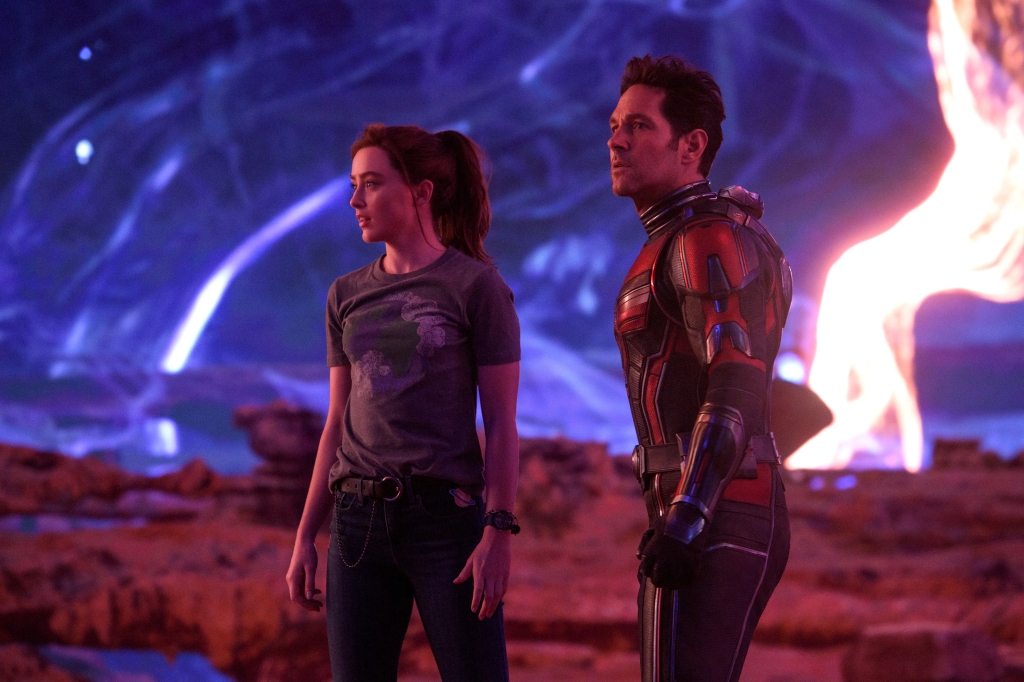
Marvel got off to a bad start this year when Ant-Man and the Wasp: Quantumania debuted to lukewarm reviews. Of any Marvel film to not hit the mark, this wasn’t the one the brand would have chosen. Not only did it open the studio’s hotly anticipated Phase 5, this film marked Kang’s (Jonathan Majors) debut, who is scheduled to be the big-bad in the next Avengers films. Although critics and audiences largely agree he made a strong impression, the film around him was uninspiring. It didn’t help that later in the year, Majors would later plead guilty to serious sexual assault charges, casting doubt over his future in the franchise.
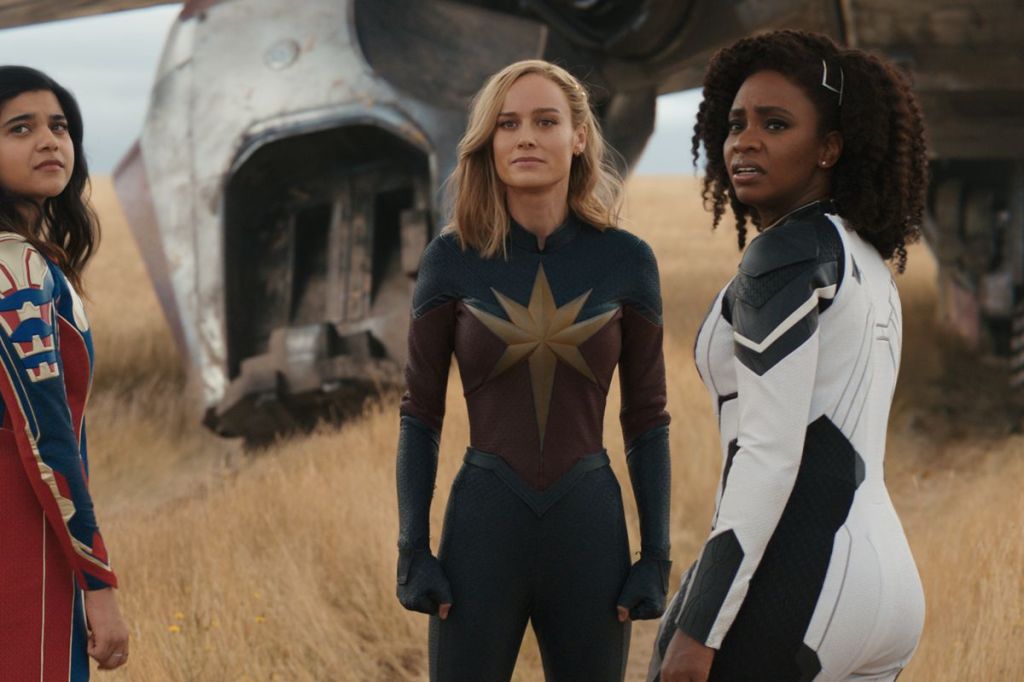
Later in the year, The Marvels bombed financially, becoming the studio’s lowest grossing film of all time, with tepid reviews despite a talented black female director in the form of Nia DaCosta. On the plus side for Marvel, Guardians of the Galaxy Vol. 3 was a hit and marked director James Gunn’s final work for the studio and is now spearheading a rebranded vision for DC.
Moving swiftly onto DC, because of the aforementioned upcoming regeneration, all four of the films released this year could be considered ‘legacy products’ now that the DCEU is closing up shop. That meant limited or in some cases, next-to-no marketing for its films, unceremoniously dumped into cinemas having been, at one time, part of a bigger picture. Shazam: Fury of the Gods and The Flash received mixed reviews and the DCEU closer Aquaman and the Lost Kingdom washed up with a poor reception. Blue Beetle was a surprise critical hit but given the limited marketing, flopped financially.
Sony was arguably the big winner this year with Spider-Man: Across The Spider-Verse opening unanimously positive reviews and tipped for Awards consideration.
There’s a varying degree of quality in this list but for the most part, it was a poor year for the genre. Comparing to the comic-book films of 2022, my top pick for this year doesn’t compare to any of the top three last year.
8) Spider-Man: Across The Spider-Verse
The part where you completely disregard this ranking, I just can’t understand the love for Spider-Man: Across The Spider-Verse. I thought its predecessor, Spider-Man: Into The Spider-Verse, was overrated but at least it had its plus points in that it had plenty of heart and well-developed characters. This sequel was just an overlong headache throughout, completely and utterly overstuffed, stretching the already worn multiverse trope at nauseum. Many left the film giddily excited by its cliffhanger ending but I can’t imagine sitting through another 150 minute snoozefest.
⭐⭐
Rating: 1.5 out of 5.
7) The Marvels
The sequel to the surprisingly entertaining Captain Marvel had all the right things going for it, chiefly an interesting director in the form of Candyman‘s Nia DaCosta. What a shame that the finished product completely misses the mark, both as a Marvel and a Nia DaCosta film. The Marvels is utterly bereft of the director’s fingerprints and completely misguided. It doesn’t help that not only do you need to have seen Captain Marvel to be up-to-date before watching this film but you also need to have seen two Marvel television series – Ms Marvel and Secret Invasion. The trademark quippy humour of Marvel films rears its ugly head here and it’s missing almost all of the ingredients that made its predecessor a success. There’s next-to-no character development for Brie Larson’s Carol Danvers and the film doesn’t capitalise on her relationship with Nick Fury (Samuel L. Jackson) – the interplay between them was one of the main ingredients that made it work. The film also suffers from a poor and one-dimensional villain and a grating score. It’s quite possibly the worst Marvel entry to date, with other contenders including Avengers: Age of Ultron and the boring and formulaic Black Widow.
The film to kick-start the Marvel Cinematic Universe’s Phase 5 fell short of the mark. Unlike both of its excellent predecessors, Ant-Man and Ant-Man and the Wasp, which acted as pallette-cleansers, Ant-Man and the Wasp: Quantumania performs a very different function in that it needs to introduce Kang, the big bad for Marvel’s forseeable future.
Starting with the positives, the cast are excellent and the chemistry shared between Paul Rudd’s Scott Lang and his daughter is admirable, although not as heartfelt as in previous films. Jonathan Majors is by far and away the standout as Kang, a cool and calculated villain with oodles of charisma and intelligence. Outside of the fun performances, the film unfortunately has an episodic quality to it, akin to watching a Saturday morning television show. Moving the story away from Earth to the Quantum Realm also lowers the film’s quality. The first two films excelled with their innovative action sequences and their manipulation of size and spectacle, whereas this disappointingly doesn’t. Most distractingly, the Quantum Realm is not well-realised. There is an unnerving amount of CGI and the film is visually drab. Even the score by Christophe Beck isn’t particularly memorable and Bill Pope’s cinematography is surprisingly anonymous considering his filmography, likely drowned out by the distracting CGI.
The Flash is a mixed bag – there’s some fun to be had in the middle with Michael Keaton’s Batman but it’s bookended by fairly turgid first and third acts. The multiverse is an increasingly worn concept and it really plagues this film as it lessens the stakes for the characters. Despite a carousel of cameos from stars all over the DC canon, the result is a film with an episodic quality akin to watching a Saturday morning cartoon than the series-defining reset The Flash was intended to be. The problem of ropey visual effects also plagues The Flash, especially a spectacularly misjudged opening action sequence involving a group of babies. Ezra Miller makes for a fine, if schizophrenic lead, although the character arguably received a more meaningful arc with less screentime in Zack Snyder’s Justice League.
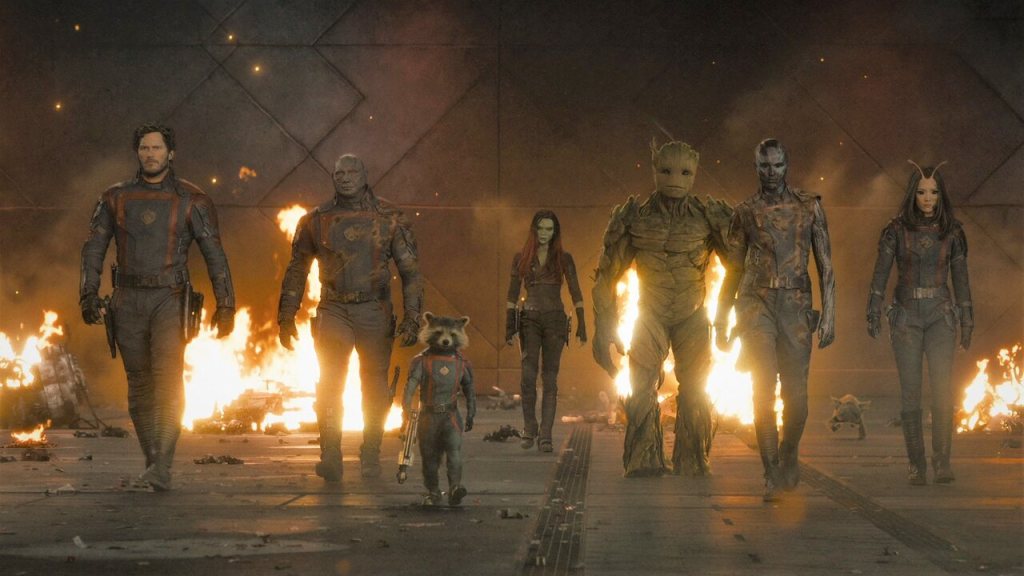
Guardians of the Galaxy Vol. 3 is quite different in tone from its predecessors but for the most part, it’s an enjoyable trilogy closer. Returning director James Gunn treats the characters with love and care and it’s impressive how even minor characters get a meaningful arc. When you’re juggling close to ten primary characters, that’s no mean feat. The film is surprisingly dark in places and has Gunn’s fingerprints all over it, even if its violence, language and disturbing depictions are somewhat sanitised. It’s also a very personal watch, its story mirroring Gunn’s Marvel experience and how he is saying goodbye to the conglomerate that propelled his career. That said, I wish Gunn took more narratively risks and applied his ‘everyone is expendable’ mentality from The Suicide Squadhere. Like Guardians of the Galaxy Vol. 2, it’s also baggily constructed and at least half an hour too long. It’s also not as humorous as the first two but this isn’t necessarily a con given it tackles darker subject matter.
The final film in the DCEU before it’s reimagined under James Gunn’s leadership attracted negative reviews but I found returning director James Wan‘s sequel to be very entertaining and visually interesting. Devil’s Deep, a volcano island lots of the second act takes place in is particularly nicely realised and there’s an excellent early heist and ensuing chase that can only have been created by Wan with his horror tinge. The cast are all clearly having fun. Jason Momoa essentially plays himself and Wan-regular Patrick Wilson fares much better this time round. His villain was a little disappointing in the original due to a lack of character development but Wan puts a much greater focus on him to great effect and both Momoa and Wilson share an excellent bromance chemistry. Yahya Abdul Mateen II makes for a sinister, if slightly cartoonish villain and Randall Park is another bright spot as Dr Stephen Shin.
You can tell it’s a film that was meant to be bigger than it is and it does feel like some scenes have been cut down and storylines reduced. This sequel is twenty minutes shorter than its predecessor and the film runs at a brisk pace, never really taking the time to breathe.
Blue Beetle is a pleasant surprise and by far and away its biggest asset is the amiable family dynamic which although affectionate, is fiercely positive. The characters are generally very well developed and by the half way point when there is a pivotal moment in the narrative, it’s safe to say we’ve really come to care for them. Angel Manuel Soto’s film feels like a fusion of Iron Man, Ant-Man, Spy Kids and Coco and he does a great job of making Palmera City seem like a real place, with its Miami-esque new town juxtaposed against the suburbs that are undergoing gentrification, signifying an economic inequality. The film does a great job of showing you the mansions and the neighbourhood Jaime Reyes (Xolo Maridueña) lives in, and it feels like an actual Central or South American city. Although it’s not going to set the superhero genre alight, I appreciated Blue Beetle’s upbeat energy and it manages to stand out in a crowded genre.
Shazam: Fury of the Gods isn’t as fresh as its predecessor but aside from a rocky start, it’s another entertaining ride. It’s considerably of a higher production value than Shazam spin-off Black Adam that released last year. This sequel mostly retains its warm portrayal of family and all of the characters receive meaningful character development. The script penned by Henry Gayden and Chris Morgan is sharply written and there’s a few laughs peppered throughout. Once again, Sandberg’s horror fingerprints can be felt all over the film, particularly in the climactic battle sequence and there’s even a cameo by the Annabelle doll that you’ll need to keep an eye out for. Other than the opening action sequence, there’s some fun set pieces here and even the final climactic battle remains consistently fun to watch, often the undoing of many a comic book film. The film is well shot by Gyula Pados but the score by Christophe Beck is disappointing and unmemorable.
Director: Taika Waititi Starring: Michael Fassbender, Oscar Kightley, Kaimana, David Fane, Rachel House, Beulah Koale, Taika Waititi, Will Arnett, Elisabeth Moss Certificate: 12A Run Time: 103 mins
Next Goal Wins is the latest from Taika Waititi, a sports comedy drama about Dutch-American coach Thomas Rongen (Michael Fassbender) and his efforts to lead the American Samoa national football team. Prior to his involvement, the team were regarded as the weakest football team in the world, most famous for their embarrassing 31-0 loss to Australia in an Oceanian qualifying match for the 2002 FIFA World Cup. The hot-tempered and washed-up Rongen attempts to train them for World Cup qualification in 2014, where their first match will be against Tonga but struggles due to their lack of cohesion and discipline.
American Samoa is portrayed as an insular community, with almost everyone working second or third jobs and there is a blanket 20mph speed limit (although apparently 30mph in reality). It’s certainly a natural fit for Waititi’s whimsical nature with a strong back catalogue of quirky comedies. Considering Waititi has since transitioned to bigger budget fare with Thor: Ragnarok and its controversial sequel Thor: Love and Thunder, it’s refreshing to see Waititi return to the genre that ignited his career.
Although Next Goal Wins is deeply flawed and has a rough-and-ready construction, it’s ultimately still a fun film with plenty of laughs and an amiable, feel-good nature. What allow his best comedies, such as Hunt For The Wilderpeople or What We Do In The Shadows, to succeed is his divergence from typical genre codes and conventions and it isn’t quite clear in Next Goal Wins whether Waititi knowingly adheres to or is trying to mock the generic constructs of the underdog sports comedy. The script, penned by Waititi and The Inbetweeners mastermind Iain Morris, packs itself full of quips and whilst perhaps two thirds of the jokes land, the remaining that don’t really don’t. While Waititi rarely strays from the established formula, the decision to reframe the second half of the football match as a second-hand memory is refreshing and allows the film to really stick the landing.
The performances are a mixed bag. Revered for his colder performances in films such as TheKiller, Michael Fassbender feels miscast as Rongen in what is arguably his first comedic role and his performance clashes oddly with the Samoan American community, although this is arguably by design to capture the disconnect. Elisabeth Moss and Will Arnett (who replaced Armie Hammer after abuse allegations came to light meaning the film was delayed) offer odd performances and fail to justify their limited screen time.
There’s some great performances from the Samoan American characters however, with Oscar Kightley, hilarious as the inept policeman in Hunt for the Wilderpeople, the standout as the loveable team manager. Kaimana is also brilliant as Jaiyah Saelua, a non-binary player who is initially treated with utter contempt by Rongen.
The film’s nicely shot by Lachlan Milne, who also shot Hunt For The Wilderpeople, although it’s odd he doesn’t capture the beauty of the mountains when he’s given the chance to. The original score by Michael Giacchino didn’t do much for me, with the jukebox choices faring better.
Next Goal Wins is ultimately an odd film by Waititi and isn’t one of his best considering his more subversive filmography. Still, it just about succeeds with its feel-good energy and a large proportion of its jokes to make it a fun experience. Check out Champions if you’re after a more consistent underdog sports comedy this year, which stars Woody Harrelson as a similarly washed-up coach who’s tasked with guiding a team of disabled players as community service.
Director: Zack Snyder Starring: Sofia Boutella, Djimon Hounsou, Ed Skrein, Michiel Huisman, Doona Bae, Ray Fisher, Charlie Hunnam, Anthony Hopkins Certificate: 12A Run Time: 134 mins
Rebel Moon – Part One: A Child of Fire is the latest by visionary director Zack Snyder, and is based on a concept he repeatedly pitched to various studios over the years. After strong success with the excellent Army of the Dead, Netflix had confidence in the filmmaker and gave him the green light.
Set on the fictional galaxy ruled by the imperialistic Motherworld, a farming colon on the moon of Veldt are threatened. Kora (Sofia Boutella), a former Imperium soldier heads on a quest to recruit warriors from across the galaxy to rise up against the Imperium. If you think that sounds just a little like Star Wars, you wouldn’t be wrong. Snyder says he was inspired by Star Wars, the works of Akira Kurosawa and Heavy Metal magazines.
Not a filmmaker associated with brevity, Netflix grew concerned in post-production that the film would underperform due to its unwieldy length. Snyder then decided to split the film into two parts (Rebel Moon – Part Two: The Scargiver will release in April 2024). It also became apparent Snyder’s vision was going to be R-rated and Netflix unconventionally decided it would release a younger audience-friendly cut, with an R-rated cut to follow down the line.
Many will remember the debacle that was Justice League, where Snyder’s interpretation of the material was butchered with. After riotous demand, the superior Zack Snyder’s Justice Leaguewas released and the two films couldn’t have been any more different. Netflix’s strategy of releasing two separate cuts is deeply reminiscent of Snyder’s previous experience and one has to wonder how different the director’s cut will be from what we have here.
Rebel Moon – Part One: A Child of Fire starts off promisingly as we are introduced to the citizens of Veldt and how they are tormented by the sinister Atticus Noble (Ed Skrein). Unfortunately, the rest of the film doesn’t live up to the strong beginning and gets bogged down in uninteresting, derivative lore as we go through the motions of Kora assembling a ragtag team. Strangely for a Snyder film, it’s not even particularly visually accomplished and the film is murkily shot. It almost feels as if Snyder is trying to shake his trademark visuals, given it’s 45 minutes before we get the first slow motion sequence. Even the score by the always-reliable Junkie XL is strangely uninspired.
The performances are also quite hokey. Sofia Boutella has proven she can be great, for example in Kingsman: The Secret Service or Prisoners of the Ghostland but she is very wooden here and has no charisma. Charlie Hunnam puts on a particularly unconvincing Northern Irish accent and even Djimon Hounsou isn’t given much to do. The cast member that fares best is Ed Skrein’s sinister villain and I’m looking forward to seeing the development of his character in the sequel.
Rebel Moon – Part One: A Child of Fire is sadly mostly a misfire in this more family-friendly format and Snyder’s worst film. There are certainly hints at a more mature and edgier film, though, and it’ll be interesting to see just how different Snyder’s cut will be. For a more thought-provoking sci-fi, although flawed, check out The Creator.
Director: John Woo Starring: Joel Kinnaman, Scott Mescudi, Harold Torres, Catalina Sandino Moreno Certificate: 15 Run Time: 104 mins
Silent Night is an action thriller by John Woo, his first English language film since 2003’s negatively received Paycheck. Brian Godluck (Joel Kinnaman) is an electrician, who lives with his wife, Saya (Catalina Sandino Moreno) and young son Taylor Michael. On Christmas Eve 2021, while Brian is playing in the garden with his son, Taylor Michael is killed when he is caught in the crossfire of a drive-by shooting by a local cartel. Brian pursues the gang but is shot in the neck, with his vocal cords severely damaged. He luckily survives and once he’s out of hospital, decides to enact his revenge by training himself up physically and setting a target date of the following Christmas Eve for all the gang members to be dead. It’s a pretty straightforward plot but key to the film standing out is the fact there is next-to-no-dialogue.
For the most part, Silent Night is a return to form for Woo with a trio of giddy action sequences. Two car chases are particularly vividly shot, especially the opening one where we see both the chase itself overhead and from the perspective of a character running towards the cars from an alley. There’s also a terrific stairwell sequence that’s meant to feel as if it’s one take.
The story is pretty simplistic and Woo isn’t known for his subtlety – the film feels overly schmaltzy at times and cutting this out would have resulted in an even leaner film. The lack of dialogue mostly works well, although there are scenarios the characters fin themselves in, such as a meeting at a police station, where two people clearly need to communicate with words. I think the film would have packed more of a punch with a limited script rather than with virtually no spoken words.
As for the performances, Joel Kinnaman can be quite a wooden actor but strip him of dialogue and he does an excellent job. Catalina Sandino Moreno, who was famously Oscar-nominated for her leading role in Maria Full of Grace stands out as Brian’s wife, Saya, and beautifully conveys her empathy to her husband and her heartbreak at the loss of her son.
Given the lack of dialogue, there’s greater pressure for Marco Beltrami’s score to deliver and boy, does it. Beltrami crafts several memorable themes and conveys the grief of the traumatic incident and the energy of the kinetic action sequences brilliantly.
Although overly sentimental in its tone, Silent Night is mostly a blast throughout. Woo reminds us he can deliver balls-to-the-wall action and while the action doesn’t top John Wick: Chapter 4 earlier this year, it’s a significant step above the average action thriller. I’ve got a feeling this could be an enduring Christmas film as time passes and I’m excited to see what Woo does next.











 The Film Meister