The Nun 2 (Review)

Uncategorized
⭐⭐ (Poor)

Director: Michael Chaves
Starring: Taissa Farmiga, Jonas Bloquet, Storm Reid, Anna Popplewell, Bonnie Aarons
Certificate: 15
Run Time: 110 mins

The Nun 2 is the latest in The Conjuring universe and a sequel to the 2018 spin-off. Valak (Bonnie Aarons), the titular demonic nun was first introduced in The Conjuring 2 to chilling effect but despite a talented cast and crew, The Nun was a trainwreck. The film’s jump scares were mechanical and weak, its editing extremely poor and the narrative paper-thin. Its only saving grace was its chilling atmosphere that director Corin Hardy failed to fully utilise. 

Director Michael Chaves helms this sequel, having already two films in the series under his belt – The Curse of La Llorona and The Conjuring: The Devil Made Me Do It. Chaves has proven a solid hand and there was a lot to like particularly with mainline Conjuring effort, but it’d be fair to say his scares are a few rungs below series mastermind James Wan or Annabelle: Creation director David F. Sandberg. 

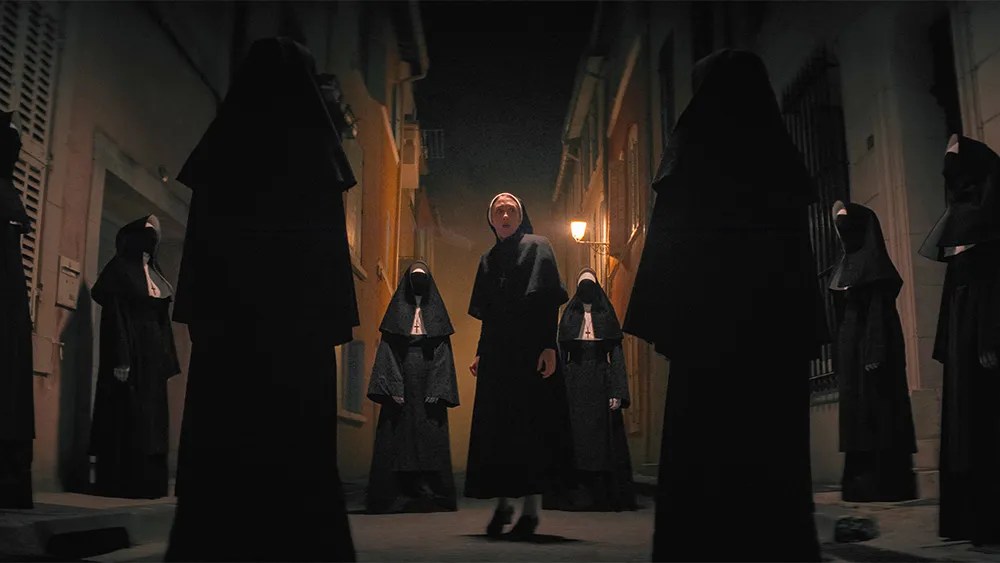
The Nun 2 is set four years after the events of the first film and moves the action to France. Both Taissa Farmiga and Jonas Bloquet return as Sister Irene and Maurice, with Irene now serving in an Italian convent and Maurice in a French boarding school. Maurice is friendly with a young Irish girl named Sophie (Katelyn Rose Downey) and her mother and teacher Kate (Anna Popplewell). After a priest is brutally murdered in a church in Tarascon, France, Sister Irene is set to investigate with Sister Debra (Storm Reid), a young novice.

The Nun 2 is a much stronger film than the first in the storytelling department but it still suffers from its fair share of problems. Starting with the positives, the film is edited coherently, unlike the first, where the scenes were often so short that the film felt like an extended trailer. Chaves also makes a much stronger effort to develop the characters and put them through an arc, even if they’re still rather generic. It’s also a reasonably good-looking film, slickly shot by cinematographer Tristan Nyby and although it’s not as memorable as it could have been, Marco Beltrami’s score has some exciting moments. Finally, the second half is entertaining in places and the concept of Malignant and M3gan writer Akela Cooper’s story is strong, even if the execution is rather ramshackle. 

Unfortunately, Chaves’ scares aren’t particularly effective and the film’s first hour is quite boring, as Sisters Irene and Debra try to catch up with the fact Valak still lives on in Maurice, which we learned at the close of The Nun. Much has been made of the more gory nature of elements of the film’s horror, but I didn’t find the film particularly violent or blood-curdling at all, even compared with other series entries. 

Although there’s a reasonable amount of ambition in Cooper’s story, the screenplay (Cooper in collaboration with Ian Goldberg and Richard Naing) is clunky. There’s some inexcusable exposition, an all-knowing librarian the nuns meet in their investigation who conveniently happens to know all the particulars of a Macguffin device they need and exactly how to defeat the demon is incredibly lazy. A revelatory line in the film’s climax relating to a mother’s eyes is also unintentionally laughable.  

Several characters are also severely short-changed. Despite a potentially interesting introduction where it is revealed Sister Debra has been sent to the church as a means of escaping the racial hell of 1950s Mississippi, the character isn’t given anything to do.  Anna Popplewell is also surprisingly awful as Kate with an unconvincing Irish accent. 

While The Nun 2 represents an improvement over its predecessor, it’s plagued by mostly ineffective scares, a tedious first hour and clumsy execution of the somewhat amiable storyline. It’s Chaves’ weakest effort in the series and the film’s existence as both a sequel and a prequel to The Conjuring hurts it as we already know the outcome of some of the film’s characters, which lessens one’s investment in the jeopardy they’re faced with. 

⭐⭐ (Poor)

Blue Beetle (Review)

Uncategorized
⭐⭐⭐ (Good)

Director: Angel Manuel Soto
Starring: Xolo Maridueña, Bruna Marquezine, Adriana Barraza, Damián Alcázar, Raoul Max Trujillo, Susan Sarandon, George Lopez  
Certificate: 12A
Run Time: 127 mins

Blue Beetle is the third of four entries in the DCEU this year as it dwindles down prior to James Gunn’s relaunched DCU and is the only film in the quartet to not be a sequel. Directed by Angel Manuel Soto, Blue Beetle is an origin story of the Mexican superhero, effectively a suit with a wide array of armaments.

Jaime Reyes (Xolo Maridueña) returns from Gotham Law school to the fictional Palmera City to  discover his tight-knit family are at danger of losing their home in an increasingly gentrified area. Kord Industries, co-founded by Victoria Kord (Susan Sarandon) effectively rule the city, with Victoria on the hunt for an ancient alien artefact known as the Scarab, so she can develop her own range of law enforcers. Her niece, Jenny (Bruna Marquezine) doesn’t believe in her nefarious intentions and Jaime, who takes a shine to her and is entrusted with keeping the Scarab safe, ends up getting fused with the artefact transforming him into an armoured exoskeleton. Think a Latin-infused Iron Man meets Ant-Man equivalent. When Victoria learns that Jaime has the Scarab, it’s safe to say she wants its out of him and will go to depraved depths to achieve her goal. 

Blue Beetle is a pleasant surprise and by far and away its biggest asset is the amiable family dynamic which although affectionate, is fiercely positive. The characters are generally very well developed and by the half way point when there is a pivotal moment in the narrative, it’s safe to say we’ve really come to care for them. Angel Manuel Soto’s film feels like a fusion of Iron Man, Ant-Man, Spy Kids and Coco and he does a great job of making Palmera City seem like a real place, with its Miami-esque new town juxtaposed against the suburbs that are undergoing gentrification, signifying an economic inequality. The film does a great job of showing you the mansions and the neighbourhood Jaime lives in, and it feels like an actual Central or South American city.  

There’s some thrilling action sequences too with believable CGI, an achievementcompared to the poor visual effects in The Flash or last year’s Black Adam. Although there is a final act battle, I appreciated the film didn’t outstay its welcome, a common problem that plagues a number of superhero films. 

Gareth Dunnet-Alcocer’s script sometimes resorts to cliche but I appreciated the links to present day Latin politics, such as when Jaime’s younger sister, Milagro (Belissa Escobedo) remarks they are invisible to Sarandon’s villain. These lines didn’t feel shoehorned in.

Xolo Maridueña is very charismatic as Jaime, a young adult trying to carve a way for themselves who doesn’t know how to stand out. George Lopez also stands out as Rudy, Jaime’s Uncle, and the comedian brings an excellent level of cynicism and eccentricity. Although Bruna Marquezine initially serves as an expository machine, once her character is absorbed into the Reyes family, she also shines and shares a palpable chemistry with Maridueña. 

It’s just a shame the film is let down by a poor villain. Although Sarandon turns in a nasty performance, the script doesn’t really delve into her psyche. The film could also have been a little edgier, such as incorporating the body horror and resulting sense of disgust of being fused with a foreign entity. 

On the plus side, Bobby Krlic’s score is excellent and he crafts some memorable themes. I was really excited to see how Hereditary and Beau is Afraid cinematographer Pawel Pogorlezski would lens the film. Although the cinematography isn’t quite as innovative as I was hoping it would be. I appreciated him holding onto shots a little longer than is standard

Although it’s not going to set the superhero genre alight, I appreciated Blue Beetle’supbeat energy and it manages to stand out in a crowded genre. The characters are well developed and easy to root for, with the film supported by a class commentary of what it’s like to grow up in a Latin American family. I hope Gunn integrates these characters into the relaunched DCU as it would be a shame to chuck away this film’s good work. 

⭐⭐⭐ (Good)

Gran Turismo (Review)

Uncategorized
⭐⭐⭐ (Good)

Director: Neill Blomkamp 
Starring: David Harbour, Orlando Bloom, Archie Madekwe, Darren Barnet, Geri Halliwell Horner, Djimon Hounsou
Certificate: 12A
Run Time: 134 mins

Gran Turismo is the latest by director Neill Blomkamp, an adaptation of the PlayStation race simulator video game of the same name. It tells the true story of Jann Mardenborough, a devoted teenage gamer who is given an opportunity to turn his racing driver dreams into reality when he is invited to take part in a Nissan-funded competition. This initiative startled the racing world, after all, you can’t just press the reset button if you wreck a car in reality. 

Blomkamp made his name in sci-fi and ever since his startling debut District 9, his career has been on a downward trajectory. The reception to his follow-up Elysium was rather ambivalent and CHAPPiE effectively killed his career, with the director removed from an Alien project. I thought the icy reception to Elysium and CHAPPiE was rather unfair, both brimming with ideas and CHAPPiE, in many ways, represented a bombastic culmination of his work.  

After a six year hiatus, Blomkamp directed the found-footage horror Demonic, which received the worst reviews of his career and now here we are. A video-game-cum-sports-drama seems like an odd fit for the sci-fi director, so how does the film fare?

Despite the underwhelming marketing, Gran Turismo fares surprisingly well. Although formulaic, Blomkamp manages to blend the genres reasonably well and he mostly hits the right notes with an underdog story that’s full of heart. Some of the race sequences are quite tense, if not predictable, although there is an over-reliance on CGI as Blomkamp tries to bridges the gap between Mardenborough racing on the console and on a real track. A late sequence in Le Mans sees the racer visualise he is back in the comfort of his home playing in the simulator, with the car digitally deconstructing around him, which is executed rather clumsily. The film’s generally lacking in subtlety, be it from the clunky script and domineering score by Lorne Balfe and Andrew Kawczynski. 

Best known for Midsommar, Archie Madekwe gives an earnest and grounded performance as Mardenborough. David Harbour’s the highlight, however, as Jack Salter – the hardened, grizzled coach who trains the gamers and effectively forms a surrogate father bond with Mardenborough as the film progresses. Orlando Bloom isn’t brilliant as a slimeball marketing executive, with a wandering accent and hammy delivery, but it doesn’t detract too much from the film. Djimon Hounsou’s reliable as Mardenborough’s footballer father, although it’s a shame the bond between them isn’t further developed. 

It’s also a little disappointing Blomkamp doesn’t inject much of his authorial stamp on the film. Although an early sequence where Mardenborough and his brother head out on a drinking session is set in an industrial, grimy location, it lacks the grit of Blomkamp’s other work. It also feels uncharacteristic of Blomkamp to lack an over-the-top villain, although Bloom is the closest-fitting performance. 

Still, the fact Gran Turismo has received mixed-to-positive reviews can only be beneficial for Blomkamp to getting back to his sci-fi roots if it acts as a stepping stone. Although it’s content to not reinvent the wheel, I had fun with Gran Turismo and it tells a reasonably gripping story. It’s a lot better than it has any right to be by racing video game standards – one only needs to cast their mind back to Need For Speed or Speed Racer.

⭐⭐⭐ (Good)

Oppenheimer (Review)

Uncategorized
⭐⭐⭐⭐⭐ (Perfect)

Director: Christopher Nolan
Starring: Cillian Murphy, Emily Blunt, Matt Damon, Robert Downey Jr, Florence Pugh, Josh Hartnett, Casey Affleck, Rami Malek, Kenneth Branagh, Benny Safdie, Jason Clarke,
Certificate: 15
Run Time: 180 mins

Oppenheimer is the latest by Christopher Nolan and nominally a biopic on the father of the atomic bomb. Although $100 million is a relatively high budget, it’s his smallest film since The Prestige. Inspired by the 2005 novel, American Prometheus, the film opens on exploring Oppenheimer’s (Cillian Murphy) early academia life, his recruitment by Leslie Groves (Matt Damon) and direction of the Manhattan Project to the 1952 security hearing which cemented his fall from grace.

As you’d expect, Nolan doesn’t stick to storytelling convention and Oppenheimer is told in a non-linear fashion.  The colour sequences (titled ‘Fission’) are from the perspective of Oppenheimer and the black-and-white sequences (‘Fusion’) from Lewis Strauss (Robert Downey Jr.), the driving force of the revoking of Oppenheimer’s security clearance.

Whilst Nolan is one of, if not my favourite working director, neither Dunkirk or Tenet rank among his best work for me and both left me feeling empty. I was worried Oppenheimer was going to fall into the same camp (and was prepared to lay the blame on Kenneth Branagh who features in all three) but luckily, my apprehension was unfounded. 

Oppenheimer is a tension-fuelled, thought-provoking minor-key masterpiece and is straight up there with Nolan’s best work. It’s an incredibly rich piece of work and it left me feeling stone-cold with its characters haunting deliberation over the consequences of their work. This is a largely dialogue-heavy film for its lengthy three hour running time and except a breathtaking sequence depicting the Trinity test (even more impressive considering the minimal CGI), is largely bereft of action. 

The script is brilliantly written (although I’m sure some will take umbrage that the characters speak like Nolan), constantly ramping in tension and Jennifer Lame’s editing is a monumental achievement. This is a film that will be studied in academia and Nolan cleverly first portrays fragments of a scene to then revisit and develop the image later on is a stroke of genius. Many filmmakers make the mistake of telling rather than showing but Nolan has always treated his audience as being intelligent. 

Cillian Murphy has often represented one of the mechanisms to a successful Nolan film, and steps up to the lead role for Oppenheimer. His performance is simply sensational and a career-best. He conveys many of the emotions Oppenheimer is feeling in any given moment with his facial expressions, his mannerisms note-perfect. I particularly appreciated how Murphy’s demeanour changes when the character realises the consequences of his actions.

It’s not all Murphy’s show and Oppenheimer is stacked with A-list actors. Emily Blunt puts in a terrific performance as the pioneer’s wife, Kitty and Robert Downey Jr is surely going to be Oscar-nominated for his slippery, yet atypical portrayal of Lewis Strauss. 

Elsewhere, Josh Hartnett is great as Ernest Lawrence, a scientist who regularly reminds Oppenheimer “theory will only take you so far” and Benny Sadie is another highlight as  charismatic Hungarian theoretical physicist Edward Teller.  Tom Conti quite literally becomes Albert Einstein and Gary Oldman makes for a chilling President Truman in a memorable scene. I mentioned earlier Kenneth Branagh being the weak point of both Dunkirk and Tenet but he’s great as Niels Bohr, who was an influential influence on Oppenheimer in his early studies. 

The film is beautifully shot by now-Nolan regular Hoyte van Hoytema and Ludwig Göransson’s score is the glue that holds the film together. Both the sound and music are a character in themselves, Göransson’s predominantly string-based score unnerving and beautiful – I will be very surprised if there is a better soundtrack in cinema this year. Some have complained it’s overused but I disagree and the moments where there is silence on the screen are only made more impactful. Many have also criticised the sound mixing on some of Nolan’s past work, in that the sound can often drown out the dialogue, but I didn’t have a problem with it here and it only heightened the drama unfolding on-screen. 

Oppenheimer is a masterpiece in Nolan’s already remarkable career and an unconventional but bold take on the biopic genre. This is especially impressive considering many recent biopics released in the last decade or so have suffered from being formulaic. Effectively Nolan’s JFK, Oppenheimer is not only a riveting and fascinating deconstruction of the nuclear mastermind but an emotional wallop.

Much of what cements Nolan’s best works as cinematic classics is their rewatchability and having seen Oppenheimer twice, I want to see it again. It’s a film so dense and rich that you’ll pick out a new detail each time you revisit it and the three hour length passes by in a flash. In a summer where we’ve had disappointments such as The Flash and Indiana Jones and the Dial of Destiny, which have been ugly, big-budget sequels that tarnish their legacy, Oppenheimer has restored my faith in cinema. It’s one of the best films of the year and a must-see. 

⭐⭐⭐⭐⭐ (Perfect)

Barbie (Review)

Uncategorized
⭐⭐⭐ (Good)

Director: Greta Gerwig
Starring: Margot Robbie, Ryan Gosling, America Ferrera, Kate McKinnon, Michael Cera, Issa Rae, Rhea Perlman, Will Ferrell
Certificate: 12A
Run Time: 114 mins

Barbie is the hotly anticipated live-action film centred around the familiar Mattel doll. The film is directed by actress and screenwriter Greta Gerwig, who is two-for-two with the coming-of-age dramas Lady Bird and Little Women. Both of her efforts were polished and insightful character studies, with Lady Bird having a particularly strong impact with its hard-hitting portrayals of loneliness, depression and uncertainty.  

This decidedly bigger-budget film sees Stereotypical Barbie (Margot Robbie) reside in Barbieland, a matriarchal society where all women are self-confident and successful. Meanwhile, their Ken counterparts spend their days lounging around the beach. Beach Ken (Ryan Gosling) takes a particular shine to her, but Barbie rebuffs him in favour of her independence. 

One day, she is suddenly overcome with worries about mortality and visits Weird Barbie (Kate McKinnon) for advice. Weird Barbie advises her to visit the real world and find the child who is playing with her to remove these feelings. Things, however, take a twist when Barbie discovers Ken stowed away in the convertible as she drives towards reality. 

Barbie has a well-paced and energetic first half. Unfortunately, the latter half struggles in incorporating too many ideas are thrown and I found its message overly preachy. Starting with the positives, Gerwig explores some interesting themes, including existentialism and the impact both Barbie and Ken have had on modern culture. There are obvious references to Groundhog Day, Toy Story, The Wizard of Oz and The Lego Movie in its storyline and I also appreciated Gerwig’s personal and loving nods to her Sacramento roots, which also worked wonders for Lady Bird. Despite its 12A rating, Barbie isn’t particularly suitable for children and I suspect most of the themes and jokes will go over their heads. 

There’s some great performances here too. Margot Robbie is perfectly cast as the titular character, deftly balancing the likeability, humour and pathos needed for the crisis she undergoes.  Even Helen Mirren’s satirical narration points to her suitability. 

Ryan Gosling’s an excellent match for Robbie, who explodes with charisma but also convinces in the character’s darker moments. We already know Gosling can sing well from his Oscar-nominated turn in La La Land and he has a phenomenal sequence in the film’s final act called ‘I’m Just Ken’.  Other highlights include Rhea Perlman as Ruth Handler, Barbie’s creator and Mattel co-founder and Simu Liu shines as an alternative Ken who belittles Gosling. 

It’s a shame Will Ferrell is rather wasted in what is essentially a reprisal of his role from The Lego Movie as the CEO of Mattel. All of the character’s jokes felt forced and distracted from the focal relationship between Barbie and Ken.

Barbie also looks top-notch for its relatively high $145 million budget, with excellent production and costume design. The film is lusciously shot by Martin Scorsese-regular Rodrigo Prieto with its bright and vivid colour palette. 

The film’s second half just didn’t work for me. It introduces too many ideas and ties itself in knots and it struck me as preachy in tone. In fact, there is one character who delivers an extended speech late into the film about what it means to be a woman in current society which although inspirational, is incredibly heavy-handed. It doesn’t leave any room for nuance whatsoever. While its exploration of gender is interesting on the surface, the resolution the film ultimately reaches borders on unsettling and sexist. 

Barbie is the first film to be directed by Gerwig where she has collaborated with another individual on the script, in this case her partner and fellow filmmaker Noah Baumbach. While I can tolerate Marriage Story, I’ve not been a fan of the vast majority of Baumbach’s filmography. That lots of Barbie’s humour didn’t work for me, nor did it seem to work for large swathes of the audience in the packed cinema screening, suggests his contributions to the script are why the film falters. The film feels as if Gerwig was in charge of the film’s first half, with Baumbach piloting the second, although this isn’t necessarily the case. 

Ultimately, Barbie is a real mixed bag with a fun and energetic first half that then fizzles out. There’s a lot to admire, especially the performances, visuals and the fact Gerwig has effectively created a feminist fantasy comedy under the guise of a corporate property. It’s just a shame it cannot hold its momentum throughout and the film would have worked a lot better if it had dropped some of the themes and tangents it takes in its second half. 

⭐⭐⭐ (Good)

Insidious: The Red Door (Review)

Uncategorized
⭐⭐⭐ (Good)

Director: Patrick Wilson
Starring: Ty Simpkins, Patrick Wilson, Sinclair Daniel, Hiam Abbass, Rose Byrne
Certificate: 15
Run Time: 107 mins

Insidious: The Red Door is the fifth instalment in the highly profitable series and actor Patrick Wilson’s directorial debut. Director James Wan and writer Leigh Whannell kickstarted the series in 2011, with Insidious attracting a positive critical reception and banking a cool $100 million from a $1.5 million budget. Wan and Whannell are still on hand in a producing capacity, with Whannell also contributing to the story along with Halloween Kills’ Scott Teems. 

The film is set nine years after the events of Insidious: Chapter 2, returning back to the Lambert family who fronted the first two films. Both the highly underrated Insidious: Chapter 3 and the disappointing Insidious: The Last Key were prequels and largely focussed on Lin Shaye’s charismatic psychic Elise Rainier. It’s impressive how even five films in, there is yet to be an outright bad entry, which you can’t say about many other horror franchises. 

Insidious: The Red Door opens on the funeral of Lorraine Lambert (Barbara Hershey) and we learn shortly after that both Josh (Patrick Wilson) and Renai (Rose Byrne) are now divorced. It’s time for 19-year-old Dalton (Ty Simpkins) to head to college and Josh attempts to heal their strained relationship by driving him to college. Of course, it wouldn’t be an Insidious film without a venture into The Further, the vast and dark dimension where many souls are damned to remain forever, instigated by Dalton’s first college art class.

While in many ways, Insidious: The Red Door is a step-up from the disappointing fourth instalment, Patrick Wilson’s directorial debut is a mixed bag. It’s quite different from its predecessors, and all the better for it, in that it’s a drama film at its core rather than a horror. Although it’s been done plenty of times before, Wilson successfully crafts a gripping family dynamic and takes his time with the characters. The first two acts are very much a slow burn and I particularly appreciated the small detail, for example, of a father struggle to know what to write to his son via text message. Wilson deftly explores the theme of generational trauma and to some extent, it provides a satisfying closure to the Lambert family’s story. It’s not perfect – an extended sequence in a frat house simply doesn’t belong in the film – but you have to admire Wilson’s ambition to take the series in a different direction. 

There’s some excellent performances here too. Ty Simpkins makes for a gripping lead as the brooding Dalton, who struggles to fit in with his family and society. Patrick Wilson’s also reliably brilliant as the weary, worn-down father who doesn’t want to repeat history with his own family that’s held him back. Newcomer Sinclair Daniel is also great as Chris, Dalton’s charismatic college roommate who befriends him, although one does need to suspend belief a little at her choice to remain with him in certain scenarios. 

The film’s competently shot by Autumn Eakin too, an inverted opening shot of a gravestone particularly effective in setting the dour opening. 

Unfortunately, where Insidious: The Red Door falls short is its sudden rush to the finish and the film falling short as a horror. After the admirable first two acts, the venture back into The Further is unsatisfactorily rushed for the story Wilson’s trying to tell. 

This is by far, the least scariest film in the franchise and while there are perhaps two intriguing ideas, the jump scare itself is poorly executed. Both Wan and Whannell understand the art form of how to achieve an effective jump scares with their Insidious entries and Wilson fails in establishing a tension. The Red Door also seems to undermine the previous film’s logic as to how The Further operates, which I found quite frustrating. 

Although returning composer Joseph Bishara reuses uses some of his effective original themes, the score is overused and certain sequences, such as Josh walking out of Dalton’s room in an upset state, would have been more impactful without music. A scene featuring Josh and Dalton attempting to converse in a car also doesn’t really land an impact as the dialogue is drowned out by a backing track.

While Insidious: The Red Door has its fair share of problems and doesn’t reach the heights of the first three films, there’s still plenty to admire here. I liked Wilson’s attempt at a familial exploration and the cast are all game for it. It’s a shame the horror elements of the film are weak and a rewrite would have been the only logical solution for the underwhelming and rushed finale. On an initial viewing, I think The Red Door has more going for it than The Last Key and although deeply flawed, this fifth (and supposedly final) entry into the enduring series has some bright spots. 

⭐⭐⭐ (Good)

Indiana Jones and the Dial of Destiny (Review)

Review

Rating: 3 out of 5.

Director: James Mangold
Starring: Harrison Ford, Phoebe Waller-Bridge, Antonio Banderas, John Rhys-Davies, Toby Jones, Boyd Holbrook, Ethann Isidore, Shaunette Renée Wilson, Mads Mikkelsen
Certificate: 12A
Run Time: 154 mins

Indiana Jones and the Dial of Destiny is the long-awaited fifth instalment of the swashbuckling series, despite many assuming the underrated Kingdom of the Crystal Skull represented Harrison Ford’s swansong. How wrong they were, as Ford is once again front and centre of the action at age 80. Dial of Destiny is the the first time Steven Spielberg isn’t in the director’s chair with James Mangold stepping up to the challenge. Mangold is more than up to the task as he is no stranger to concluding chapters – just take a look at the excellent Logan, a grim and fitting closing chapter that framed the X-Men frontman as a relic of the past. 

Dial of Destiny is set in 1969, 12 years after the events of Kingdom of the Crystal Skull. An elderly Jones retires from his teaching role, only to be shortly visited by his goddaughter Helena (Phoebe Waller-Bridge), who also happens to be an archaeologist. She hopes to find the titular dial built by the ancient Syracusan mathematician Archimedes, which Jones happens to have half of. The pursuit of the dial drove Helena’s father Basil (Toby Jones) mad, who we meet in the film’s opening 25 minute prologue set in 1944 alongside a de-aged Indy where they first lay eyes on the dial. 

If both halves of the dial are combined, it can allow for possible time travel. However, astrophysicist (and former Nazi) Jürgen Voller (Mads Mikkelsen) is also after the dial so he can time travel to 1939 to assassinate Adolf Hitler and lead Germany to World War II victory. 

Indiana Jones and the Dial of Destiny is a disappointing finale on a number of levels. It’s overlong, the visual effects are unconvincing and it’s the first film in the series to lack a sense of fun in its action sequences. James Mangold clearly has a vision as his depiction of Jones immediately after the prologue shares parallels with Logan, a drunk and miserable shadow of his former self with his head stuck in the past. I suspect Disney didn’t want to take a risk and watered down Mangold’s treatment. 

It’s a film that clings onto nostalgia and visually, certainly intends to be in keeping with its predecessors. However, considering the film has a mammoth $300 million budget, the visual effects are surprisingly ropey. There’s an overreliance on CGI throughout and the de-aging of Harrison Ford in the prologue is largely unconvincing. While Ford looks younger, the way the character talks and moves is like an old man. The prologue’s action sequences feel formulaic, is dimly lit and lacks any spark in its action, content to just go through the motions. While Mangold-regular Phedon Papamichael’s cinematography is admirable in later set-pieces, they too lack the energy of previous installments.

The film could have really benefitted losing half an hour and it would have really tightened everything up. It’s a whole twenty five minutes than the previous longest entry Indiana Jones and the Last Crusade, and its story doesn’t warrant the extra length.

Harrison Ford turns in a committed performance but he expectedly lacks the physicality given his age. The way in which Jones constantly gets himself out of perilous situations feels too neat. To be honest, Ford’s performance in this, Star Wars: The Force Awakens and Blade Runner 2049 are all pretty interchangeable. 

Phoebe Waller-Bridge joins the cast as Helena and while she’s tolerable, she just doesn’t share a palpable chemistry with Indy. Mads Mikkelsen makes for an excellent villain and receives a decent amount of development and if he were in a better film, he’d be a real highlight. 

However, much of the rest of the star-studded cast are squandered. The two biggest casualties are Antonio Banderas and John Rhys-Davies. Banderas fails to make an impression as Reinaldo, a frogman with more of a glorified cameo and Davies is underused. Logan villain Boyd Holbrook plays Mikkelsen’s henchman but doesn’t receive much development. Shaunette Renee Wilson and Toby Jones are two of the film’s bright spots and give it their all with characters that don’t have much meat to the bone.

John Williams returns on scoring duties and it’s largely successful and he even introduces a couple of new themes, a piano-based riff in an early chase sequence makes a strong impression. 

Overall, Indiana Jones and the Dial of Destiny is a disappointing finale to the series. It’s lacking in stakes, as well as the Spielberg magic that made his four entries complete blasts from start to finish. The film’s not a complete failure as I admired the hints of how Mangold wanted to explore the character in its early scenes and Mikkelsen stands out, despite his relatively straightforward villain. However, in all other respects, it’s the thorn in what was a four-strong series and is a big disappointment considering the talent involved. 

The Flash (Review)

Uncategorized
⭐⭐ (Poor)

Director: Andrés Muschietti 
Starring: Ezra Miller, Sasha Calle, Michael Shannon, Ron Livingston, Maribel Verdú, Kiersey Clemons, Antje Traue, Michael Keaton
Certificate: 12A
Run Time: 144 mins

The Flash is the solo film for the superhero that can travel at the speed of lightning, although its production journey has been anything but rapid. Although there were plans for a film as far back as the 1980s, as far as the DCEU (DC Extended Universe) is concerned, there were tentative plans for a 2016 release, with duo Phil Lord and Chris Miller writing a treatment. That then changed to Seth Grahame Smith after Lord and Miller vacated the project, before creative differences led to Rick Famuyiwa jumping on board. He then left and the Game Night duo of John Francis Daley and Jonathan Goldstein took the mantle, who then they also departed (but receive a story credit) before we arrive at Andrés Muschietti who managed to get the project to the finish line.

Muschietti is, by far, the least interesting pick of the bunch. His debut horror Mama was pretty dreadful and he then went on to helm It and It: Chapter Two. Both It films were very watchable, but their downfall was resorting to cheap, mechanical jump scares – Muschietti just doesn’t do darkness very well, and I was more than a little trepidatious for The Flash as this has always been the DCEU’s winning ingredient.

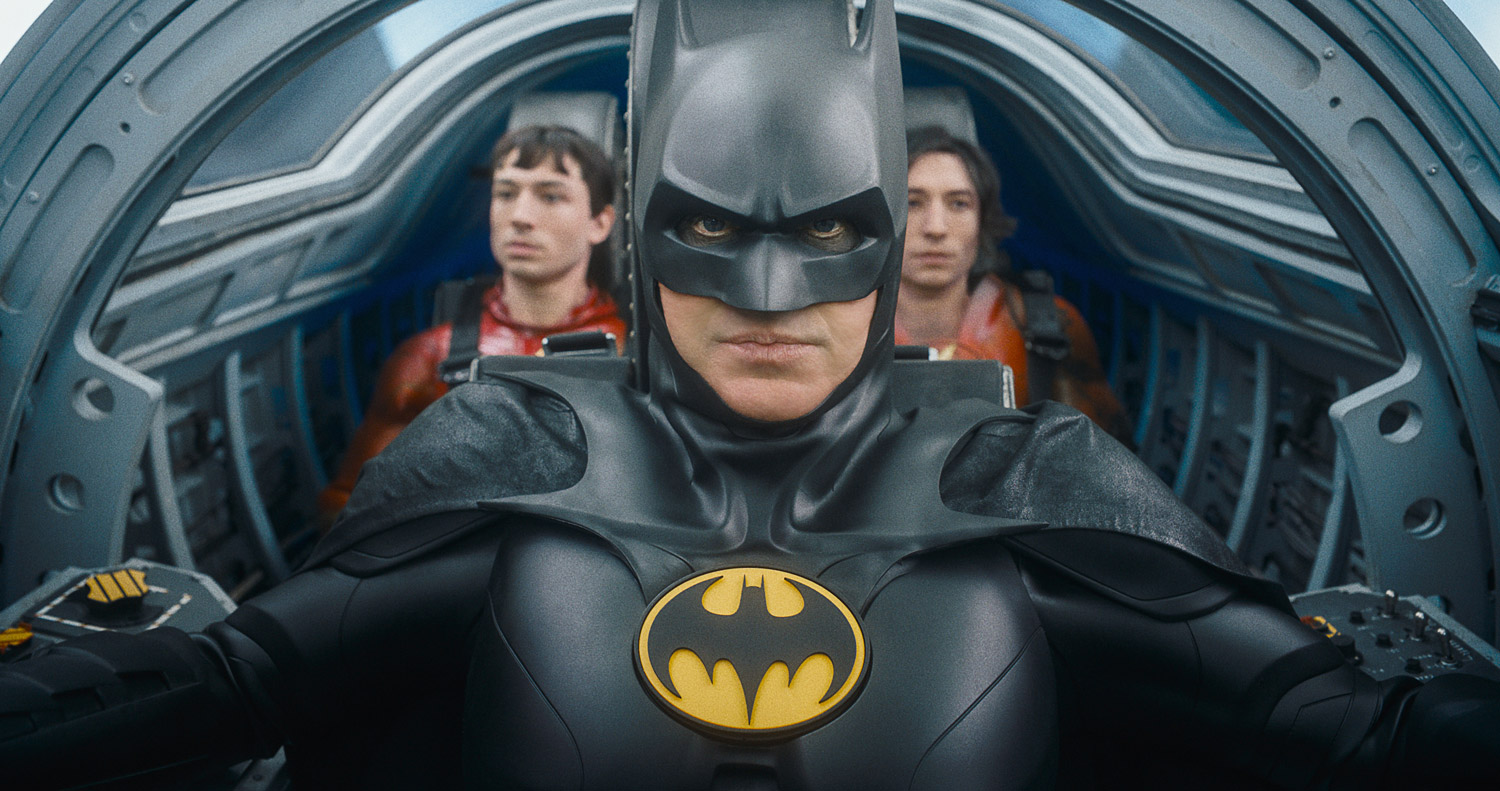
In the film, Barry Allen (Ezra Miller) continues to reel over the death of his mother and against Batman’s (Ben Affleck) advice, travels back in time to try and prevent the tragedy. It wouldn’t be a spoiler (given the trailers have revealed this already) that Barry’s actions mean he rewrites history and finds himself in a different multiverse where members of the Justice League don’t exist and he finds an older Batman (Michael Keaton reprising his role from Tim Burton’s Batman and Batman Returns).

The Flash is a mixed bag – there’s some fun to be had in the middle with Keaton’s Batman but it’s bookended by fairly turgid first and third acts. The multiverse is an increasingly worn concept and it really plagues this film as it lessens the stakes for the characters. Despite a carousel of cameos from stars all over the DC canon, the result is a film with an episodic quality akin to watching a Saturday morning cartoon than the series-defining reset The Flash was intended to be.

There’s a burgeoning theme of ropey visual effects affecting big-budget films recently due to artists being overworked and under-resourced. Many were quick to pick up on the inexcusably poor CGI in Thor: Love and Thunder, Black Adam and Ant-Man and the Wasp: Quantumania for example. Unfortunately, this problem has also infected The Flash, despite Muschietti going on the record and saying it was intentional, as the sequences are shot from Allen’s perspective. “Yeah, right”, I say. A spectactularly misjudged opening action sequence involving a group of babies will surely be an example used in future classes in film schools of what’s not fit for cinema release.

Despite the 144 minute run time, most of the supporting characters aren’t particularly well-developed. Ezra Miller makes for a fine, if schizophrenic lead, although the character arguably received a more meaningful arc with less screentime in Zack Snyder’s Justice League. Sasha Calle makes her debut as Supergirl and has zero charisma. Both Ron Livingston (replacing Billy Crudup) and Maribel Verdu play Allen’s parents and offer reasonable performances but aren’t particularly well-developed, and this is also true of Kiersey Clemons’ Iris West.

The three bigest casualties are Ben Affleck, Michael Shannon and Antje Traue, all reprising their roles from previous films. Affleck’s Batman appears in the film’s first act, in what is designed to be a poignant send-off for the actor, but his appearance in the poor opening sequence and brief scene later in the first act have more of an embarassing effect. Shannon and Traue reprise their roles as villains General Zod and Faora-Ul from Man of Steel and both get absolutely nothing to work with. In fact, I’d need to rewatch the film to determine if Traue even gets a line in the script. I can’t say I’m surprised Shannon’s recently gone on the record to call his series return “unsatisfying”.

The film finds its feet when Keaton’s Batman arrives and the treatment of the character is somewhat satisfying.  He receives some good character development, a grizzled version of his former self and there’s an entertaining scene with him explaining what the multiverse is using a bowl of spaghetti. There were times in the second act I thought I was watching a sequel to Batman Returns rather than a film about The Flash and that’s somewhat troubling. Still, despite the good work, I wonder if Keaton could have received an even more satisfying treatment under a different director as Muschietti neglects to lean into the character’s darkness.

Benjamin Wallfisch’s score is utterly forgettable and his decision to include Danny Elfman’s Batman theme but ignore Junkie XL’s Flash theme is criminal. Guardians of the Galaxy Vol. 3 cinematographer Henry Braham lenses the film and while he’s battling with poor CGI, there are some interesting shots such as the camera panning to Siberia from Wayne Manor via an inversion.

Despite a fun second act, it’s a shame The Flash isn’t the triumph it ought to have been. It’s plagued by a poor beginning and end, shoddy CGI and a script that short-changes most of its characters, while including some frankly baffling cameos. In fact, The Flash is the closest DCEU entry to feeling like a Marvel Cinematic Universe film with its throwaway humour which really reduces any impact of the narrative. That’s not to say all Marvel films are guilty of this but the humour and lightness are certainly some of the series’ defining traits. I’m also gravely concerned Muschietti has been given the gig of directing the upcoming The Brave and the Bold and do not see him as a proper fit for a Batman project.

⭐⭐ (Poor)

Beau Is Afraid (Review)

Uncategorized
⭐⭐⭐⭐ (Excellent)

Director: Ari Aster
Starring: Joaquin Phoenix, Nathan Lane, Amy Ryan, Stephen McKinley Henderson, Hayley Squires, Denis Ménochet, Kylie Rogers, Parker Posey, Patti LuPone  
Certificate: 15
Run Time: 179 mins

Beau Is Afraid is the new film by Ari Aster, who’s two-for-two with horror films Hereditary and Midsommar. Both films demonstrated Aster as an auteur on top of his craft in the horror genre, impressing with their social commentary and disturbing yet metaphorical storytelling, eschewing mechanical jump scares. While Aster’s third effort may be hard to pigeonhole into a genre – it has surreal and tragicomic elements – the director certainly hasn’t completely departed from horror. The film follows the mild-mannered but anxiety-ridden Beau (Joaquin Phoenix) who lives alone in what seems to be an overly poverty-stricken city. Beau is meant to be catching a flight to see his mother, Mona (Patti LuPone), but misses his plane due to some bizarre circumstances and the film follows his surreal odyssey to get there. 

Beau Is Afraid is easily the most confounding cinematic experience I have had in quite some time. It’s a fiercely original effort – a sprawling, paranoia-inducing epic with more than its fair share of Kafka-inspired horror infused with Charlie Kaufman surrealism and a dose of Darren Aronofsky’s mother!. As you’d expect from an Ari Aster film, it’s overflowing in symbolism and requires multiple viewings to better understand its meaning. This isn’t a film that will ever be truly understood, but after two viewings, there is a ton to unpack. A beautiful animated sequence towards the close of the film’s second act is particularly affecting

It seemed to me as if two storylines were going to converge in the third act, but the finale didn’t play to my expectations at all. In my opinion, this is a filmic experience of what it means to have anxiety, with Aster’s heightened portrayal of reality. The heights in how Aster portrays Beau’s city setting is utterly nightmarish, supported by Bobby Krlic’s satisfyingly sickly score. Aster’s regular cinematographer Pawel Pogorzelski’s moody cinematography is stunning, an individual once again at the top of his game. 

Joaquin Phoenix is phenomenal as Beau, effortlessly flitting between being pathetic  the line between pathetic – crazed emotions, stunts, panic, confusion. While this is Phoenix’s film, there’s some great supporting performances too. Amy Ryan and Nathan Lane are both sickly sweet as a couple who house Beau in one of his episodes and I’m sure both Armen Nahapetian and Julia Antonelli, who play younger versions of two characters have a fruitful career ahead of them. 

Beau Is Afraid is quite the filmic assault on the senses and is another home run for Aster, whose transposed his proven skill in the horror genre to surreal cinema. It’s undoubtedly the most ambitious and challenging film of the year and frankly, a miracle that A24 were happy to finance the film and had this level of trust in Aster. Many will take umbrage with Beau Is Afraid and dismiss it as self-indulgent, but for most of its three hour run time, I was utterly transfixed.

⭐⭐⭐⭐ (Excellent)

Guardians of the Galaxy Vol. 3 (Review)

Uncategorized
⭐⭐⭐ (Good)

Director: James Gunn
Starring: Chris Pratt, Zoe Saldana, Dave Bautista, Karen Gillan, Pom Klementieff, Vin Diesel, Bradley Cooper, Will Poulter, Sean Gunn, Chukwudi Iwuji, Linda Cardellini, Nathan Fillion, Sylvester Stallone 
Certificate: 12A
Run Time: 150 mins

Guardians of the Galaxy Vol. 3 is the final instalment in the well-regarded series and wider Marvel Cinematic Universe, once again written and directed by James Gunn. Coming six years after Vol. 2, this third entry has experienced a protracted production, the height of which Gunn being fired from the project in July 2018 after controversial tweets from his past resurfaced. Gunn was later reinstated but not before he was attached to direct The Suicide Squad, which he planned to complete before production continued on this film. Gunn’s venture to DC paid off and he was later hired to co-chair DC’s future slate with producer Peter Safran. Not only is Guardians of the Galaxy Vol. 3 the close of a trilogy, it is also Gunn’s Marvel swansong. 

This threequel picks up after Avengers: Endgame and Thor: Love and Thunder, where we briefly saw the Guardians team up with the Norse god. The Guardians’ peace at their headquarters is quickly disturbed by the arrival of Adam Warlock (Will Poulter), sent by Vol. 2’s big-bad Ayesha (Elizabeth Debicki). Rocket Racoon (Bradley Cooper) is left seriously wounded by the attack. The Guardians are unable to help Rocket as he has a kill switch embedded in his body and need to travel to Orgocop, a company led by the maniacal High Evolutionary (Chukwudi Iwuji) to find the override code. Intercut into the mission is a recounting of Rocket’s disturbing past. 

Guardians of the Galaxy was a refreshing antidote to the Marvel formula when it released, with Gunn crafting a compelling story of the C-list comic-book heroes with plenty of heart and humour.  Although there was also fun to be had in Vol. 2, it was a rather messy and unbalanced film with a problematic third-act that descended into a meaningless CGI-fest. The Suicide Squad, on the other hand,was mostly terrific and really showcased Gunn’s talent for adult comic-book fare, unconstrained by the 12A / PG-13 rating. Now that Gunn’s been brought down a peg and the film needs to cater for a younger audience, can Vol. 3 successfully close out the trilogy? 

Guardians of the Galaxy Vol. 3 is quite different in tone from its predecessors but for the most part, it’s an enjoyable trilogy closer. Gunn treats the characters with love and care and it’s impressive how every characters gets a meaningful arc and isn’t short-changed. When you’re juggling close to ten primary characters, that’s no mean feat.  The film is surprisingly dark in places and has Gunn’s fingerprints all over it, even if its violence, language and disturbing depictions are somewhat sanitised. It’s also a very personal watch, its story mirroring Gunn’s Marvel experience and how he is saying goodbye to the conglomerate that propelled his career. That said, I wish Gunn took more narratively risks and applied his ‘everyone is expendable’ mentality from The Suicide Squad here. Like Vol. 2, it’s also baggily constructed and at least half an hour too long. It’s also not as humorous as the first two but this isn’t necessarily a con given it tackles darker subject matter.  

The cast are uniformly excellent and it’s refreshing to see Chris Pratt excel again in a leading role, after a tired performance in Jurassic World Dominion last year. Of the Guardians themselves, both Bradley Cooper and Pom Klementieff are the standouts this time around, both receiving some excellent, poignant lines they deliver with satisfying conviction.  Chukwudi Iwuji is brilliant as the High Evolutionary, a properly nasty villain who he plays with a Shakespearean quality. I hope this is the performance audiences and critics recognise and he receives more high-profile work as a result. The only character I didn’t really connect with was Will Poulter’s Adam Warlock. Although the character receives an arc, the attempts of humouring the character felt forced. 

Visually the film looks rousing and is colourfully shot by returning cinematographer Henry Braham. Fortunately, the film doesn’t suffer from the ropey visual effects which plagued Thor: Love and Thunder and Ant-Man and the Wasp: Quantumania.

Although Tyler Bates scored the first two films, he is replaced by John Murphy who scored The Suicide Squad for this trilogy-closer. Murphy’s score has its moments but is underused and there isn’t really a theme to latch onto. That said, the signature jukebox soundtrack curated by Gunn is well-utilised once again, especially an early sequence set to a slowed-down version of Radiohead’s Creep

Overall, Guardians of the Galaxy Vol. 3 is a very competent trilogy closer but the first is still the best in the series. What it lacks in humour and its baggy pacing is made up by its heart and interesting portrayal of darker subject matter.  Gunn’s presence will be missed from the Marvel machine but I’m excited to see what we will see from him in DC where his creativity and adult-oriented leanings aren’t sanitised. 

⭐⭐⭐ (Good)