Next Goal Wins (Review)

Review
⭐⭐⭐ (Good)

Director: Taika Waititi
Starring: Michael Fassbender, Oscar Kightley, Kaimana, David Fane, Rachel House, Beulah Koale, Taika Waititi, Will Arnett, Elisabeth Moss  
Certificate: 12A
Run Time: 103 mins

Next Goal Wins is the latest from Taika Waititi, a sports comedy drama about Dutch-American coach Thomas Rongen (Michael Fassbender) and his efforts to lead the American Samoa national football team. Prior to his involvement, the team were regarded as the weakest football team in the world, most famous for their embarrassing 31-0 loss to Australia in an Oceanian qualifying match for the 2002 FIFA World Cup. The hot-tempered and washed-up Rongen attempts to train them for World Cup qualification in 2014, where their first match will be against Tonga but struggles due to their lack of cohesion and discipline.

American Samoa is portrayed as an insular community, with almost everyone working second or third jobs and there is a blanket 20mph speed limit (although apparently 30mph in reality). It’s certainly a natural fit for Waititi’s whimsical nature with a strong back catalogue of quirky comedies. Considering Waititi has since transitioned to bigger budget fare with Thor: Ragnarok and its controversial sequel Thor: Love and Thunder, it’s refreshing to see Waititi return to the genre that ignited his career. 

Although Next Goal Wins is deeply flawed and has a rough-and-ready construction, it’s ultimately still a fun film with plenty of laughs and an amiable, feel-good nature. What allow his best comedies, such as Hunt For The Wilderpeople or What We Do In The Shadows, to succeed is his divergence from typical genre codes and conventions and it isn’t quite clear in Next Goal Wins whether Waititi knowingly adheres to or is trying to mock the generic constructs of the underdog sports comedy. The script, penned by Waititi and The Inbetweeners mastermind Iain Morris, packs itself full of quips and whilst perhaps two thirds of the jokes land, the remaining that don’t really don’t. While Waititi rarely strays from the established formula, the decision to reframe the second half of the football match as a second-hand memory is refreshing and allows the film to really stick the landing. 

The performances are a mixed bag. Revered for his colder performances in films such as The Killer, Michael Fassbender feels miscast as Rongen in what is arguably his first comedic role and his performance clashes oddly with the Samoan American community, although this is arguably by design to capture the disconnect. Elisabeth Moss and Will Arnett (who replaced Armie Hammer after abuse allegations came to light meaning the film was delayed) offer odd performances and fail to justify their limited screen time. 

There’s some great performances from the Samoan American characters however, with Oscar Kightley, hilarious as the inept policeman in Hunt for the Wilderpeople, the standout as the loveable team manager. Kaimana is also brilliant as Jaiyah Saelua, a non-binary player who is initially treated with utter contempt by Rongen. 

The film’s nicely shot by Lachlan Milne, who also shot Hunt For The Wilderpeople, although it’s odd he doesn’t capture the beauty of the mountains when he’s given the chance to. The original score by Michael Giacchino didn’t do much for me, with the jukebox choices faring better.

Next Goal Wins is ultimately an odd film by Waititi and isn’t one of his best considering his more subversive filmography. Still, it just about succeeds with its feel-good energy and a large proportion of its jokes to make it a fun experience. Check out Champions if you’re after a more consistent underdog sports comedy this year, which stars Woody Harrelson as a similarly washed-up coach who’s tasked with guiding a team of disabled players as community service. 

⭐⭐⭐ (Good)

Rebel Moon – Part One: A Child Of Fire (Review)

Review
⭐⭐ (Poor)

Director: Zack Snyder
Starring: Sofia Boutella, Djimon Hounsou, Ed Skrein, Michiel Huisman, Doona Bae, Ray Fisher, Charlie Hunnam, Anthony Hopkins
Certificate: 12A
Run Time: 134 mins

Rebel Moon – Part One: A Child of Fire is the latest by visionary director Zack Snyder, and is based on a concept he repeatedly pitched to various studios over the years. After strong success with the excellent Army of the Dead, Netflix had confidence in the filmmaker and gave him the green light.  

Set on the fictional galaxy ruled by the imperialistic Motherworld, a farming colon on the moon of Veldt are threatened. Kora (Sofia Boutella), a former Imperium soldier heads on a quest to recruit warriors from across the galaxy to rise up against the Imperium. If you think that sounds just a little like Star Wars, you wouldn’t be wrong. Snyder says he was inspired by Star Wars, the works of Akira Kurosawa and Heavy Metal magazines. 

Not a filmmaker associated with brevity, Netflix grew concerned in post-production that the film would underperform due to its unwieldy length. Snyder then decided to split the film into two parts (Rebel Moon – Part Two: The Scargiver will release in April 2024). It also became apparent Snyder’s vision was going to be R-rated and Netflix unconventionally decided it would release a younger audience-friendly cut, with an R-rated cut to follow down the line. 

Many will remember the debacle that was Justice League, where Snyder’s interpretation of the material was butchered with. After riotous demand, the superior Zack Snyder’s Justice League was released and the two films couldn’t have been any more different. Netflix’s strategy of releasing two separate cuts is deeply reminiscent of Snyder’s previous experience and one has to wonder how different the director’s cut will be from what we have here. 

Rebel Moon – Part One: A Child of Fire starts off promisingly as we are introduced to the citizens of Veldt and how they are tormented by the sinister Atticus Noble (Ed Skrein). Unfortunately, the rest of the film doesn’t live up to the strong beginning and gets bogged down in uninteresting, derivative lore as we go through the motions of Kora assembling a ragtag team. Strangely for a Snyder film, it’s not even particularly visually accomplished and the film is murkily shot. It almost feels as if Snyder is trying to shake his trademark visuals, given it’s 45 minutes before we get the first slow motion sequence. Even the score by the always-reliable Junkie XL is strangely uninspired.

The performances are also quite hokey. Sofia Boutella has proven she can be great, for example in Kingsman: The Secret Service or Prisoners of the Ghostland but she is very wooden here and has no charisma. Charlie Hunnam puts on a particularly unconvincing Northern Irish accent and even Djimon Hounsou isn’t given much to do. The cast member that fares best is Ed Skrein’s sinister villain and I’m looking forward to seeing the development of his character in the sequel. 

Rebel Moon – Part One: A Child of Fire is sadly mostly a misfire in this more family-friendly format and Snyder’s worst film. There are certainly hints at a more mature and edgier film, though, and it’ll be interesting to see just how different Snyder’s cut will be. For a more thought-provoking sci-fi, although flawed, check out The Creator.

⭐⭐ (Poor)

Silent Night (Review)

Review
⭐⭐⭐⭐ (Excellent)

Director: John Woo
Starring: Joel Kinnaman, Scott Mescudi, Harold Torres, Catalina Sandino Moreno
Certificate: 15
Run Time: 104 mins

Silent Night is an action thriller by John Woo, his first English language film since 2003’s negatively received Paycheck. Brian Godluck (Joel Kinnaman) is an electrician, who lives with his wife, Saya (Catalina Sandino Moreno) and young son Taylor Michael. On Christmas Eve 2021, while Brian is playing in the garden with his son, Taylor Michael is killed when he is caught in the crossfire of a drive-by shooting by a local cartel. Brian pursues the gang but is shot in the neck, with his vocal cords severely damaged. He luckily survives and once he’s out of hospital, decides to enact his revenge by  training himself up physically and setting a target date of the following Christmas Eve for all the gang members to be dead. It’s a pretty straightforward plot but key to the film standing out is the fact there is next-to-no-dialogue. 

For the most part, Silent Night is a return to form for Woo with a trio of giddy action sequences. Two car chases are particularly vividly shot, especially the opening one where we see both the chase itself overhead and from the perspective of a character running towards the cars from an alley. There’s also a terrific stairwell sequence that’s meant to feel as if it’s one take. 

The story is pretty simplistic and Woo isn’t known for his subtlety – the film feels overly schmaltzy at times and cutting this out would have resulted in an even leaner film. The lack of dialogue mostly works well, although there are scenarios the characters fin themselves in, such as a meeting at a police station, where two people clearly need to communicate with words. I think the film would have packed more of a punch with a limited script rather than with virtually no spoken words. 

As for the performances, Joel Kinnaman can be quite a wooden actor but strip him of dialogue and he does an excellent job. Catalina Sandino Moreno, who was famously Oscar-nominated for her leading role in Maria Full of Grace stands out as Brian’s wife, Saya, and beautifully conveys her empathy to her husband and her heartbreak at the loss of her son. 

Given the lack of dialogue, there’s greater pressure for Marco Beltrami’s score to deliver and boy, does it. Beltrami crafts several memorable themes and conveys the grief of the traumatic incident and the energy of the kinetic action sequences brilliantly. 

Although overly sentimental in its tone, Silent Night is mostly a blast throughout. Woo reminds us he can deliver balls-to-the-wall action and while the action doesn’t top John Wick: Chapter 4 earlier this year, it’s a significant step above the average action thriller. I’ve got a feeling this could be an enduring Christmas film as time passes and I’m excited to see what Woo does next. 

⭐⭐⭐⭐ (Excellent)

Aquaman and the Lost Kingdom (Review)

Review
⭐⭐⭐ (Good)

Director: James Wan
Starring: Jason Momoa, Patrick Wilson, Amber Heard, Yahya Abdul-Mateen II, Randall Park, Dolph Lundgren, Temuera Morrison, Martin Short, Nicole Kidman 
Certificate: 12A
Run Time: 124 mins

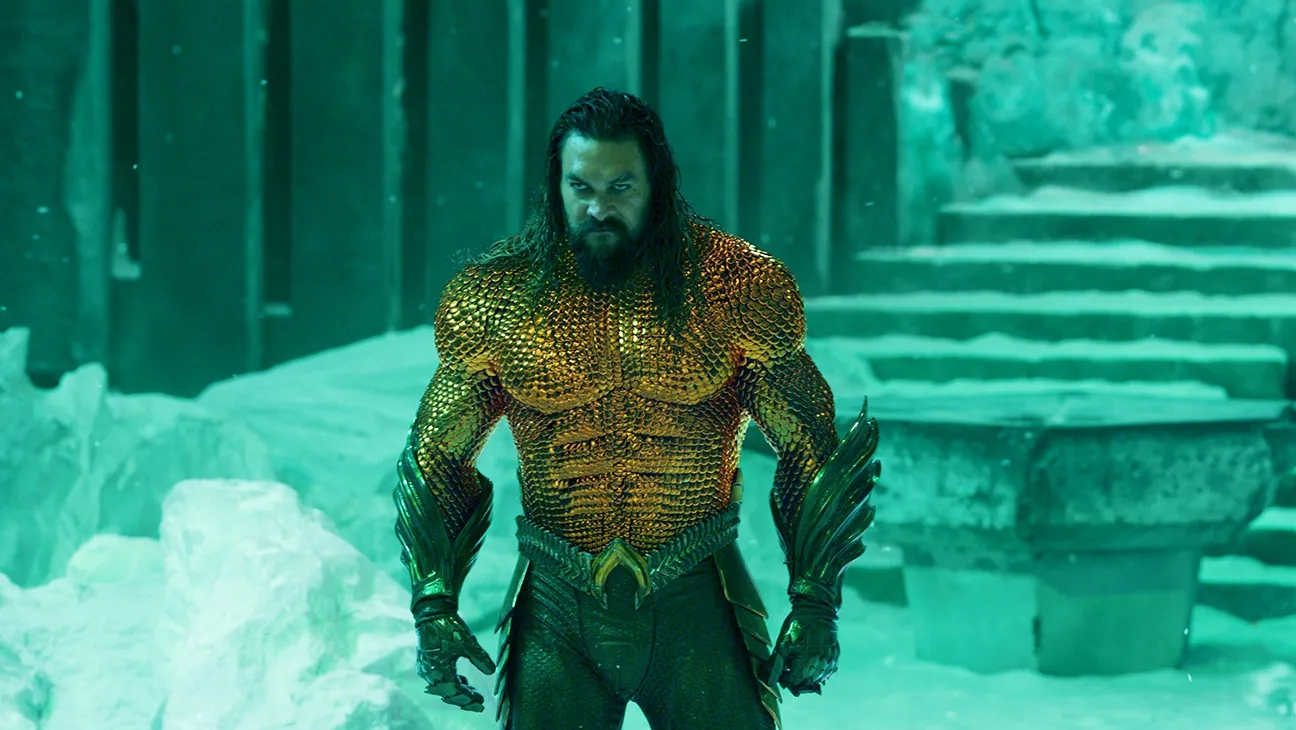
Aquaman and the Lost Kingdom is the final entry in the DCEU before it’s reimagined under James Gunn’s leadership and has had quite the tumultuous production. At the centre of these problems were the abuse allegations between Johnny Depp and Amber Heard, Heard’s inclusion in the film generating a great deal of controversy. Throw in bad test screenings, extensive reshoots, an ever-changing release date and the shut-down of the DCEU and you have a perfect storm. 

Horror maestro James Wan returns in the director’s chair, with this sequel picking up four years after the events of Aquaman. Although ramshackle, Aquaman was plenty of fun with its campy tone and arresting visuals, ultimately becoming the highest grossing DCEU film. How unfortunate that this sequel is being unceremoniously dumped with next-to-no-marketing. 

According to Wan, Aquaman and the Lost Kingdom is inspired by the works of animator Ray Harryhausen and the horror films of the 1960s while mixing in buddy comedy elements. The film opens with Arthur Curry (Jason Momoa) splitting life between land and sea and caring for his newly born son, Arthur Jr. David Kane (Yahya Abdul-Mateen II), better known as Black Manta, the secondary villain in the first film, continues to seek revenge against Arthur for his father’s death and finds a black trident that possesses him. Once Manta launches havoc on Atlantis five months after becoming possessed, Arthur decides to break his half-brother Orm (Patrick Wilson), the main antagonist of the first film, out of prison to locate Manta. 

Aquaman and the Lost Kingdom is by and large, very much cut from the same cloth as the original only without some of the finesse, likely due to the evolving DCEU situation. It’s very entertaining and visually interesting – Devil’s Deep, a volcano island lots of the second act takes place in is particularly nicely realised and there’s an excellent early heist and ensuing chase that can only have been created by Wan with his horror tinge. You can tell it’s a film that was meant to be bigger than it is and it does feel like some scenes have been cut down and storylines reduced. This sequel is twenty minutes shorter than its predecessor and the film runs at a brisk pace, never really taking the time to breathe. 

The cast are all clearly having fun. Jason Momoa essentially plays himself and Wan-regular Patrick Wilson fares much better this time round. His villain was a little disappointing in the original due to a lack of character development but Wan puts a much greater focus on him to great effect and both Momoa and Wilson share an excellent bromance chemistry. Yahya Abdul Mateen II makes for a sinister, if slightly cartoonish villain and Randall Park is another bright spot as Dr Stephen Shin.

Rupert Gregson-Williams is on scoring duties again, largely revisiting themes from the first film which is a sensible move. The film’s lusciously shot by Don Burgess, an inverted establishing shot in a grand hall a particular standout.  

Aquaman and the Lost Kingdom is an entertaining, if slightly throwaway ending to the DCEU. If you enjoyed Aquaman, you’ll likely enjoy this sequel because the tone is almost identical. It’s a shame the film isn’t quite as ambitious as it likely was originally, given the DCEU’s evolving situation and it’s also disappointing we likely won’t see these characters again in this permutation. Still, Aquaman and the Lost Kingdom is a slightly above average comic-book film and is undeserving of its dismal reviews. 

⭐⭐⭐ (Good)

Maestro (Review)

Review
⭐ (Terrible)

Director: Bradley Cooper
Starring: Carey Mulligan, Bradley Cooper, Matt Bomer, Vincenzo Amato
Certificate: 15
Run Time: 129 mins

Maestro is the sophomore writer-director effort by actor Bradley Cooper, after A Star Is Born (2018) which earned7 lots of awards love. Conversely, I didn’t think his remake was up to much, despite Lady Gaga’s committed performance. Cooper moves to Netflix for Maestro, a biopic about composer Leonard Bernstein covering his conducting debut at the New York Philharmonic in 1943 to 1987, nine years after the death of his wife, Felicia Montealegre. The film was originally meant to be directed by Martin Scorsese but he opted to work on The Irishman instead, allowing Cooper to board the film. Scorsese remains in a producing capacity, as does Steven Spielberg who also considered directing the film at one point. 

Every year, there is at least one (if not multiple) undeserving Awards films and for 2024, that honour goes to Maestro. Bradley Cooper is so infatuated with himself, so hungry for Awards success that he doesn’t tell anything meaningful about Bernstein at all. The film is completely inert of energy and a real chore to sit through for its extended 129 minute run time. 

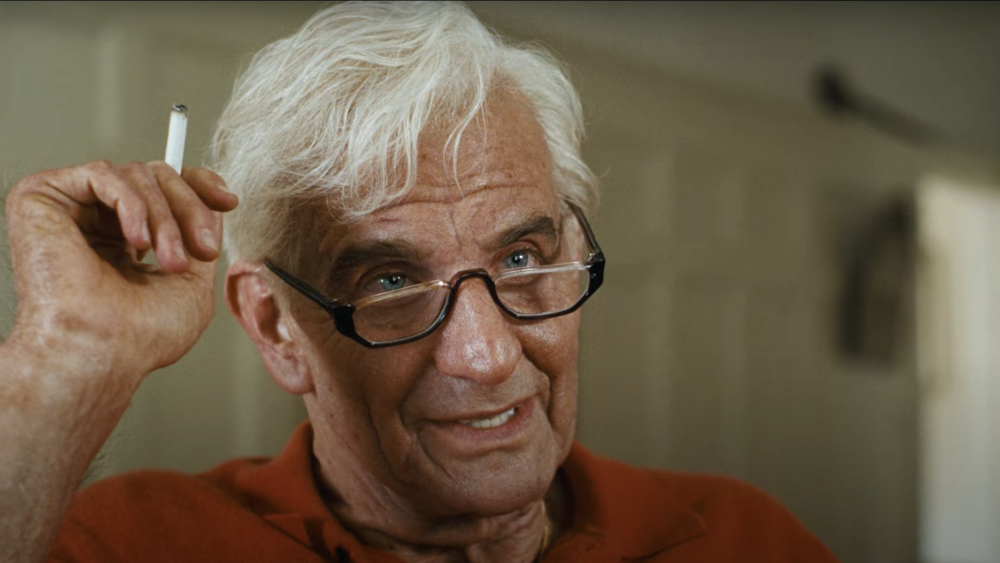
While Cooper may look like Bernstein with a fake schnozz and wrinkles, he’s just playing himself. Even Carey Mulligan, who generally shines in everything she’s in, fails to make much of an impression as Felicia Montealegre, because the film doesn’t dig into the psyche of her character at all. Rather miserably, the only scene I felt anything for her character is when she is diagnosed with cancer. The chemistry between Cooper and Mulligan is non-existent 

The decision to race through the composer’s first 15 years in 45 minutes and then stay fixated on a shorter period throughout the rest of the film is an odd decision. Cooper isn’t sure what the focus of the film should be, veering between Bernstein’s early conducting success, his relationship with Felicia and his debauchery and the result is a film that feels superficial. One can learn more about Bernstein from his Wikipedia page than from Maestro

Even Matthew Libatique, Darren Aronofsky’s preferred cinematographer, fails to inject his signature personality into the film. This is despite the stylistic use of black-and-white and a classical Hollywood 4:3 aspect ratio used in Bernstein’s early years which then switches to widescreen and colour. 

Maestro is a disappointing failure that fails to meaningfully explore Bernstein’s career and Cooper’s direction and performance comes across as smug and desperate for Awards success. Luckily, with Oppenheimer and Killers of the Flower Moon likely looking set to dominate, I’m hopeful Maestro won’t win anything but it’s a shame a film as desperate as this will almost certainly still receive undeserved recognition. 

⭐ (Terrible)

Leave The World Behind (Review)

Review
⭐ (Terrible)

Director: Sam Esmail
Starring: Julia Roberts, Mahershala Ali, Ethan Hawke, Myha’la, Kevin Bacon
Certificate: 15
Run Time: 141 mins

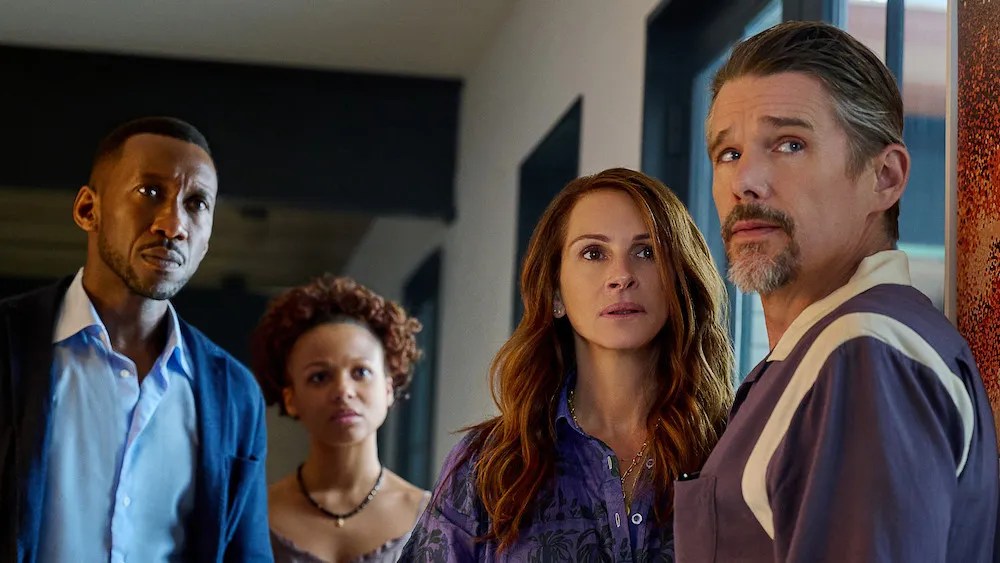
Leave The World Behind is a post-apocalyptic thriller written and directed by Sam Esmail, most notable for creating the TV series Mr Robot. It is an adaptation of the 2020 novel of the same name by Rumaan Alam, which opens with Amanda Sandford (Julia Roberts) waking up one day and deciding to take her family (husband Clay and children Rose and Archie) on a spontaneous Long Island holiday. After a trip to the beach where an oil tanker runs ashore, they notice there is no WiFi or television signal when they return to their rental home. Later in the night, George H. Scott (Mahershala Ali) and is daughter Ruth (Myha’la) show up at the house, claiming to be the owners and that they have fled a blackout in the city. Amanda and Clay (Ethan Hawke) debate, at nauseum, whether they trust George’s alibi and are willing to accept them into their home, despite George’s offer to make things right financially for the unusual disturbance.  

Leave The World Behind is an utter car crash of a film – an overlong slog with an ear-scraping script, unlikeable characters and terrible performances. It makes M. Night Shyamalan’s The Happening appear a masterpiece. The dreadful script makes itself known in the very first scene where Amanda justifies her decision to take her family on holiday through her narrow-minded view of humanity and doesn’t let up throughout the film. Characters talk unnaturally, engaging in inconsequential, insufferable monologues and the film is full-to-the-brim with pointless exposition.

Julia Roberts has a pretty spotty track record and her character is insufferable and entitled. While perhaps that means Roberts does a good job of depicting a despicable character, the poor dialogue she is saddled with means she can’t be taken seriously. I’ll watch Ethan Hawke in anything Sinister, Boyhood, First Reformed and The Black Phone but even he’s terrible in this – Clay is just a nonsensical individual. Amanda and Clay’s two children, Rose and Archie (Farrah Mackenzie and Charlie Evans) are also insufferable and while Rose is clearly meant to represent the innocent figure, she’s already well on a non-returnable path to loathsomeness. The always-reliable Mahershala Ali also isn’t given a lot to work with as the homeowner and Myha’la’ angsty teenager is a just a know-it-all brat. The only actor who comes out of the film with his reputation relatively unscathed is Kevin Bacon, who satisfies the brief of playing an untrusting survivalist.

While a collection of contemptible characters isn’t automatically reason to dismiss a film, the unsubtle and showy storytelling is. There is no tension at all to any of the scenarios the characters are put through and the attempts at horror aren’t effective, thanks to obvious CGI or green screen. A sequence with a flamboyance of flamingos is particularly laughable and although Tod Campbell may regard his cinematography as edgy with events framed in disorienting angles to try and mask the horrible script is just distracting. This is in combination with Mac Quayle’s annoyingly erratic score, with the soul and rap choices particulary ill-fitting.

Leave The World Behind is one of the worst filmic experiences I’ve been subjected to in quite some time and is a complete and utter failure. There are no stakes whatsoever and with the exception of Kevin Bacon, the cast are uniformly terrible. The film is obviously trying to analyse and form an opinion on modern culture, with examples such as the rise of driverless cars and the demise of physical media, as well as the themes of race, class and identity. But the film faulters because it’s either overly explicit or not explicit enough in its meaning and the result is a miserable experience with no satisfying conclusion. I genuinely don’t understand the positive critical reception Leave The World Behind has received and I’d highly recommend avoiding this turgid and tediously-paced work at all costs.

⭐ (Terrible)

Wonka (Review)

Review
⭐⭐⭐ (Good)

Director: Paul King
Starring: Timothée Chalamet, Calah Lane, Keegan-Michael Key, Paterson Joseph, Matt Lucas, Matthew Baynton, Sally Hawkins, Rowan Atkinson, Jim Carter, Tom Davis, Olivia Colman, Hugh Grant
Certificate: PG
Run Time: 116 mins

Wonka is a prequel to Roald Dahl’s Charlie and the Chocolate Factory novel, telling the chocolatier’s origin story. There have already been two excellent adaptations of Dahl’s novel – Mel Stuart’s 1973 Willy Wonka and the Chocolate Factory with a scene-stealing turn by Gene Wilder in the lead role and Tim Burton’s more faithful but equally dark 2005 adaptation starring Johnny Depp. While the thought of an origin story may seem like a cynical cash grab (and goes against Dahl’s wishes), it’s written and directed by Paul King, who struck gold with his Paddington films. While I found Paddington overrated, Paddington 2 represents the gold standard of sequels with its infectious energy. 

Timothée Chalamet has big boots to fill in place of Wilder and Depp, and Wonka opens with the young chocolatier arriving at an unnamed European city that feels like a hybrid between Dickensian London and upmarket Paris. He’s hoping to fulfil his dream by opening a chocolate shop at the Galeries Gourmet. However, the Galeries’ main chocolatiers Slugworth, Prodnose and Fickelgruber (Paterson Joseph, Matt Lucas and Matthew Baynton) have a monopoly over the city. Dubbed the ‘Chocolate Cartel’, they even control the Chief-of-Police (Keegan-Michael Key) and their large reserve of chocolate is stashed underneath a parish, run by the corrupt Father Julius (Rowan Atkinson) and his ‘chocoholic’ monks. Wonka also has his own problems to contend with, when he is banished to work 10,000 days performing laundry to repay his debt at a hotel he stays at, run by Mrs Scrubbit (Olivia Colman) and her henchman Bleacher (Tom Davis). There are five other captors who have fallen foul to Scrubbit’s con and Wonka hatches a plan to sell enough chocolate to free them all. 

I went into Wonka with low expectations and while I didn’t come out a changed individual, it’s much better than expected. The film has King’s stamp through and through and while there’s some laughs to be had, it’s combined with a decent story with a lot of heart. While there are some dark undertones to the story, it doesn’t really feel one of Roald Dahl’s creations – there are no Dahlian lessons for children about the consequences of bad behaviour, for instance. 

Chalamet is solid as the titular character and while he doesn’t amaze in the musical numbers, he’s more than good enough but he’s no Wilder or Depp. His Wonka lacks the terrifying element of either of his predecessors but that is partly a limitation of the film’s story. Chalamet’s decision to lead a kids film is also a shrewd move, given his more brooding adult fare with films such as Dune, Bones And All and Call Me By Your Name.

Wonka’s greatest asset are the performances all round. The Boggis, Bunce and Bean-like villains trio are all excellent (there’s a particularly funny gag with Baynton’s Fickelgruber who resents the poor). Paterson Joseph is particularly sinister as Slugworth and although he’s had a long career, I hope his propels him into the limelight. Atkinson is also excellent as the clergyman, albeit underused and Jim Carter is a highlight as Abacus Crunch, who was previously an accountant for the villains. After his terrific turn as the antagonist in Paddington 2, Hugh Grant steals the show as the Oompa Loompa, who is given an entertaining story and gets to revive the 1971 film’s original tune. 

Like the 1973 film (although Tim Burton’s remake also includes some songs), King’s film is a musical. Although there are more musical numbers than the original, King gets the balance of song to story right and although Neil Hannon is no Candyman with the quality of the songs – they’re just not as memorable as any of the creations of Leslie Bricusse or Anthony Newley (although he reprises Oompa Loompa and Pure Imagination) – they’re good enough. A duet between Chalamet and newcomer Calah Lane, who plays Noodle who becomes Wonka’s assistant, is the highlight and helps to really furthers their relationship. Joby Talbot’s supporting original score fares well and also respectfully reprises notes from the original. 

Wonka also looks gorgeous with its eye-popping production design, although its cinematography by Chung-hoon Chung, one of director Park Chan-Wook’s key collaborators, feels uncharacteristic of him considering his back catalogue, lacking a surreal edge. This would have lent well here, considering many of the characters have dreams they’re looking to fulfil. 

Wonka is ultimately a surprising success for what seemed like a misjudged prequel and I admired King’s kind-hearted and amiable tone. Although it occasionally feels a little like a Christmas pantomime with its low stakes and musical numbers, there’s some good chuckles to be had and the sumptuous, sugar-rush production design is worth experiencing in the cinema. I don’t think Roald Dahl would have appreciated it (although he was a tough critic of many adaptations of his literary works) and it feels more Dickensian than Dahl with its workhouse elements and conniving characters. However, as a piece of candy, Wonka more than does the job even if it doesn’t reach the sugary heights of the other adaptations). I’d certainly be game for a sequel that explores how Wonka morphs into the darker character we meet in Dahl’s novel but it wouldn’t feel fitting of King’s directorial style – still one can hope. 

⭐⭐⭐ (Good)

May December (Review)

Uncategorized
⭐⭐⭐⭐ (Excellent)

Director: Todd Haynes
Starring: Natalie Portman, Julianne Moore, Charles Melton
Certificate: 15
Run Time: 117 mins

May December is the new Todd Haynes film, a drama loosely inspired by the Mary Kay Letourneau scandal where the then-34 year old had a sexual relationship with 12-year-old Vili Fualaau. Haynes-regular Julianne Moore plays Gracie Atherton-Yoo, who was caught having sex with 13-year-old Joe Woo at the age of 36 and gave birth to Joe’s child while serving a prison sentence. 23 years later, Gracie and Joe (Charles Melton) are married with three children, their relationship seemingly continuing to blossom. Natalie Portman plays Elizabeth Berry, an actress who is about to play Gracie in a film and as part of her research for the role, spends a couple of weeks with the family to find inspiration for her performance. She also further researches the wider community and how the scandal continues to loom over the town.

May December is an excellent, multi-layered drama and is quite possibly Todd Haynes’ finest work to date – I was enthralled from start to finish.  The film isn’t interested at all in unpicking the how’s and why’s of what happened. Haynes refreshingly chooses to focus on the dark and tangled obsessions of its characters and how they mirror each other. The film is seeping in details to unpick and there are many different possible readings, which make it all the more satisfying. It’s brilliantly paced with a sharp script by Samy Burch which deftly balances the camp and unease. 

Natalie Portman is phenomenal as Berry, in what is a fitting companion piece to her roles in Vox Lux and Jackie, in which she plays characters that are also putting on a performance. As Berry delves deeper into Gracie’s psyche, she starts to imitate Gracie’s mannerisms and appearance, even pursuing a faux-relationship with Joe to try and imitate the life of her subject. Crucially, Portman’s performance asks the question – is Berry simply looking to create the most authentic performance possible or is she looking for sexual gratification out of the process? 

Julianne Moore’s lispy turn is also impressionable as the flawed and unstable Gracie, who lives her life on tenterhooks. But it’s Charles Melton who out-acts both Portman and Moore as the genteel Joe who doesn’t know how to live his life. He’s lost his childhood which was stolen from him by Gracie but he wants a meaningful relationship with his children and is bittersweet about his two youngest flocking the nest to go to university. Two tremendous scenes stand out in particular, one of Joe sharing a beer with his ageing, chain-smoking father on his balcony and him trying cannabis for the first time with his son outside his bedroom window. 

Perfectly complimenting the film is a peppery score by Marcelo Zarvos, who reuses Michael Legrand’s whirlwind-like themes from The Go-Between but develops them beautifully. The film is lusciously shot by Christopher Blauvelt, a scene where Berry and Gracie are talking while Gracie’s daughter is trying on graduation dresses is particularly memorable, Berry effectively bookend by two Grace’s in the mirror. I also loved the butterfly imagery, a hobby of Joe’s. 

May December is a deliciously compelling psychological drama that demands multiple rewatches to further unpick its meanings. It’s Haynes’ best film and is totally seductive in its execution and it will leave you breathless in its closing moments. This is a must-see and one of the best films of the year. 

⭐⭐⭐⭐ (Excellent)

Saltburn (Review)

Uncategorized
⭐⭐⭐ (Good)

Director: Emerald Fennell
Starring: Barry Keoghan, Jacob Elordi, Rosamund Pike, Richard E. Grant, Alison Oliver, Archie Madekwe, Carey Mulligan
Certificate: 15
Run Time: 131 mins

Saltburn is the sophomore effort from Emerald Fennell, whose directorial debut was the razor-sharp feminist vigilante thriller Promising Young Woman, where she won an Academy Award for Best Original Screenplay. This follow-up is also an original work that is a fusion of black comedy and a psychological thriller. Barry Keoghan plays Oliver Quick, an Oxford University English Literature scholarship student, who struggles to fit in due to his inexperience with the upper-class. Even his professor is shocked he’s read the entire reading list. The other students sneer and make a mockery of him until he befriends Felix Catton (Jacob Elordi) one day, after he lets him borrow his bike to get to a class after he suffers a puncture. Felix is won over by Oliver’s tales of his seemingly hard upbringing, with tales of his parent’s alcoholism and addictions. After Oliver becomes distraught over the sudden death of his father, Felix invites him to spend the summer at his family’s lavish estate, Saltburn. 

Like Promising Young Woman, Saltburn is a darkly satirical piece that isn’t afraid to withhold the shock-factor. It has a raucous quality to it and explores the themes of excess and obsession, with thoroughly unlikeable, vampiric characters, although Fennell’s sharp script gives us plenty to make us invest in them. Oliver feels like a character who is going to be played with and then disposed when he no longer provides enjoyment to his owner and while Fennell satisfies that brief to an extent, she lends her jet-black hand to it. The film’s horror tinge is particularly satisfying and its narrative leaves you guessing where it might head to the very end, although a final twist does feel a little tacked on, especially on a rewatch. 

Although thoroughly entertaining for the most part, Saltburn suffers from its clashing of tones, at times feeling like St Trinians meets an Edgar Wright film with the darker, erotic undertones of The Talented Mr Ripley and Brideshead Revisited. I’d have preferred the film to do without the former, the tacked-on balloon celebratory stylings at odds with the film’s darker elements. The film would have had more bite if it leaned further into its Gothicism and the cheekiness of its erotic thriller elements. 

Most of the performances are more than up to the task of conveying the film’s violent playfulness, with Jacob Elordi and Rosamund Pike highlights as the entitled Oxfordian and his nosy mother. Richard E. Grant also shines as the blue-collared father and Archie Madekwe continues to impress after solid turns in Midsommar and Gran Turismo as Felix’s American cousin, Farleigh, who is an utterly abhorrent shit-stirrer. Paul Rhys is also clearly having fun as the eloquent yet judging Duncan, the head butler who wears a permanent smirk on his face. 

The only performance that doesn’t fully work is Barry Keoghan, who despite terrific performances in films such as The Killing of a Sacred Deer, American Animals and The Banshees of Inisherin, is simply miscast here. While he conveys the slimy, obsessive elements of Oliver brilliantly, his Liverpudlian accent is unconvincing.   

Linus Sandgren’s cinematography is uncharacteristic of the DP, whose work typically revels in opulence in films such as La La Land and Babylon. Here, Sandgren prefers to keep everything dark and dingy and the narrow 1.33:1 aspect ratios offers a claustrophobic feel. It also offers the film a timeless quality – although Saltburn is meant to be set in 2006, its aesthetic perfectly places it in the Victorian or post-War era. Fennell reunites with Promising Young Woman composer Anthony Willis, whose original score hits the spot but the frequent needle-drops felt forced and aggressively contrast the film’s dark storyline and aesthetic. 

Saltburn is ultimately a wholly original follow-up with an interesting tale of excess and obsession that doesn’t fully work with an issue of tone. Despite its flaws, it’s still a thoroughly entertaining film with fun performances and original visuals that is sure to challenge viewers preconceptions of the genres it fuses.

⭐⭐⭐ (Good)

The Hunger Games: The Ballad of Songbirds and Snakes (Review)

Uncategorized
⭐⭐⭐⭐ (Excellent)

Director: Francis Lawrence 
Starring: Tom Blyth, Rachel Zegler, Peter Dinklage, Jason Schwartzman, Hunter Schafer, Josh Andrés Rivera, Viola Davis
Certificate: 12A
Run Time: 157 mins

The Hunger Games: The Ballad of Songbirds and Snakes is the latest in the dystopian fantasy series and an adaption of Suzanne Collins’ 2020 novel. This prequel is set 64 years prior to The Hunger Games and follows a young Coriolanus Snow (Tom Blyth) on his path to political power, the villain devilishly played by Donald Sutherland in the other films. At the start of the film, Snow is selected to mentor a tribute in the 10th Annual Hunger Games and he is paired with the undernourished District 12 tribute Lucy Gray Baird (Rachel Zegler), who is a member of a travelling musician group. Although the film very much fictions as an origin story for Snow, it also serves to explore how the games came to be in the first place. 

Francis Lawrence returns in the director’s chair, having directed all of the previous entries bar the first. While Gary Ross’ original entry is my favourite for its stripped-back and rugged atmosphere, The Hunger Games: Catching Fire doesn’t lag far behind it in how it develops the first film’s thought-provoking themes. I wasn’t so hot on the decision to split the third novel into two films, although The Hunger Games: Mockingjay Part 2 was still thoroughly entertaining and they were still competently directed by Lawrence. Does this fifth entry prove there is still life in the series? 

The Hunger Games: The Ballad of Songbirds and Snakes is an excellent adaptation and quite possibly the most mature film in the series to date. Lawrence does a great job of showcasing the more outright barbarity of the games, which are minimalist and lack the polish and pizzazz of future arenas. In fact, the games in this film are set in a literal arena, rather than the forest or tropical settings of The Hunger Games and Catching Fire. Knowing Lucy Gray is unlikely to win, Snow suggests revisions to the game structure, such as sponsorship, to improve her chances, while simultaneously propelling the games as a spectacle to increase viewership. 

Tom Blyth makes for an excellent Snow and conveys his calculated nature and like all of the best villain origin stories, we can understand why he becomes the way he does by the film’s end. Rachel Zegler is also strong as Lucy Gray, although neither Blyth or Zegler share the same levels of chemistry as Jennifer Lawrence and Josh Hutcherson did in the original. 

Viola Davis is deliciously evil as gamemnaker Dr Volumnia Gaul and Jason Schwartzman is another standout as Lucky Flickerman, a predecessor of Caesar (Stanley Tucci), who Schwartzman channels. Josh Andrés Rivera is also excellent as Sejanus, a classmate of Snow who grows increasingly resentful of the games. 

Composer James Newton Howard returns to score this film and he deftly melds past and new memorable themes. The film’s lusciously shot by Lawrence-regular Jo Willems, who really captures the wonder of the Capitol and the expanse of the forest outside of District 12. The film look like it’s worth a lot more than its $100 million budget. 

Although many have taken issue with it, the third act was the most interesting because it is so starkly different from the games-driven first two acts. It hurtles towards Snow’s descent into villainy and really develops the remaining characters. The film is the longest in the series at 157 minutes but justifies its length through the sheer amount of material it needs to get through. 

The Hunger Games: The Ballad of Songbirds and Snakes is an excellent return to Panem and I really admired its more cold-blooded tone and its deeper dive into Snow’s character. It breathes new life into the series and it’ll be interesting to see if Collins writes a sequel to further explore Snow’s rise to power. It’s not quite as thrilling as the first two films but it’s a step-above both Mockingjay films and that’s more than one could hope for. 

⭐⭐⭐⭐ (Excellent)